Corporate training games convert the soft skills training process from something that people hear about in a seminar into something they participate in. Soft skills training involves communication, empathy, feedback, and conflict resolution, which are all things that are difficult to teach through a PowerPoint presentation but easier to practice in a realistic simulation where everything is meaningful and every decision matters. For decision makers, the questions include whether employees will be able to complete the activity, whether there will be behavioural change, and whether it fits within our LMS and budget. Abhiwan Technology has developed these games in such a way which enable organizations to enhance their employees' skill level through interactive training sessions.This article provides information about the ways in which corporate training games assist employees in gaining necessary soft skills and developing better decision-making capabilities.
What are Corporate Training Games for Soft Skills Training?
Corporate training games help employees practice soft skills through interactive, work-related scenarios. An educational game development company can create these games to simulate real workplace situations, such as handling an unhappy client, resolving conflicts, and giving constructive feedback. Employees can make decisions and see how their actions affect others. As a result, they learn to respond more effectively to workplace challenges. The same approach can also be used for employee onboarding, workplace policy training, and leadership development.
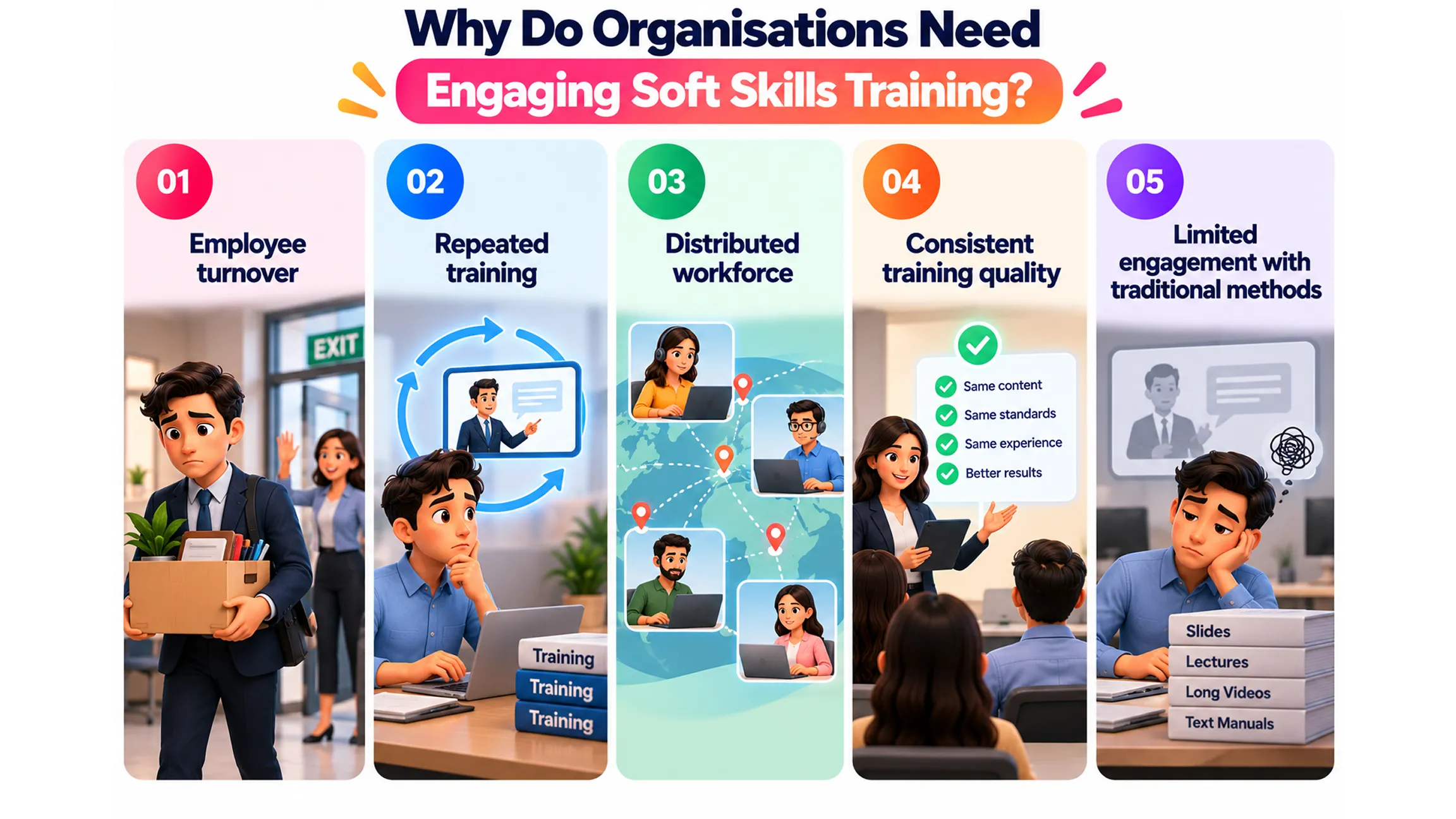
Why Do Organisations Need Engaging Soft Skills Training?
Corporate training games address the limitations of traditional soft skills training. Instead of relying only on lectures and presentations, they allow employees to practice communication, teamwork, conflict resolution, and decision-making through realistic workplace scenarios.
Employee turnover
Every recruit has to learn communication and teamwork basics. It is much easier to use the game repeatedly rather than schedule training anew.
Repeated training
Annual refresher using the same presentation becomes dull after some time. Scenarios and scoring make people want to engage with a game.
Distributed workforce
Hybrid or multi-site teams cannot train in one room together. The game is accessible on both mobile and desktop devices.
Consistent training quality
Trainers focus on various aspects of learning. The game gives consistent scenarios and feedback for every learner.
Limited engagement with traditional methods
Passive delivery methods have lower completion rates and limited recall, while interactive options engage the learners since they have to do something.
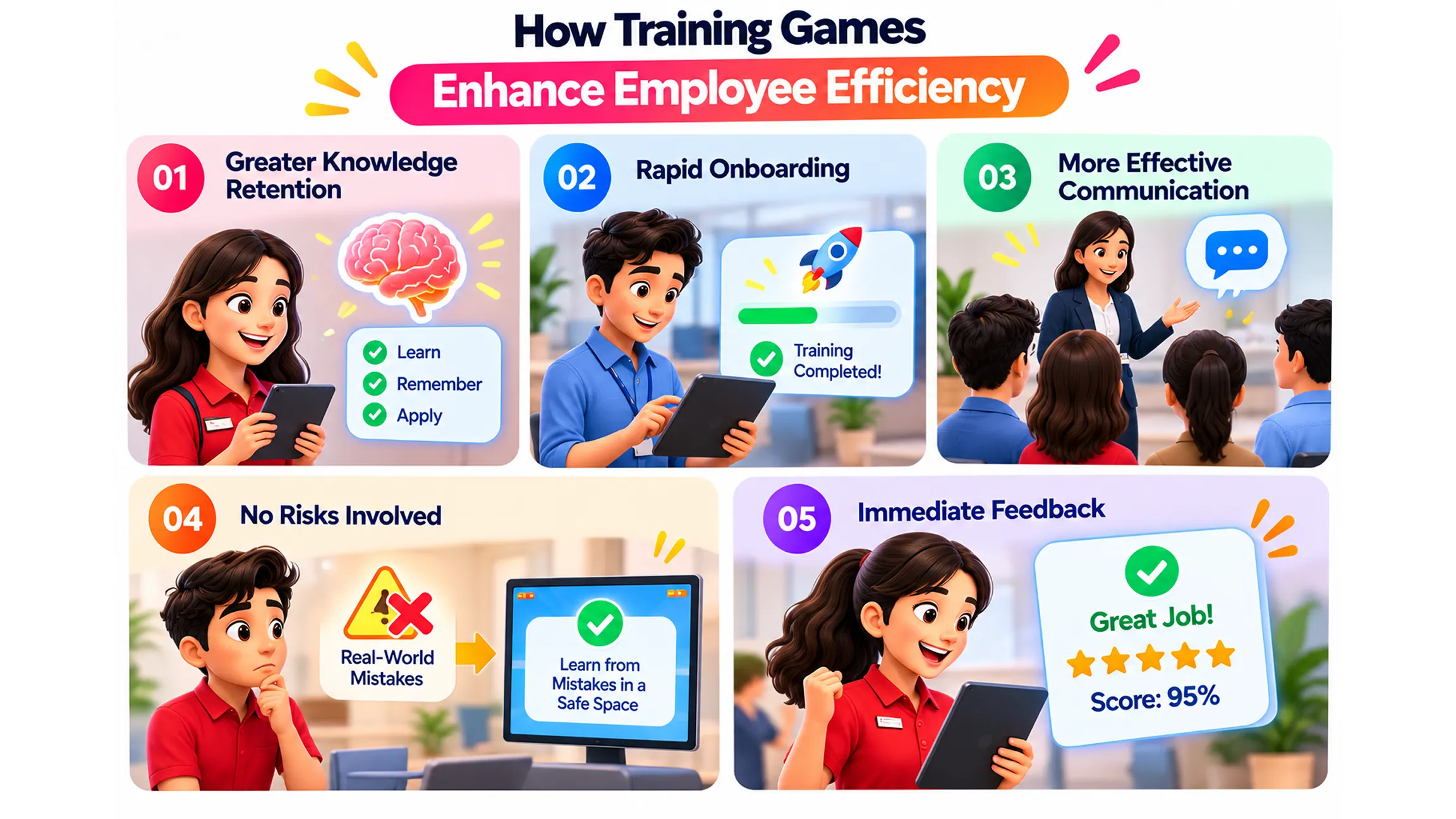
How Training Games Enhance Employee Efficiency
Strategically designed educational game development aims at five benefits that management can measure:
Greater knowledge retention
An employee remembers his own choice and its results much longer than an item from bullet points. Interactive tasks assist in consolidating concepts via repetition.
Rapid onboarding
A new employee practices typical scenarios within his first weeks rather than learning about them by making actual mistakes. It helps him to better understand work processes.
More effective communication
Practicing difficult dialogues gives more confidence and shows itself in people’s attitude to their colleagues and customers. Practice assists in developing employees' skills in this sphere.
No risks involved
There is no penalty for an incorrect answer in a game, so an employee can practice what works and what does not.
Immediate feedback
The learner receives an outcome of each decision right away, together with its explanation, not after an analysis by a trainer. Thus, they can pinpoint errors, eliminate misconceptions, and take advantage of the experience in future situations.
Key Features of Soft Skills Training Games
While considering a proposal, these are the features that distinguish a genuine training solution from a visualised test:
Interactive Scenarios
An educational game development company can produce interactive scenarios, putting learners into realistic workplace conditions. Learners practice their communication, teamwork, and decision-making skills in a safe way.
Branching Decisions
Branching decisions give learners an opportunity to decide what outcome will be the result from their decision. It helps to evaluate the consequences of their actions and develop their decision-making skills.
Rewards and Points
Rewards and points acknowledge the success of learners during training. It encourages them to actively engage in the learning process.
Leaderboards
Leaderboards provide motivation for learners through competition. However, this feature can be used only if healthy competition is beneficial for your corporate culture.
Real Time Feedback
Real time feedback is used to determine the reason for the success or failure of a specific decision. These factors increase the effectiveness of HR training games, since it helps the employees realize their mistakes, learn about other methods, and implement it into practice.
How to Measure the ROI of Game-Based Soft Skills Training
To calculate the ROI of corporate training games, it is essential to agree on some metrics beforehand and then evaluate only a few of them.
| Metric | What to measure | Why it matters |
|---|---|---|
| Training completion rate | Share of assigned employees who finish each module | Shows whether the format actually engages people |
| Knowledge retention | Scores on follow-up checks weeks after training | Shows whether learning sticks |
| Behaviour and performance | Manager observations, feedback scores, scenario results | Links training to how people actually work |
| Time to productivity | Days until new hires reach performance targets | Shows how much faster onboarding becomes |
| Training cost | Cost per learner compared with workshops, travel, and trainer time | Shows efficiency at scale |
| Employee and customer outcomes | Engagement, escalations, customer satisfaction | Connects training to business results |
Results will differ depending on the programme or design. Do a pilot test with a control group where possible and evaluate the game with your data, not general statements.
Corporate Training Games: Facts and Figures
- Training games for corporations are used in more than 5 industries, which include banking, healthcare, retail, manufacturing, and customer service, to practice work skills among workers.
- According to a survey by TalentLMS conducted in 2019, 83% of employees who participated in the training process using gaming technologies were motivated, demonstrating the efficiency of gaming training.
- One training game can be created for more than 3 platforms at once, such as mobile, web, and PC, letting workers practice using the same training games.
Why Should You Choose Abhiwan Technology for Developing a Soft Skills Training Game?
Founded in 2018, Abhiwan Technology develops custom educational games for corporate training, skill development, language learning, and employee assessments. The company develops Mind Maze for Bajaj Finserv and cognitive assessment games in collaboration with AIIMS & ICMR. The company offers custom development services using Unity & Unreal Engine, LMS integration, and support on Android, iOS, Web, and PC. The company has a six-stage development process comprising planning, designing, testing, launch, and after-launch support services.
What Are the Most Important Soft Skills for Employees?
There are many lists from various sources; however, the most frequently mentioned skills are communication, teamwork, problem-solving, adaptability, emotional intelligence, time management, and leadership. Those are precisely the soft skills that require the use of judgement, which makes corporate training games more appropriate for developing them than a presentation on slides. A person simply will not learn how to manage a difficult conversation based on reading an instruction about that; but he or she can do it within a particular scenario, analyze the outcome, and repeat the process. Select a few prioritized skills that you want to develop at the beginning.
Do Training Games Really Work for Adult Learners?
Adults generally tend to learn better when training is job-related, leverages past experiences, and allows them to immediately apply the learning, all of which the scenario-based games aim to achieve. Well designed hr training games provide instant feedback and a safe environment for failing, while respecting the learner’s limited time with bite-sized sessions. But then, the key lies in designing an online quiz game will not lead to behavioral change. That is why tracking outcomes based on a baseline, as done in the ROI chart shown above, is critical.
Conclusion
Corporate training games provide an opportunity to help organizations learn through doing rather than presenting information, with reliable delivery and measurement of change in behavior throughout all teams. The most effective programs begin with a limited number of key skills, realistic scenarios, integration with your current LMS system, and comparison of results with your baseline data. A good partner like Abhiwan Technology will help you customize a program based on your audience, time schedule, and metrics requirements, starting with one pilot scenario or ending up with an entire set. Before signing any agreement, be sure to get a playable demo, data delivery options, and success metrics criteria.
Written By Vaibhav Karanwal