Corporate training games provide retail teams with something a presentation can never do: the opportunity to safely deal with the difficult customers, the complicated returns, and the Saturday rush without the need to experience it firsthand. Rather than listening to the lengthy module, the new cashier goes through the scenarios and sees the results right away. Abhiwan Technology developed the Mind Maze project for Bajaj Finserv, demonstrating how game-based learning can help companies educate and train their employees through interactive gameplay. Here we will look at what exactly retail training games consist of, what tasks they solve, how they are developed, and what to expect from your development partner.
What Are Corporate Training Games for Retail Teams?
The development of a game that aims to change people's behavior in the work process is educational game development, and it implies that every element of the game should have some educational value. For example, it can teach players to greet customers properly, find mistakes in the pricing, or follow the rules of giving refunds, not just entertain. Retailers can partner with an educational game development company like Abhiwan Technology to create engaging training games. These games combine instructional design with interactive features such as dialogue choices, scoring systems, countdown timers, and instant feedback. The game company needs to deal with logistics issues as well, like shorter periods to fit within breaks, mobile capability for shared devices, and reporting a store manager can understand at a glance.
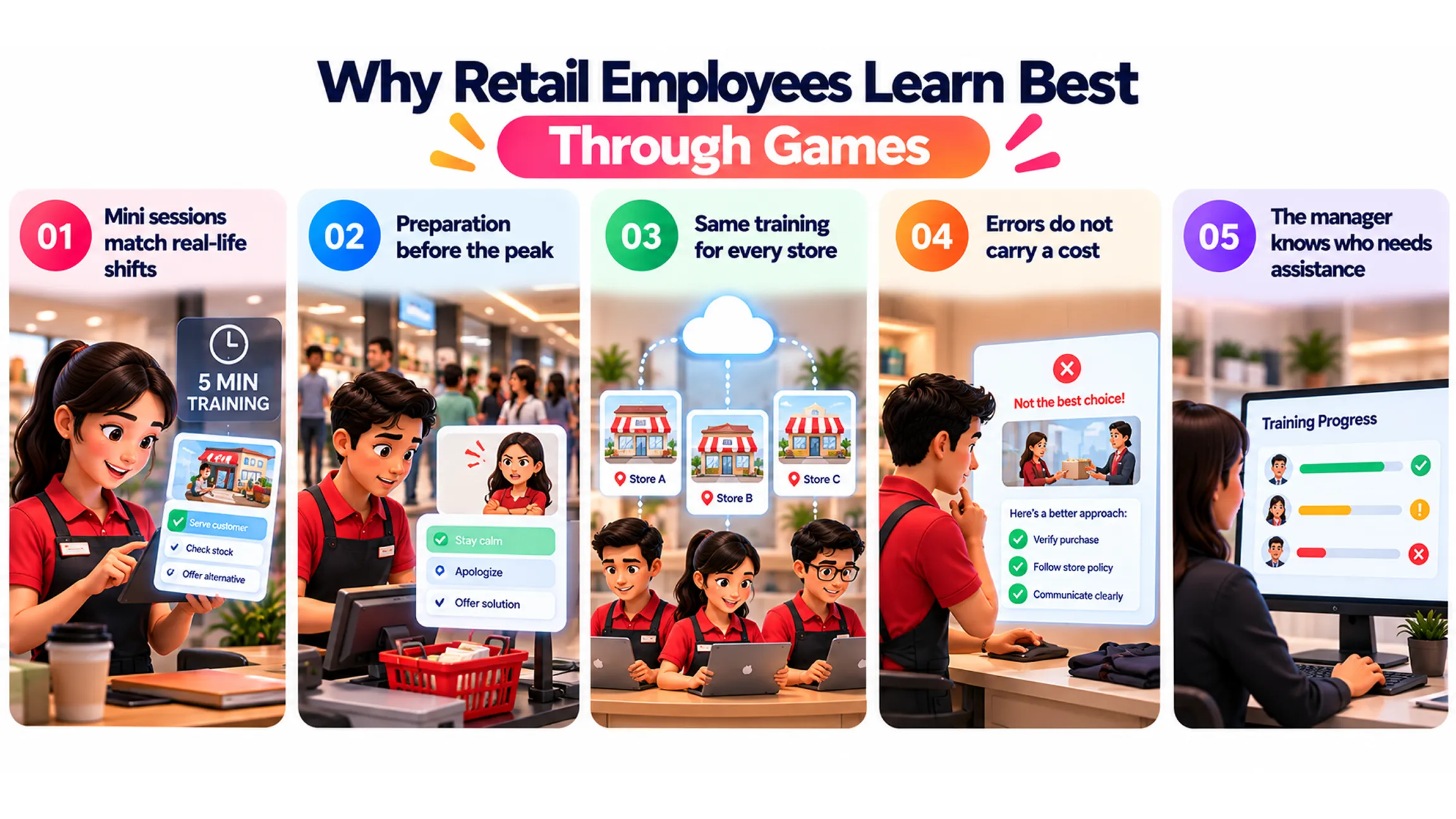
Why Retail Employees Learn Best Through Games
Corporate training games are a perfect match for retail because the job is full of split of second decisions, rotating schedules, and seasonal hiring, making class time difficult to schedule.
Mini sessions match real-life shifts
Since a session lasting five to ten minutes can be done either during a break or at the beginning of a shift, the training does not compete with the sales floor for time. Employees who would not do a course lasting forty minutes can play the shorter game, even if the progress and score are clearly seen.
Preparation before the peak
With properly planned educational game development, an employee has a chance to practice handling a lengthy line, lack of products, or angry customers before encountering such situations in reality. Going through the same scenario multiple times until doing the correct action automatically becomes second nature and cannot be achieved by reading the manual.
Same training for every store
When using corporate training games, each employee gets the exact scenario and feedback regardless of being employed in the main shop or a small subsidiary shop. This eliminates any differences due to having various trainers giving instructions in a slightly different manner.
Errors do not carry a cost
An incorrect refund or an unaddressed safety issue in a game has no impact on an actual customer or fellow employee. Employees have the freedom to make incorrect choices, learn from them, and discover why they failed.
The manager knows who needs assistance
Data from a game identifies the scenario that is being repeatedly attempted by employees, the hesitation points, and the questions missed. This allows a retail manager to focus coaching efforts on a particular area rather than running through the whole course again.
Retail Training Scenarios Games Can Include
Any recurring situation in retail can be translated into a scenario. The table below outlines various training needs and their equivalent scenarios.
| Retail training need | Example game scenario | What it builds |
|---|---|---|
| Customer service | Handle an upset customer at the counter through branching dialogue | De-escalation and empathy |
| Returns and refunds | Process a return that breaks policy by a single day | Policy judgment and confidence |
| Upselling and product knowledge | Match a shopper's needs to the right product before a timer ends | Consultative selling and product knowledge |
| Cash handling and loss prevention | Spot counterfeit notes and suspicious behaviour in a busy queue | Attention to detail |
| Safety and compliance | Find hazards in a stockroom before opening time | Hazard recognition |
| Seasonal onboarding | Complete a first shift on a store map with guided tasks | Fast familiarity with layout and routines |
These modules can also be considered as hr training games because returns policies, conduct, and safety in the workplace are normally managed or audited by HR. It is better to develop all these modules under the same platform to avoid inconsistencies in scoring, reporting, and updates.
How Gamification Makes Retail Training More Engaging
In the gamified training program, some game-related features such as points, levels, badges, timers, challenges, and progress tracking are introduced. While implementing the concept in the retail setting, one will be able to make the training program more interactive without introducing game scenarios. Employees will be able to receive certain points for making correct choices, complete challenges depending on the everyday situation at a store, and track their progress in learning. Corporate training games will be able to introduce all these features within the framework of real-life scenarios so that the employees could practice customer service, handling returns, product information, and safety issues. Thus, the only difference between the two concepts is that gamification means the introduction of the gaming features into a training program, while the corporate training game is focused on the learning through the game itself.
How Do You Measure the Effectiveness of Training Games?
To start with, one needs to define what success will look like before creating a training game; for instance, a reduction in the number of errors while giving refunds, a shorter onboarding period, and higher scores in product knowledge tests. Game statistics provide valuable insights into the success of the training game, such as completion rates, repeat rates, average time spent, and decisions made within each particular scenario. A lot of her training games track user performance within an LMS. Best evidence would be a comparison of performance on the shop floor of trained and untrained participants during several months.
Corporate Training Games: Facts & Figures
- It takes 6 to 20 weeks to develop corporate training games of this nature, with smaller, single-scenario modules taking less time and multi-module games taking more.
- Abhiwan Technology has achieved 98% customer satisfaction, a 4.8-star rating, and 90% on-time delivery.
- Training games can be developed for Android, iOS, web, and PC, and can be integrated into a learning management system to track completion and report back to HR automatically.
- Outcome statistics on training games for retail vary widely depending on the program, so be sure to ask for pilot statistics from any vendor.
Corporate Training Games by Abhiwan Technology
Abhiwan Technology, established in 2018, is an educational game development company that creates corporate training games, skill enhancing games, language training games, and assessment-based learning games. The six-step process used by the company begins with identifying the training objective and target audience, followed by game architecture planning, design and development, testing and quality assurance, deployment, and post-deployment services through the use of game creation platforms such as Unity, Unreal Engine, and 3ds Max. This company has created the Mind Maze for Bajaj Finserv as a mind training game for employees, has created cognitive assessment games in collaboration with AIIMS and ICMR, and has proven experience creating assessment-based games. In the case of the retailer, the starting point for this game development process will be the functions to train, the duration of a typical working shift, and the devices used in the store; the content may be updated after deployment due to product changes, policy updates, or special promotions.
Conclusion
The use of corporate training games provides retail employees with opportunities to learn about customer service, return procedures, safety practices, and product knowledge in short training exercises that can be performed during actual shifts and to the same standards in every store. Ideally, such a training programme should focus on particular skills that need to be developed by the retailer, use realistic scenarios and not tests, and provide feedback that can be used by management. With the help of a partner like Abhiwan Technology, you can develop a training programme to suit your staff members, devices, and schedule, whether it is one training session for onboarding or a multiple-module one.
Written By Vaibhav Karanwal