
Problem-solving is an important skill in education, employee training, and professional development. However, traditional learning methods do not always give learners enough opportunities to practice decision-making in realistic situations. Reading instructions or watching training videos can explain a concept, but interactive experiences can allow users to apply what they have learned. Educational game development can help organizations turn problem-solving exercises into interactive experiences. By means of challenges, scenarios, puzzles, simulations, and game-like tasks, students can learn to identify problems, analyze possibilities, make decisions, and comprehend results. For schools and educational institutions, training companies, and organizations, custom educational games can be developed to satisfy some specific needs. Abhiwan Technology develops educational games that are interactive to be used for education, work training, and acquiring practical skills.
What Is Educational Game Development?
Educational game development is the process of making games that are designed for a specific educational goal or learning outcome. Games like these emphasize both the fun aspect of gaming and the educational component, such as challenges and feedback. For instance, this can involve a game where learners encounter a problem and find a solution, as well as receive information about the consequences of their actions.
A custom educational game can include:
- Interactive challenges
- Problem-solving scenarios
- Puzzles and quizzes
- Decision-making activities
- Simulations
- Rewards and progression
- Feedback systems
- Performance tracking
- Multiple difficulty levels
- Individual or multiplayer experiences
The game mechanics depend on the target audience, subject, learning goals, and platform.
Why Use Games for Problem-Solving Skills?
Problem-solving is generally learned through practice. To do this, students should have chances to assess different situations and possible solutions, make choices, and learn from their mistakes. Games for training purposes can provide such a learning environment for users without worrying about making mistakes in the real world. For instance, trainees could encounter a problem occurring at work and consider possible solutions. They choose an action and see the outcome. This makes it possible to connect theory with practical decision-making. Games can also help to repeat the same kind of exercises in an interesting manner. Instead of repeating the same exercises, the learners could go through many levels of the game.
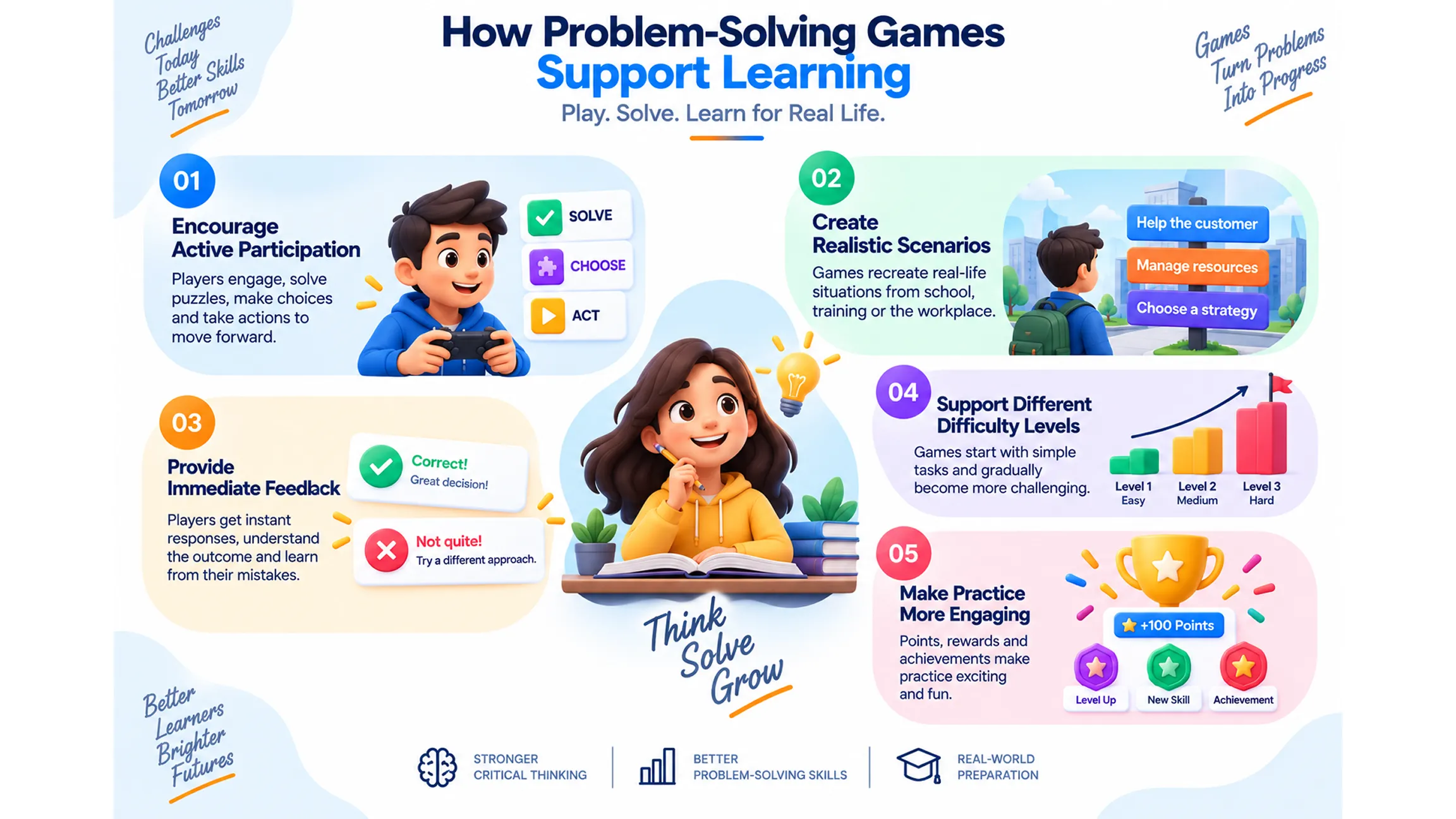
How Problem-Solving Games Support Learning
1. Encourage Active Participation
Games require players to engage in learning. They have to recognize hints, solve puzzles, choose the correct option, or perform actions in order to progress. This creates an opportunity for a more active learning process rather than just absorbing knowledge.
2. Create Realistic Scenarios
A problem-solving game can recreate situations that learners may encounter in school, training, or the workplace. For example, a business training game could ask an employee to handle a customer complaint, manage limited resources, or choose between different business decisions.
3. Provide Immediate Feedback
Game-based education provides players with responses to their actions immediately. Thus, the students understand what is going on and why one decision led to a specific outcome. Unlike just marking answers as wrong, mistakes become part of the learning process.
4. Support Different Difficulty Levels
Games can begin with simple tasks and move to more difficult ones. This enables players to learn with an increasing challenge level.
5. Make Practice More Engaging
Practice can turn out to be monotonous when it only includes worksheets and tests. Game elements like accomplishments, points, rewards, and progress help make practice more exciting.
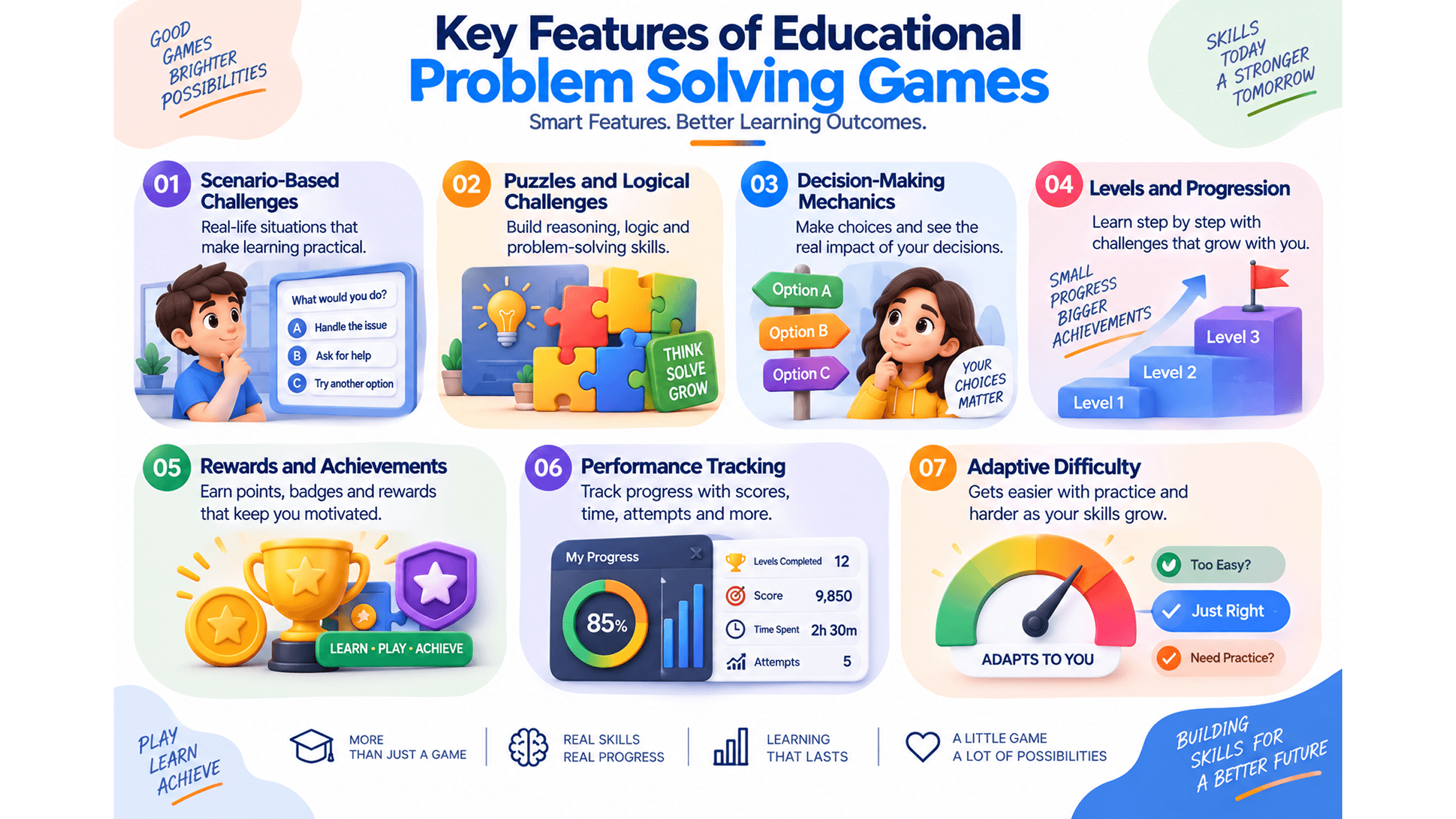
Key Features of Educational Problem Solving Games
An educational game development company can build different features depending on the learning requirements.
Scenario-Based Challenges
The scenario-based games give good opportunities for learners to find themselves in a realistic situation and act accordingly. Such scenarios can be used in education, training, customer service, or any other field.
Puzzles and Logical Challenges
The hands-on puzzles are great for improving reasoning and logic skills of learners as well as developing their ability to notice details and sequence events. They can vary in difficulty depending on the age and skills of the users.
Decision-Making Mechanics
Action-based games create an opportunity for players to choose from different variants of actions. Different actions will help the learners realize the consequences of their decisions and actions.
Levels and Progression
The use of levels is another important aspect of educational games. The levels will help the learners master the skills gradually, starting from the simplest task and finishing with a more sophisticated one.
Rewards and Achievements
Such systems as points, badges, access to extra information, and rewards can motivate learners to study more. But it is critical to make sure these systems contribute to the learning process.
Performance Tracking
For training programs, administrators may need to understand how learners are performing. Tracking can include completed levels, scores, attempts, time taken, and other relevant metrics.
Adaptive Difficulty
The difficulty of a game can be adjusted based on user performance. Strong performance may unlock more complex challenges, while additional practice can be provided where needed.
Educational Game Development for Educational Sector
Educational institutions can take services related to game development from these companies so that they can get problem solving games. Thus, a math game can include a series of logical problems which are becoming more and more complicated, while a science game might require going to the virtual world and looking for the correct answers. In a similar way, a language-learning game might include interactive conversations and tasks aimed at improving communication.
Educational games can be developed for:
- Mathematics and logical reasoning
- Science and technology
- Language learning
- Financial literacy
- General knowledge
- Coding and computational thinking
- Critical thinking
- Career preparation
The game should be designed around the curriculum or learning objective instead of simply adding educational content to an existing game format.
Corporate Training Games for Workplace Problem Solving
Businesses can also use corporate training games to help employees practice workplace skills. Traditional corporate training may involve presentations, literature, and video, as well as instructor-led methods. Even though these approaches are capable of explaining certain aspects of business, interactive gameplay allows workers to practice their skills.
A corporate problem-solving game could simulate situations such as:
- Handling customer complaints
- Resolving workplace conflicts
- Managing project delays
- Prioritizing tasks
- Allocating limited resources
- Identifying operational problems
- Responding to business scenarios
- Making team decisions
For example, the worker takes over a project that is limited in budget and has to deal with several surprise obstacles. The participant needs to make decisions regarding the resource management. Through the game, the participant receives the information about the consequences of his/her actions.
HR Training Games for Employee Development
HR training games can be designed to support the educational process inside the company through onboarding of employees, teaching soft skills, ensuring compliance, enhancing communication skills, developing leadership skills, as well as making decisions in the work environment. Rather than making employees read the regulations of the company, an interactive game may utilize the information in practical situations.
Examples include:
Employee Onboarding Games
New employees can explore company processes, workplace policies, departments, and responsibilities through interactive challenges.
Communication Games
Games provide employees with virtual conversations they can have with the customers, managers, and team members.
Leadership Games
Leadership scenarios require people to handle teams, prioritize tasks, solve problems, or make decisions in changing environments.
Compliance Games
Employees get to learn business practices through interactive situations where they have to recognize and avoid appropriate and inappropriate actions in the environment.
Workplace Ethics Games
Using case-based mechanics in games can get employees into situations that teach them how to respond to different challenges and ethical situations at their workplaces.
Where Can Problem-Solving Games Be Used?
| Use Case | How Games Can Help |
|---|---|
| Schools | Practice reasoning and problem-solving |
| EdTech | Add interactive learning experiences |
| Corporate Training | Simulate workplace decisions |
| HR Training | Support onboarding and employee development |
| Professional Training | Practice job-related scenarios |
| Skill Development | Build decision-making and logical thinking |
| Customer Service Training | Practice responses to customer situations |
| Leadership Training | Simulate management and team challenges |
Benefits of Custom Educational Game Development
Custom development allows organizations to create a learning experience around their own objectives rather than adapting their training to a generic platform.
Key benefits can include:
Learning-focused gameplay: The process of playing can be directly related to particular educational or training goals.
Realistic scenarios: Companies can create learning situations based on their real-life education or work situations.
Flexible content: New levels, questions, scenarios, and tasks can be added.
Scalable experiences: The games can be created for an individual student and for a classroom or training group, etc.
Performance insights: Tracking features can help organizations track learners' engagement and performance.
Cross-platform access: Depending on the needs of the project, games can be developed for web, mobile, or desktop applications.
Why Choose Abhiwan Technology for Educational Game Development?
Abhiwan Technology develops customized game-based experiences for education, training, and business use cases. Our approach focuses on combining engaging gameplay with practical learning objectives. As an educational game development company, Abhiwan Technology can develop solutions around your target audience, subject matter, game mechanics, and technical requirements.
Our development capabilities can include:
- Educational 2D and 3D games
- Problem-solving and puzzle games
- Scenario-based learning games
- Corporate training games
- HR training games
- Simulation-based learning
- Interactive quizzes and challenges
- Gamification mechanics
- Progress and performance tracking
- Web and mobile game experiences
Whether you need a problem solving game for students or an interactive training experience for employees, the game can be designed around the specific skills and outcomes you want to support. Explore Educational Game Development Services to discuss your project requirements with Abhiwan Technology.
Conclusion
Problem-solving skills matter across education and professional environments, but learners need opportunities to practice them rather than just read about them. Educational game development can turn learning objectives into interactive challenges where users can make decisions, test solutions, receive feedback, and progress through different levels. These games can offer enhancement to both schools and EdTech companies. Corporate training games and employee training games can allow companies to experience realistic settings for the growth and learning of employees. Abhiwan Technology creates games that are developed according to learning goals, participants, gaming needs, and objectives of the organization. The implementation of a useful problem-solving game can introduce interactivity in learning and provide companies with flexibility in the process of giving training to employees.
Written By Vaibhav Karanwal