In order to estimate game development cost prior to starting the project, divide it into scope, assets, mechanics, and platforms, estimate hours needed for each of these parts, multiply it by your realistic team rates, and add contingency. It results in a range rather than a specific number, and this number gets better as you get new information.
Most teams ignore this and grab a number from an article or a competitor's budget. This is how projects run out of money in month eight. This guide describes a concrete method to build a game project cost estimate in detail, teaches which pricing factors shift the number the most, and ends with a worked example to adapt to your own game development budget planning.
Why Is It Difficult to Estimate Game Development Cost Early?
You are estimating the price of something that does not exist yet. Your project's design can change, your team has not proved its productivity yet, and every new mechanic is somewhat of an experiment. When choosing game development services, these uncertainties make it important to understand how teams estimate project costs. In an article on GameDevProducer.com, the producer describes how game development teams make estimates for the projects they imagine rather than those they actually develop
It doesn't mean that making estimates is useless. It just means that you have to be open about what you don't know. A good estimate reveals its assumptions, involves some range, and is regularly updated. A poor estimate is just a number written somewhere on a slide.
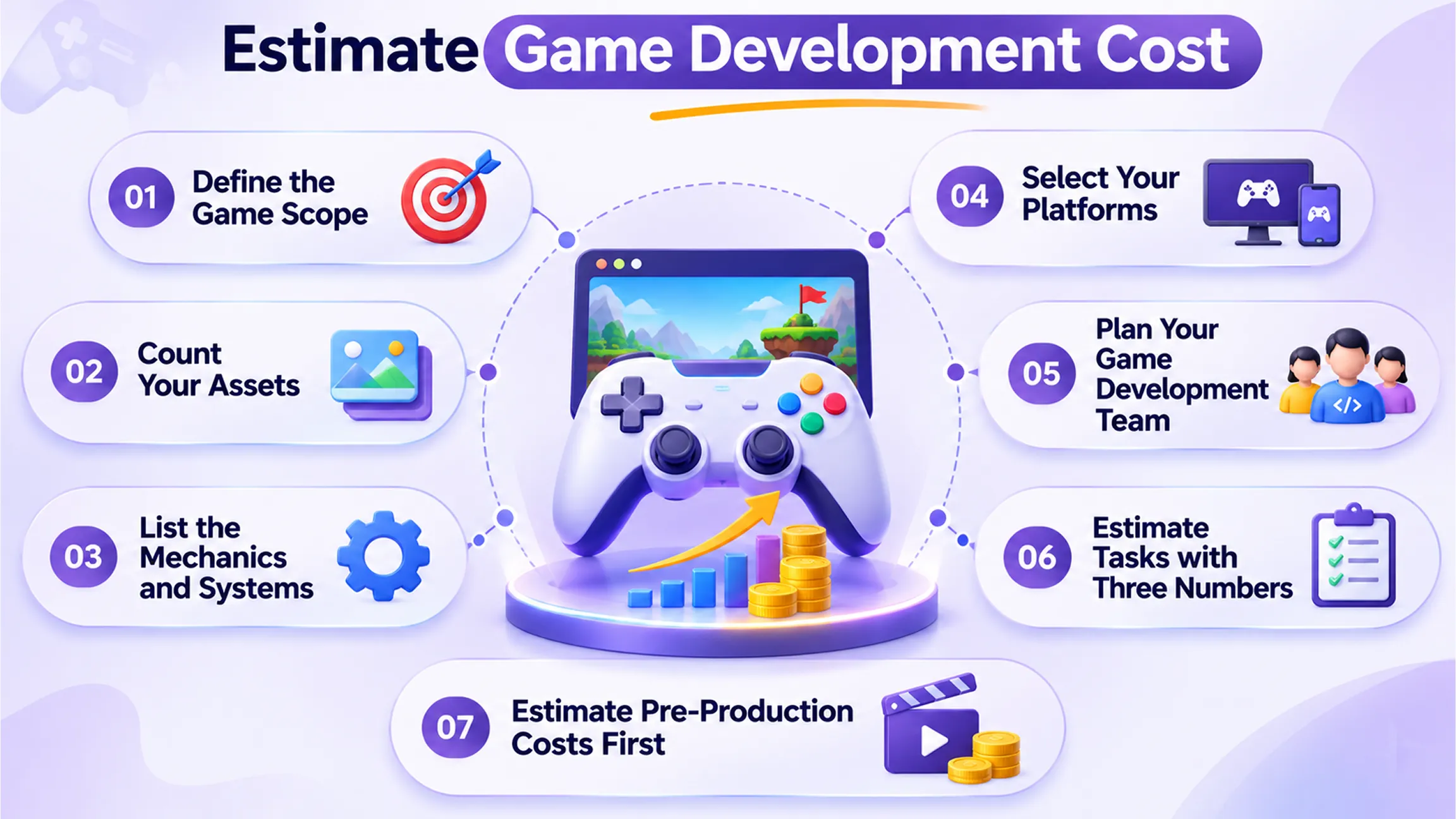
Step 1: Define the Game Scope
First, scope estimation because it's used by every later step. Create a single-page brief including genre, platform, audience, core loop, art style, and potential length of play. Make a list of all game features, then put each into one of three categories:
- Essential: no game without it.
- Should-have: it rounds out the target experience.
- Optional: can be pushed for a future release.
Handle the first group fully and the second sketched in. Leave the third out of the base budget. This single move alone frequently reduces your first estimate considerably, and you now have the basis for your dropping list in case you get short of cash.
Step 2: Count Your Assets
Assets such as characters, environments, props, animations, UI screens, music tracks, sound effects, and all the things the game needs. Asset costs are typically the biggest source of the bill and the easiest to quantify. Write up a simple asset list and identify how many of each you need and at what quality.
| Asset type | What to count | What changes the cost |
|---|---|---|
| Characters | Playable and non-playable | 2D or 3D, animation count, rigging |
| Environments | Levels, maps, backgrounds | Size, detail, number of unique spaces |
| Props and items | Weapons, collectibles, objects | Variation, level of detail |
| Animation | Moves per character, cutscenes | Hand-made or motion capture |
| UI and menus | Screens and states | Number of screens, localisation |
| Audio | Music tracks, effects, voice lines | Original or licensed, adaptive music |
Then, assign an approximate effort level (for example, simple, standard or complex) and time to each asset type. It is good to ask for the stylised 2D character rather than the fully animated 3D hero, as this will cost less. The more detailed your list, the more accurate your sum.
Price then count. Most teams have a total they want to spend, and then try to make what they want within the budget. Do it backwards: count what is required to make the design happen and then price it, then compare it to what you can spend. You'll be surprised. If there is a big difference, narrow the scope, not the quality. If scope gets cut, do it before you start building.
Step 3: List the Mechanics and Systems
Mechanics are the actions performed by the player. Systems are the formal rules that connect those mechanics: combat, inventory, crafting, progression, economy, matchmaking, all of that. All of those require design, programming, balancing, and testing.State each mechanic in a small- to medium-sized task list. 'Combat' is too large to price. 'Basic attack, block and dodge, three enemy types, two rounds of tuning after playtests' is something a programmer can give you a number on. Look closely at systems that interact with each other. A crafting system that links to inventory, economy, and save data is more expensive than three separate systems, because those links need work and testing.
For the puzzle game we will use as an example, the mechanics list looks like this: tile-matching input, scoring and combos, level goals, a hint system, lives and energy, daily rewards, and a shop. Seven things, between a few days and a few weeks of work each. Notice that the shop and the live system tend to be more costly than the actual core tile matching, since it has to work with the store and the backend.
Also note the risky items: the new tech, online play, anything the team hasn't built before; these are given a larger buffer in the later stage.
Step 4: Select Your Platforms
Every platform adds work. The mobile requires touch controls, multiple screen sizes, and a variety of devices. PC requires hardware configurations and an options menu. A console has to be approved, use dev kits, and be tested on the various platform-specific hardware. A multi-platform launch needs careful optimisation, testing, and store compliance.
Before you sign up, verify:
- Store fees and revenue share
- Age rating and privacy rules
- Set performance goals for your least-capable device
- Input type: touch, controller, or keyboard
- Review or certification time
Choose a launch platform for the base estimate and price the others as separate items. It is more expensive to retrofit a platform late in the game rather than design it in from the beginning, so choose early which are actual plans and which are hunches.
Step 5: Plan Your Game Development Team
Teams are usually the most expensive part of any game project, which is why they determine the overall budget. Write the number of each skill position you require and the months of production needed for each: designers, programmers, artists, animators, audio, QA, production.
This is a rough guide; these example ranges in the Game Dev Producer guide for typical team sizes might put a team like this:
| Project scope | Typical team size |
|---|---|
| Micro, jam-style | 1–3 people |
| Small indie | 3–8 people |
| Mid-size indie | 8–20 people |
| AA | 20–60 people |
A simple conversion of headcount to dollars. Use a loaded rate, not just salary. For employees: benefits, equipment, software, and overhead. For contractors, it's their full day or hourly rate plus the time you spend supervising them. The guide recommends taking the hourly cost of a salaried employee by dividing their annual cost by 1800 to 2000 since your billable hours will be less due to meetings and downtime.
The location often dictates the rates, and when it's for lead or design, why use them in-house? Many teams will have art, QA, or porting outsourced. Either way, get real quotes, not guesstimates with round-number costs.
Step 6: Estimate Tasks with Three Numbers
After you have divided the work into small steps, get the individual completing them to provide three figures-best case, most likely, and worst case. One way of averaging these is to take the total of the best case, four times the most likely, and the total of the worst case, and then divide by six.
Say, the worst case is 60 hours, the best case is 20 and the most likely is 30; you get (20 + 30 + 60) / 3 = about 33 hours. The weighted answer is higher than the most likely because the (negative) downside is bigger than the upside; this is typical of most real tasks. For all the tasks you recorded for each. Sum them, and you will find the total hours. Use the loaded rate that you will see below it and multiply.
Step7: Estimate Pre-Production Costs First
If holding the entire project is too speculative, price only the pre-production phase: just the prototype, design document, and technical plan. This is a neat, tightly bounded set of work. You get a good sense of the team's true velocity, the most difficult mechanics, and the true amount of asset production needed, putting you in a much better position to price production. And it's much easier to justify in a pitch.
Game Development Pricing Factors at a Glance
And these are the things most likely to cause the market for two games in the same genre to be priced wildly differently.
| Factor | Why it moves the price | How to check it early |
|---|---|---|
| Scope and length | More content means more of everything | Must-have list and play length |
| Art style and quality | 3D and detailed art cost more than stylised 2D | Asset list and art references |
| Mechanics and systems | Linked systems add design and testing | Task list per mechanic |
| Platforms | Each one adds testing and requirements | Launch plan and store rules |
| Multiplayer and backend | Servers, accounts, and anti-cheat need specialists | Online feature list |
| Team size and location | People are most of the budget | Role plan and quoted rates |
| Engine and tools | Licences, plugins and skills | Engine decision and tool list |
| Revisions | Late changes touch many departments | Design freeze date |
Step 7: Add Contingency
Budgeting without a cushion is a bad estimate. "Budgeting with a cushion" doesn't mean you think you're going to lose money. It just means you've never done that exact game before. One simple method would be to start with a task-level buffer: 15% for familiar work and 30-40% for anything involving a new technology or that's being done for the first time. Then add a project-level contingency on top. The Game Dev Producer guide recommends at least 20-25% for the entire project.
Startups should start high. If your team hasn't shipped a game before, a small prototype first will give you real speed data, not a formula.
Game Project Cost Estimate Example
This is a sample of a small 2D mobile puzzle game consisting of approximately 60 levels for six months of development. The hours and $45 blended rate are estimates for the sample, not a market quote.
| Area | Hours | Cost at $45/hour |
|---|---|---|
| Design | 400 | $18,000 |
| Programming | 1,200 | $54,000 |
| Art and animation | 1,000 | $45,000 |
| Audio | 150 | $6,750 |
| QA | 300 | $13,500 |
| Production and management | 200 | $9,000 |
| People subtotal | 3,250 | $146,250 |
| Contingency (25%) | $36,563 | |
| Tools, licences, store and legal fees | $12,000 | |
| Estimated total | about $195,000 |
The costs are not included in marketing. For paid user acquisition, show it separately as a line item. Present an estimate for a potential stakeholder (range of $170,000 to $230,000), and the assumptions.
Alter the assumptions and the total moves. Launching a second platform requires testing and optimisation work, and 300Mind's cost guideline puts about 10-20% onto adding Android to iOS and 15-40% onto multiple platforms. Transition from stylised to detailed art raises the art line the most. Hiring in a more expensive region raises each line simultaneously. Recalculate each time you make one of these changes.
Hidden Costs in Game Development
Even conservative estimates overlook things that add up to:
- QA: testing will add a significant amount of time, and after the flight fails, resubmission can take time to be certified and returned to the launch.
- Audio: original music and sound design, along with the amount of time it takes to produce them.
- LOCALISATION: translation, localisation testing, and the engineering to support additional languages.
- Revisions: it's unlikely your vendors will deliver a perfect product the first time, so prepare to get two or three rounds of each for art and audio.
- Porting: Another platform can take considerably longer than everyone anticipates – particularly the first time.
- Support after launch: patches, compatibility updates, and any content that is released after launch.
- Marketing: trailers, store assets, community activities, and advertising.
Turning Your Estimate into a Game Development Budget
Game development budget planning begins at the end of the estimate. Offer the number as a band, explain the premise behind it, and tie the cash to project milestones (prototype, vertical slice, alpha, beta), with proper exit criteria. That allows you to catch overruns early enough to still correct the course.
Refine your forecast periodically, which is best done on a monthly or sprint-by-sprint basis. Regularly compare actuals against planned, re-establish the remaining work, and recalculate the range. Teams that revise the forecast frequently identify problems earlier. Teams that accept the initial numbers as the final result do so far too late.
Common Mistakes When Estimating Game Development Costs
- Feature-level estimate. "Build combat" can't be estimated. Break down to tasks first.
- Using worst-case numbers only. Request three different figures for each task.
- Forgetting everything but people. Don't just consider the people; think about the extras: fees, tools, hardware, marketing, and the rest.
- Avoiding contingency. The contingency is the portion of the budget that sustains a project.
- Not referencing similar games. If your figure does not match other similar titles, discover the reason why.
- Providing the estimate as if it's a promise. It's a prediction that is supposed to evolve as you learn.
Working with a Game Development Partner
If you need to validate your budget before you begin production, an experienced game development studio can help. Preparing a game design document can also help you organize your scope, assets, mechanics, and platforms before estimating costs. Your development partner can analyze your project requirements, identify what's missing, and see if you're on track.
The studio will also look at your list of assets and explore other ways to minimise the expenses of the project without compromising the gameplay experience. For example, they could advise on reusing certain assets, having less complicated mechanics, customising existing tools or plug-ins, or even prioritising the main features to be included in your first release.
Before closing the partnership, request an itemized quotation that breaks down your estimated expenses on game design, artwork & animation, programming, quality assurance (QA), releasing, as well as post-release support. In this way, you could quickly tell how your money will be spent and also compare quotes between different design studios. It would be best to likewise have an understanding of the timeline, milestone payments, revisions permitted, possession of video game sources & source code, and also any kind of additional costs that might be collected along the way.
Discussing your estimate in depth with a development partner will enable you to transform it into a more feasible project budget. It will also provide you with a more transparent picture of the time, investment, and resources needed before full-scale production.
Conclusion
You won't know the precise price of a game before creating it, but you can come close enough to be able to make sound choices. Scope it out, measure the assets, identify the mechanics, size the platforms, organize the team, and quote the tasks with three numbers. Contingency factory, give a range, and come back to it often. That's what separates the budget that guides from the one that surprises.
Written By Vaibhav Karanwal