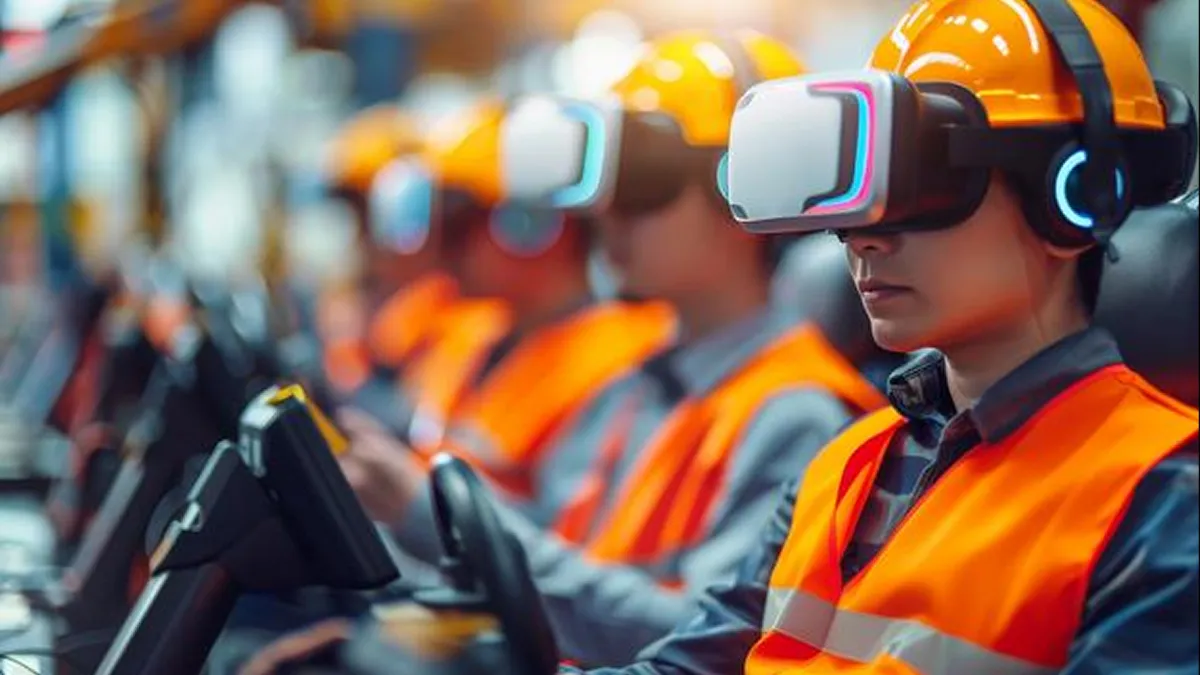
HR Training Games are replacing PowerPoint presentations and PDF documents as the medium of choice for HR professionals looking to impart knowledge that sticks. Rather than expecting employees to learn from a document detailing conflict resolution or compliance policies, scenario-based games put employees in the middle of a situation where they can make a choice and see the result before moving forward. Abhiwan Technology worked with Bajaj Finserv AMC to develop MindMaze, an interactive training game designed to make employee training and onboarding more engaging and easier to understand. This article will provide an overview of why scenario based games work for HR training and how they can make learning more practical and engaging.
What Is an HR Training Game?
An HR training game is an interactive module based on a realistic scenario in the workplace, which allows an employee to perform some action, such as dealing with a dissatisfied client or identifying a compliance risk, in a relatively safe way that can be repeated several times. Designing an HR training game is a form of educational game development that differs from other types of game development because the game has to teach a skill, not just entertain.Most companies order their HR training games to be made by studios that view the task as an educational game development craft, which implies mixing instructional design with true game mechanics and not just a quiz added to a video clip. It is important to distinguish the two things because, if a training game lacks true game elements and is basically a multiple-choice test wrapped in a game environment, the desired behavior will never be taught.
How Scenario-Based Games Work in HR Training
In scenario based training, an employee is placed in a realistic situation at work, is asked to make a decision about how to act in this situation, and is shown the result of this decision with subsequent feedback or an opportunity to make another decision. The method is usually used in areas where the judgment of an employee matters more than his knowledge, such as communication, detecting unconscious bias, conflict resolution, or reaction to a safety incident. In contrast to regular quizzing, a properly developed scenario can be branched according to the decisions made by an employee. Thus, two employees can have completely different results from going through the same course.
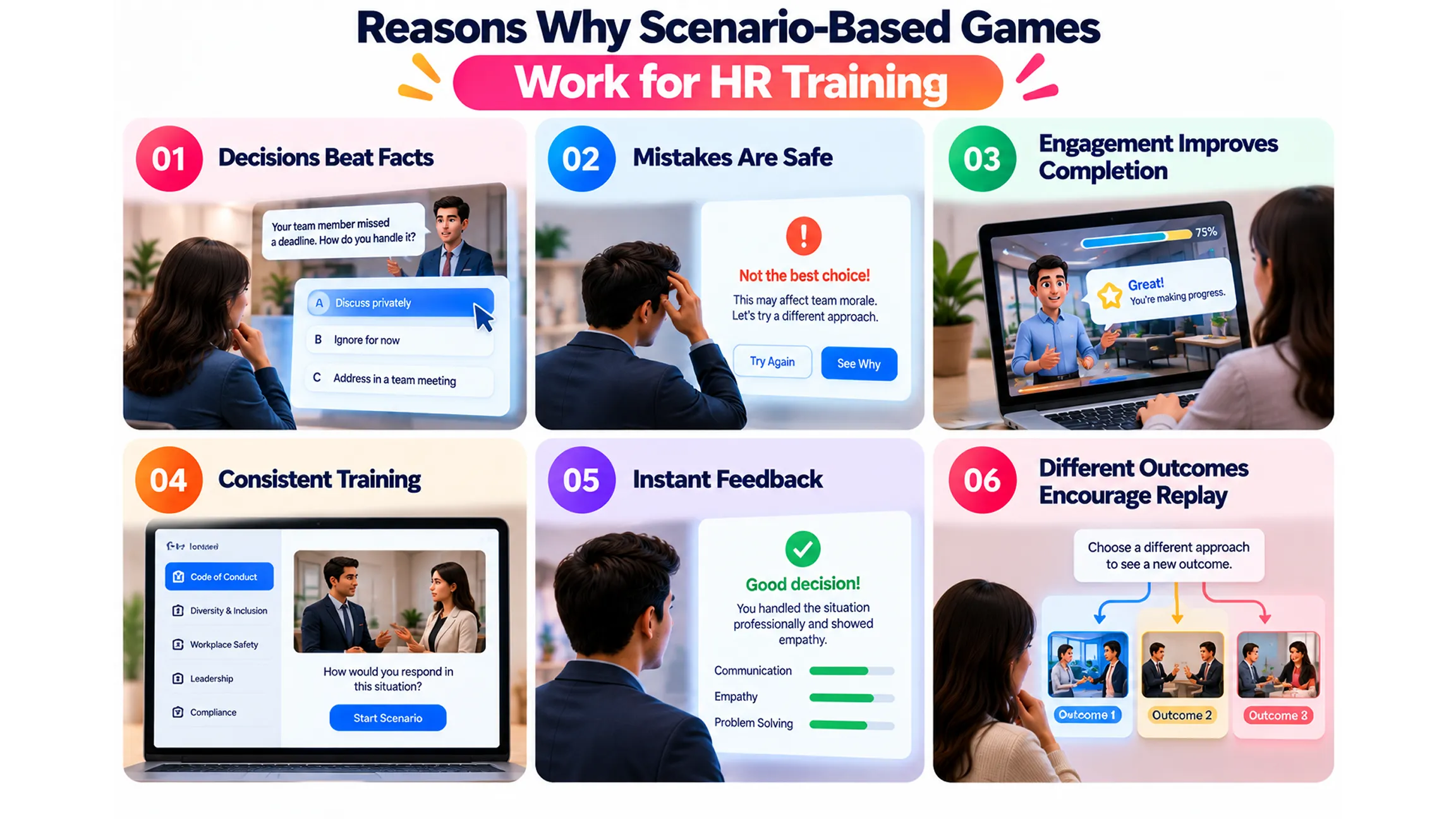
Reasons Why Scenario-Based Games Work for HR Training
Games work when manuals and lecturing training fail due to the natural way learning and retention of behavior happen.
Decisions Beat Facts
When someone recalls what decision they have made and the outcome, they will remember much longer than when they recall something from a bullet point they once read; this is precisely why well-designed educational game development beats static content in behavior change subjects like harassment training and ethics.
Mistakes Are Safe
If a recruit makes a poor decision while facing an issue with a client, then they see the outcome without having any negative consequences on the real-life business relationship. That is why educational game development plays a role in providing a safe rehearsal space. Such educational game development company could design such simulations for the employees to gain experience in dealing with difficult scenarios beforehand.
Engagement Improves Completion
There is an established truth that interactive training modules achieve greater levels of completion than the video-based or text-based training modules due to their engaging nature. Good corporate training games can engage employees through decision-making and realistic work scenarios.
Consistent Training
The game provides the same scenario and feedback to each employee, eliminating variation because different trainers conduct the same training differently.
Instant Feedback
It is possible for employees to know right away why their decision is good or bad, which makes it easier for them to learn the logic of a policy rather than only to remember the right answer.
Different Outcomes Encourage Replay
In a branching scenario, there could be different outcomes depending on the decisions made by the player, motivating him to play through the same scenario and make a different decision. An educational game development company could build branching scenarios to consider complex business situations from different sides.
HR Training Games vs Traditional Training Methods
| Training Aspect | HR Training Games | Traditional Training |
|---|---|---|
| Learning format | Interactive scenarios, choices, challenges, and feedback | Slides, PDFs, videos, or instructor-led sessions |
| Employee participation | Employees actively make decisions and complete tasks | Employees mainly consume information |
| Practice opportunities | Employees can repeat scenarios and try different responses | Practice may be limited or require separate activities |
| Handling mistakes | Mistakes can be explored safely in a simulated environment | Mistakes may only be discussed through examples |
| Personalization | Branching scenarios can change based on employee choices | Usually follows a fixed learning path |
| Performance tracking | Scores, decisions, completion, and progress can be recorded | Tracking may focus mainly on attendance or completion |
| Best suited for | Onboarding, compliance, soft skills, customer service, and decision-making | Information-heavy policies, documentation, and basic knowledge sharing |
HR Training Games: Facts and Figures
- Abhiwan Technology has achieved a customer satisfaction rating of 98%, a 4.8-star rating by clients, and a 90% on-time delivery rate in their development projects.
- The time taken to develop a training or educational game ranges between 6 and 20 weeks, depending on whether it is a simple scenario-based module or a complete 3D multi-module game.
- Training games in corporates are being created which can be integrated within the organization’s current LMS such that the data is collected in the reporting system without any need for manual effort.
Abhiwan Technology’s HR Training Games Development Services
Abhiwan Technology is an educational game development company that develops corporate training games and HR training games, apart from developing preschool games, language learning games, and skills development games. The company’s six-stage approach to developing a training game starts from defining the goal of training and audience up to the development, testing, and launch of the game using tools like Unity, Unreal Engine, and 3ds Max. The implementation of the Bajaj Finserv Mind Maze program by the studio also proved the effectiveness of the use of edutainment in the area of mind-training of employees of companies. The games are available in the following formats: Android, iOS, web, PC; LMS integration is also available for companies needing completion tracking.
How Much Does It Cost to Develop a Corporate Training Game?
The cost involved in creating a corporate training game depends highly on the size of the project and level of customization. Basic training games having one scenario, branching, and 2D graphics could have a cost of $8,000–$20,000, whereas multiple games with customization of 3D world, characters, animation, voice-over, and interactivity might cost $50,000 or even above. The number of scenarios, platforms supported, evaluation, LMS integration, reporting, among others, also affects the overall cost of development. Companies should get their own cost estimates for their particular projects since there is no standard industry cost for all organizations. Initially, the company making the game will assess the objective of the training, target audience, number of users, platforms, and other factors.
Conclusion
By using HR training games, companies get a means to train their employees not only in terms of knowledge but in terms of judgement and behaviour. This is achieved by immersing the participants in a realistic environment where the consequences of certain actions are clearly seen. This kind of training works well due to its similarity to the natural learning process and the existence of examples like Bajaj Finserv's Mind Maze, which proves that the form applies to the corporate environment. As for the development process, the partner, such as Abhiwan Technology, will develop the program based on the needs of your company, starting from a single compliance scenario up to a complete onboarding game.
Written By Vaibhav Karanwal