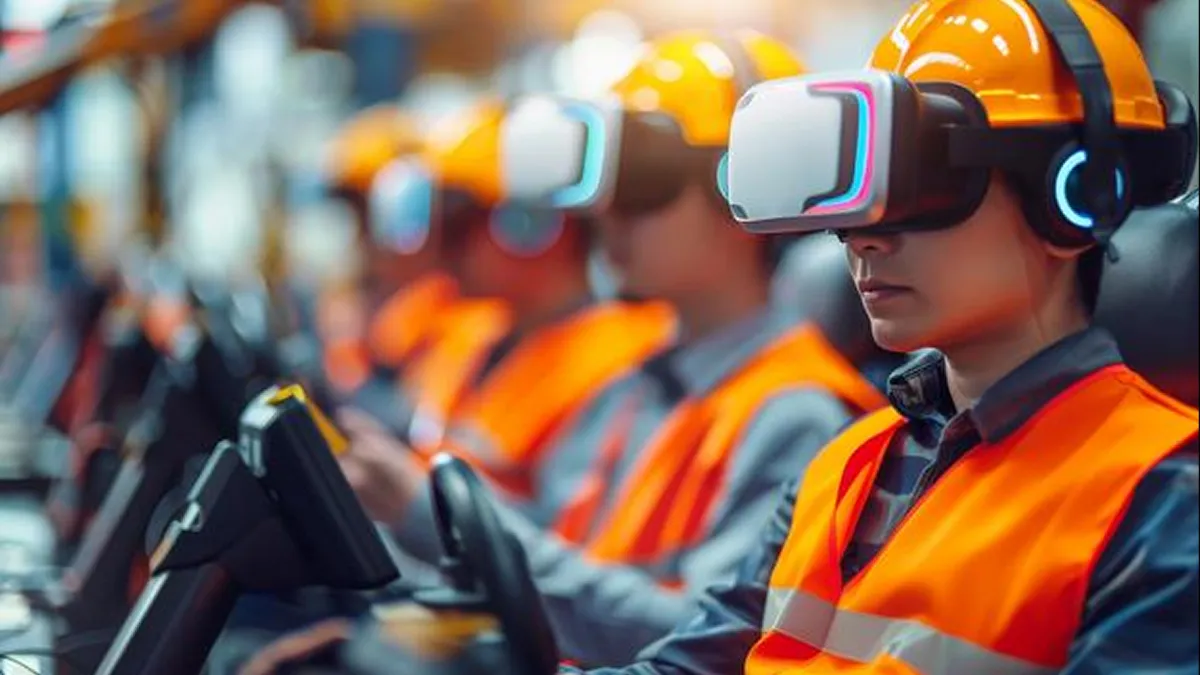
The safety training simulations provide a solution to practice dangerous procedures without risking anything in real life. An employee who needs to learn how to handle a heavy machine or deal with a chemical accident, for instance, is able to make mistakes in a simulation and not pay for them in the real environment, where they can cost him dearly. Abhiwan Technology creates an immersion in the area of safety training simulations that can be tailored specifically for workplace safety training. This is a breakthrough since, usually, safety training is either held in the classroom or in the form of occasional live exercises, which do not allow the workers to develop instinctual skills through repetition. This article will explain what simulations are about, what benefits they bring, and what one should consider when selecting a developer.
Safety Training Simulations: What Are They?
Safety simulations are types of training that rely on virtual reality, augmented reality, or mixed reality technology to virtually replicate hazardous situations in a safe environment, in which employees can train on how to respond to equipment failures, exposure to chemicals, fire, machinery accidents, or other potential dangers without risk of harm. Safety simulations will put employees into situations that require hazard identification, safety protocol application, decision-making, and quick action. Unlike learning from written safety instructions or video demonstrations, safety simulations are more practical. Providers usually offer safety and training solutions that not only include the development of safety simulations but also instructional design services to ensure that the training is actually valuable.
Why Manufacturing Needs Safety Training Simulations
Workplace environments in manufacturing suffer from some of the highest incidence of injuries in any industry. Safety training simulations enable the newly hired individual to go through a dangerous process many times over before actually going ahead with it, giving them muscle memory and quick decision-making skills which cannot be gained through a simple classroom training exercise. Since the simulation does not involve any actual materials or put anyone in danger, this process of repetition is possible much more than in the case of live drills.
Plant managers comparing various safety training solutions will usually conclude that this repetition process alone justifies their choice, as it results in fewer accidents among new employees in their first few months.
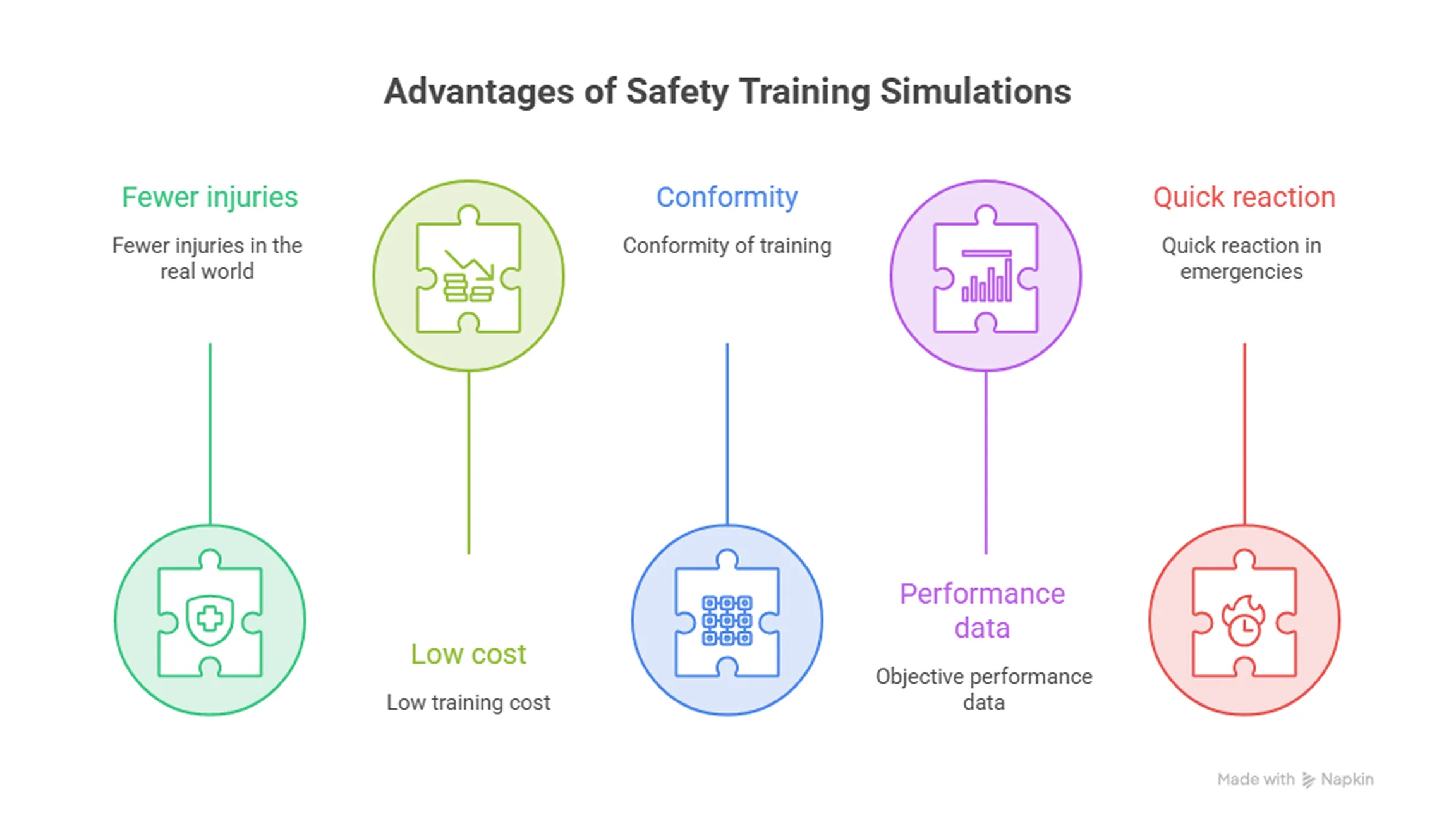
Advantages of Safety Training Simulations
Several concrete advantages become visible almost immediately after a simulation safety training program is implemented.
Fewer injuries in the real world
Staff members can practice dangerous activities or emergencies without having to be at risk in the workplace. Practice allows people to learn how to recognize the danger and react in the right way when the situation arises in reality.
Low training cost
Since virtual training requires no materials, physical settings, or devices, repeated training is less costly. Companies do not have to worry about damaging the machinery or wasting other resources.
Conformity of training
Each worker goes through the same simulations and training instructions as all the other employees, which guarantees a certain training quality for everyone.
Objective performance data
Simulation software records employee actions, reaction time, completed tasks, and mistakes made by participants in a training session. This data can be used by management to understand where extra attention needs to be paid.
Quick reaction in emergencies
Employees can practice emergencies until they get comfortable with performing the required actions in the proper manner.
Companies making their investments in safety training solutions usually find that they get compounded over time, since more and more employees will be put through a common and consistent training process.
Key Features of Safety and Training Solutions
Not all companies that provide simulation training know what is required from such training in the industrial environment. That's why it is important to consider several aspects when choosing a training solution vendor.
Accurate Hazard Simulation
Ask about the degree of matching between the simulation and your specific equipment and hazards, since a simulation module on fires would not correspond to your production hazards. In addition, the best safety training solutions should be based on your facility layout.
Stress Conditions
Ask whether the simulation will have elements that would create stress to simulate an actual emergency. The most useful safety and training solutions would include stress conditions right in the training design.
Tracking Performance Clearly
It is imperative to know the information that the program gathers in a particular session, because completion of the test will not be an assurance that the person answered the questions properly. It is important for safety and training solutions to monitor decisions made, not just completions.
Compatibility With Existing Infrastructure
Make sure the simulation is compatible with your existing LMS, training platform, or reporting systems. Quality safety training solutions must simplify management of the employee learning process, assigning and evaluating modules without developing an additional system for the trainers.
Post-Launch Maintenance
Find out what type of maintenance will be provided after the deployment of the simulation, especially if there are some changes in procedures, equipment, or safety rules. Reliable safety training solutions must provide possibilities for content updates and improvements without rebuilding the whole simulation.
Typical Industrial Safety XR Solutions
XR-based safety training includes different kinds of scenarios used in industrial safety training today.
Fire and evacuation exercises
It helps employees to identify all emergency exits, raise an alarm, and learn how to evacuate from a building through a simulation. Frequent exercises enable workers to know how to behave in a real fire situation.
Chemical spill response
The simulation recreates different kinds of situations related to chemical spills. Employees can find out about chemical exposure and learn how to respond correctly using appropriate protective gear.
Machine lockout/tag out procedures
Employees could learn how to shut off the machines and use the lockout/tag out procedure prior to performing any maintenance work or repairs. This simulation could point out mistakes made and illustrate what could happen if there is no isolation of dangerous energy sources.
Confined spaces rescue training
XR could recreate confined spaces where workers would encounter limited visibility, hazardous gases, or tough rescue situations. Employees would be able to practice safe procedures, identification of hazards, communications, and emergency response.
Fall protection training
Workers would be able to practice fall hazard recognition, proper use of fall arrest systems such as harnesses, lifelines, guardrails, ls and other safety devices. Simulations could also show employees mistakes that could lead to serious accidents.
Today, many organizations consider safety XR solutions a must for their onboarding process.
Abhiwan Technology’s Safety Training Simulation Approach
At Abhiwan Technology, Safety Training Simulations are designed based on the machinery, procedures, and layout of facilities unique to each company. By doing so, training will revolve around hazards and safety procedures that employees would most likely encounter in real life rather than training based on general scenarios. The simulations can replicate specific tasks and emergency procedures that could provide employees with practical training opportunities. Abhiwan Technology also offers safety XR solutions, which can be easily edited whenever there are changes made to the machinery, processes, and safety procedures. Consequently, companies are able to ensure that the training simulations stay relevant instead of creating new ones each time something is modified.
What are the three types of simulations?
There are generally three kinds of simulations that can be considered. In live simulations, actual persons work with actual equipment in an environment that is realistic yet controlled, for example, a physical fire drill. With virtual simulations, actual persons work with simulated equipment, and that is where most Safety Training Simulations using XR will fit in, as a trainee works with a simulated environment and not physical equipment. Constructive simulations include simulations of persons and simulations of equipment and may be used for massive models or situations where no actual persons are needed at all.
What are the 5 steps of simulation?
Although the processes used to conduct simulation exercises vary somewhat depending on the industry, there are five main steps involved in developing any simulation process. Step one involves defining the problem or the objective of the training, i.e., figuring out the particular skill or reaction that must be learned. The second step is designing the scenario and model, in terms of hazards and decision points involved in the simulation. The third step entails building the simulation and collecting relevant information or data. Step four is testing the simulation to check for accuracy. The fifth step involves deploying the simulation and analyzing the results. Good safety XR solutions view this process as an iterative process rather than a single-shot exercise.
Conclusion
The acquisition of Safety Training Simulations provides manufacturing and industrial workers with a means of developing competence in safety without having to go through costly and risky live training only. In this article, the aspects involved in safety training simulations have been outlined, their benefits discussed, and finally, the key criteria that must be verified when selecting a developer of safety simulation have been identified. When it comes to developing a simulation for your company or organization, no matter whether it is the first safety simulation or an expansion of the current training simulation for your company or organization, your own Safety Training Simulations will always be better than a general safety simulation that you got from elsewhere.
Written By Charu Sharma