The interactive kiosk software, in fact, is the one that makes a self service station in a retail shop user-friendly for customers or an additional annoyance during checkout. The hardware, which includes the touchscreen, scanner, and card reader, is important indeed, yet it is the software layer that makes the process quick enough and ensures a proper connection between the system and the inventory management of a store. In the current business world, companies compete not just with their pricing strategies and merchandise but also by providing great software experiences for their customers. Abhiwan Technology creates retail kiosk software solutions that may interact with various retail software systems depending on the specific needs of the business. This article will tell you all about the features that should be included in the software, its place in the technology ecosystem of a shop, and costs associated with it, as well as the issues of theft.
What Is Interactive Kiosk Software for Retail?
Interactive kiosk software is a solution at the application level that controls the operation of an automatic self-service terminal, from the user interface of the payment to all back-end connections with the POS, inventory management, and loyalty programs. Retailers either opt for an out-of-the-box platform or go for custom software via specialized interactive kiosk development. The main difference with retail, however, is that the software should do more than just accept a payment. For this reason, many retailers prefer to employ interactive kiosk services that will cover the software development process, product lookup, bar code scanning, loyalty integration, and receipt handling, thus providing customers with an end-to-end experience. Such software is important due to the specifics of retail kiosks. These kiosks are used much more intensively and frequently than other types of kiosks. Any problems with a check-out terminal may cause a line that nullifies the whole idea of self-service.
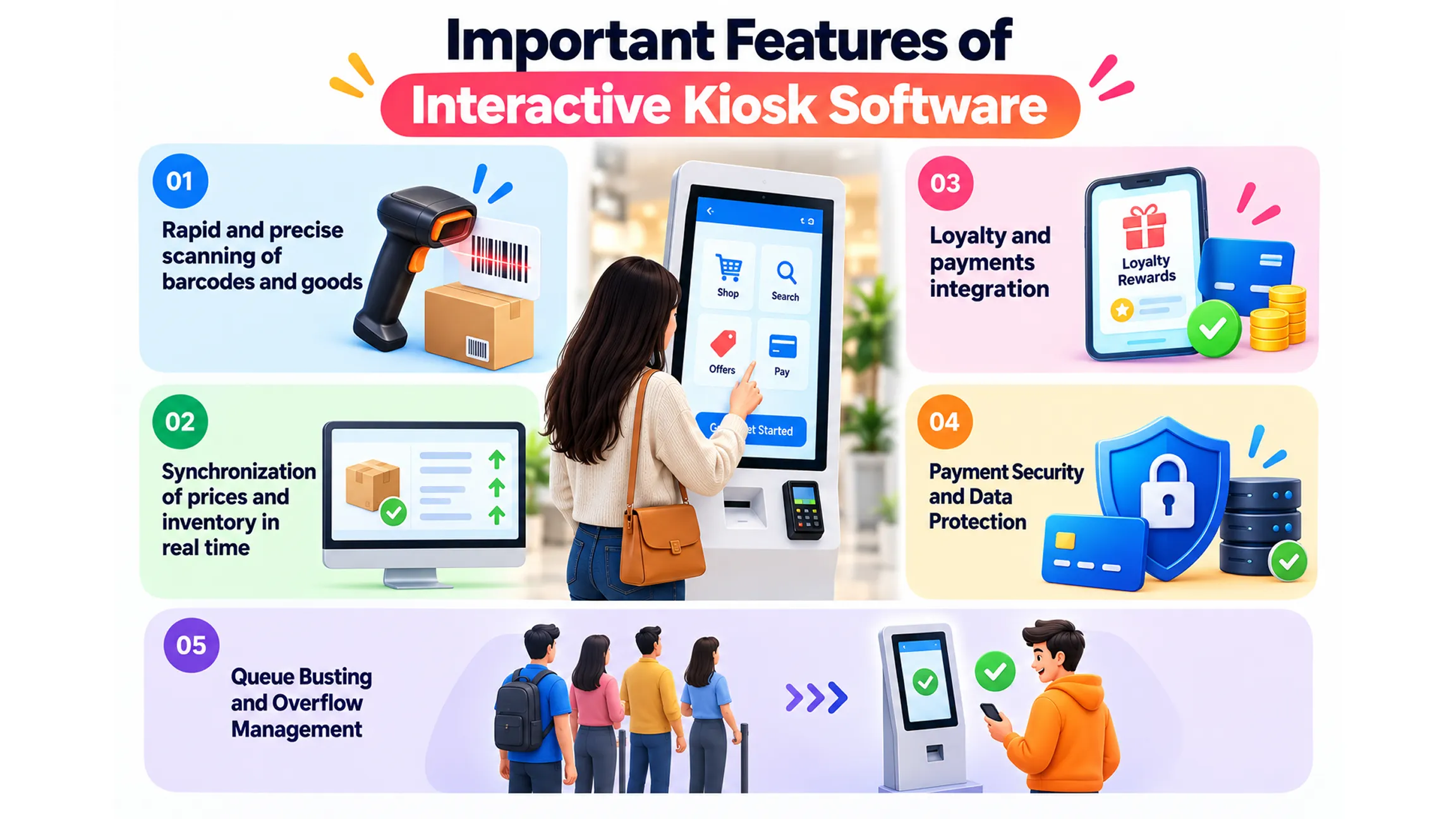
Important Features of Interactive Kiosk Software
Certain features must be present in retail kiosk software in order for it to really decrease friction rather than simply move it elsewhere.
Rapid and precise scanning of barcodes and goods
The fundamental checkout process, an integral part of the interactive kiosk development process, should be able to scan products fast and accurately, including produce and other goods that are not easy to scan due to their lack of packaging. Inaccuracy in scanning can destroy shoppers' trust in a self-service kiosk faster than anything else.
Synchronization of prices and inventory in real time
It is critical for the software to keep up-to-date prices and inventory, because any discrepancies between the two will lead to disagreements and slow down the whole checkout process. This calls for interactive kiosk services that will work with the inventory system in real time, not rely on the periodic updates of the local database.
Loyalty and payments integration
The expectation of shoppers today is to swipe their loyalty cards or applications, use coupons, and make payments using any payment method they want in the same seamless way they would do at a manned checkout station. The software developed by a reputable interactive kiosk development company is expected to integrate these as one seamless transaction instead of a string of separate processes.
Payment Security and Data Protection
As retail kiosks store and transmit sensitive information about customers and payment data, payment security should be integrated into the software at the very early stages of development. This will ensure customer data protection and minimal risks related to payments.
Queue Busting and Overflow Management
During periods of peak activity, the software of a reputable interactive kiosk development company should be capable of managing increased traffic of users simultaneously without experiencing performance issues such as queue busting in case one of the terminals fails.
Features of Interactive Kiosk Software for Retail
| Software Feature | What It Does | Benefit for Retail Businesses |
|---|---|---|
| Barcode & Product Scanning | Scans products quickly and accurately | Speeds up checkout and reduces errors |
| Real-Time Inventory Sync | Connects kiosk data with inventory systems | Keeps product availability and pricing updated |
| Loyalty Integration | Connects loyalty accounts, rewards, and coupons | Makes personalized offers easier to use |
| Payment Integration | Supports different payment methods | Provides a smoother checkout experience |
| Security & Data Protection | Protects payment and customer information | Helps reduce security and data risks |
| Queue & Traffic Management | Handles multiple users and kiosk activity | Helps reduce waiting times during busy periods |
| POS Integration | Connects the kiosk with existing retail systems | Keeps checkout and store operations connected |
| Receipt Management | Provides digital or printed receipts | Gives customers a convenient record of purchases |
Interactive Kiosk Software: Facts and Figures
- Self-checkouts have penetrated about one-third of all US grocery checkouts through FMI/VideoMining’s research.
- Suppliers limiting items in self-checkout lines reduced their waiting times by about 31% in the same research.
- Scan verify software with the help of artificial intelligence has managed to reduce unscanned items shrinkage by about 58% according to ECR Retail Loss.
- Average payback period for supermarkets' self-checkout deployment stands at 13 months according to IHL Group estimations.
Custom Kiosk Software Development by Abhiwan Technology
Established in 2018, Abhiwan Technology is one of the top interactive kiosk development company. This company designs bespoke kiosk software to help retailers implement self-checkout procedures, product lookup stations, and interactive information kiosks in bigger retail outlets. Its team of software developers, designers, and quality assurance engineers create custom software that works with any kiosk hardware and the POS systems of retailers. This software also supports advanced technology such as AR, VR, and gamification that make the company an ideal choice for retail stores wishing to incorporate interactive product configuration, loyalty games, and digital experience kiosks into their offerings. Abhiwan Technology considers the transactional capabilities of a retailer, their business needs, and the current POS systems.
What Software Do Self-Checkout Kiosks Use?
The vast majority of self-checkout systems, just like a well-designed interactive information kiosk, operate using a retail-oriented POS software layer with a barcode and weight validation engine and a payment processing interface based on a Windows or Linux embedded OS. Major retailers tend to use proven self-checkout platforms like NCR or Toshiba, but smaller retailers usually design a customized solution specifically tailored to their current inventory and payment options. In recent years, the self-checkout software increasingly features AI-driven computer vision technology, which verifies items scanned at checkout by comparing them to their visual image and weight, becoming a de facto standard.
Do Self-Checkout Kiosks Increase Retail Theft?
There is much academic evidence to suggest that they do so, at least in the absence of other prevention measures. In fact, according to numerous research studies conducted in the field of retail loss prevention, including those conducted by Grabango and the University of Leicester, shrink rates were found to be higher for self-checkout lanes than for lanes operated by salespeople, and the annual national retail shrinkage rate amounts to several tens of billions of dollars. At the same time, the disparity has diminished in the places where retailers have invested in improved self-checkout software; namely, AI-based scan validation and weight comparison systems helped decrease unscanned shrinkage.
Conclusion
The success of a self-service point of sale depends on the use of interactive kiosk software. Creating such software involves designing a system to account for real-time inventory management, customer loyalty program integration, and loss prevention at all stages, not as an afterthought following a difficult launch. The development partner can choose whether to offer a custom-built system or an alternative to an off-the-shelf product based on a client’s needs, number of transactions, and existing technologies.Abhiwan Technology provides bespoke kiosk software solutions based on retail processes, current systems, and unique needs. Self-service is gradually becoming standard practice for retail operations. However, those that gain the most benefit from the approach are those that consider software to be the product itself, not just an add-on to the hardware.
Written By Vaibhav Karanwal