Mixed Reality Development is changing the way that companies spend money on employee training, with documented cases of training time and cost savings of 40% after organizations leave the classroom training paradigm behind. There are several hidden expenses associated with classroom training that typically do not appear in a straightforward budget item, such as instructor costs, travel, hardware requirements, and downtime because employees are not working during the training period. By implementing mixed reality, organizations can address each of these problems and allow employees to participate in realistic situations without the need for any type of physical rig or training facility or even an instructor present in every training session.
Mixed Reality Development: What Is It?
Mixed reality development refers to developing applications that combine digital objects, such as 3D models of equipment or overlays with some interaction features, with the trainees' physical environment. In contrast to a virtual simulation, mixed reality ensures that the trainee can be aware of his or her physical environment at all times while receiving instructions, information, or warnings in regard to the physical equipment in front of him or her. It is because of the combination of the digital objects with the real environment that mixed reality has proven itself to be an excellent platform for technical training.
Why the Use of Mixed Reality Training Saves 40% on Training Expenses
There are multiple ways through which companies achieve their reported reduction in expenses when they use mixed reality for training purposes.
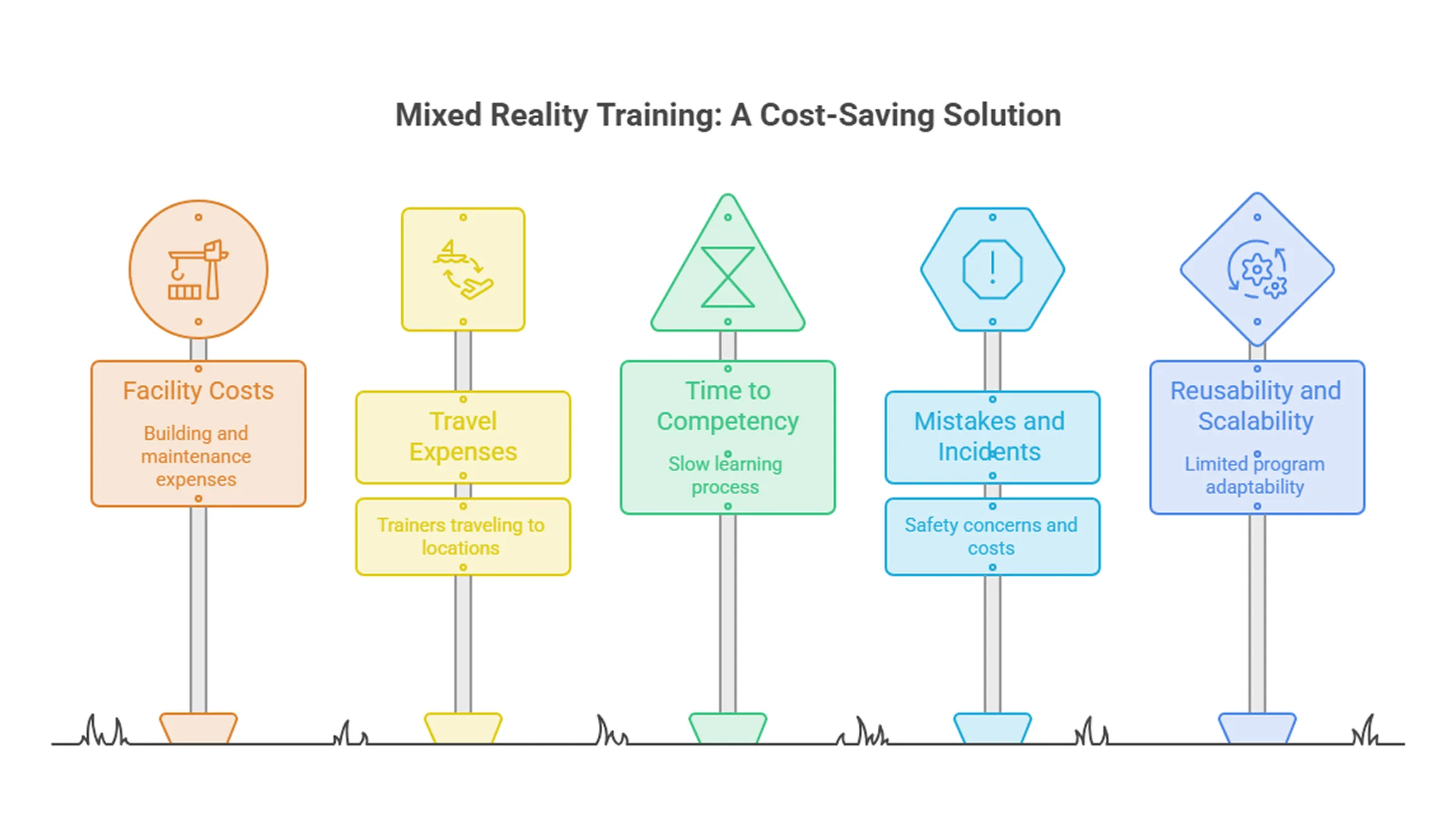
No More Costs for Building and Maintaining Physical Facilities
There are different ways in which organizations can cut down on costs associated with training through mixed reality. A mixed reality development company can help the organization to develop reusable simulations that save the costs of building expensive physical infrastructure while still training workers.
Less Need to Have Trainers Traveling
Technical training can be performed with specialized equipment, mock-ups, and other things that are not used most of the time. Mixed reality technology will substitute all of those physical facilities with virtual three-dimensional environments. This method could also be applied to mixed reality gaming and simulation.
Time Saving to Attain Competency
Employees normally attain competency more quickly by using interactive and practical simulation than by listening to lecture presentations or reading manuals or slides because the way of learning corresponds with how they will perform the task. Time savings in terms of the amount of time required to attain competency result in reduced training hours.
Fewer Mistakes and Safety Incidents
Practicing dangerous tasks in a mixed reality environment prior to performing them on actual devices avoids errors and safety risks associated with the training period. Fewer mistakes in the process of working result in less waste or damage related to training mistakes.
Reusability and Scalability of Training Programs
Mixed reality training modules may be used again and again when recruiting new employees or providing refreshers, or even used at other locations, in contrast to physical training programs that can only be applied at a certain place. The ability to use training modules repeatedly is the key factor that leads to the payback of the development costs within one or two training batches.
Practical Evidence of Cost Reduction through Mixed Reality Development
These cost savings estimates are based on independent studies rather than simply being used for marketing purposes. According to Brandon Hall Group, VR training and mixed reality training have been shown to cut training times by as much as 40 percent compared to traditional training techniques, and companies such as United Rentals have confirmed similar cost savings in the form of reduced training time for their sales teams. A knowledgeable mixed reality development company is likely to highlight statistics such as these when scoping out a project, as they provide valuable context for the expected return on investment. One such example is that of Aisin Corporation, which was able to reduce the training time for new employees by 60 percent after implementing headsets in their training.
Selecting the Right Mixed Reality Development Studio
The choice of the correct partner plays an important role in determining whether such cost reductions will be achieved in particular training. A good mixed reality development company begins with identifying the actual bottleneck of training: this is the time of onboarding, the number of mistakes, and/or travel costs, not with demonstrating a headset. The studio should have a proven track record of delivering tangible results from previous training projects, rather than providing eye-catching demonstrations, because any beautiful demonstration that does not save either time or the number of mistakes will not help you to achieve budget savings.
Mixed Reality Development Services for Corporate Training
Typically, a full set of mixed reality development services includes different specializations.
| Service | What It Includes | Cost Impact |
|---|---|---|
| Scenario and Curriculum Design | Mapping real job tasks into training modules | Reduces rework from poorly scoped content |
| 3D Equipment and Environment Modelling | Realistic digital twins of machinery or spaces | One-time cost, reused across many sessions |
| Device and Headset Integration | Optimization for Meta Quest, HoloLens, or mobile MR | Affects ongoing hardware and support costs |
| Progress Tracking and Analytics | Dashboards showing trainee performance data | Helps prove ROI and refine training over time |
| Maintenance and Content Updates | Keeping modules current as procedures change | Ongoing but far cheaper than rebuilding physical setups |
Mixed Reality Training Techniques in Business Corporations
One of the most common techniques in successful modules involves mixed reality gaming, which makes use of various techniques such as scoring or completing levels to keep users engaged, as opposed to sitting and watching the demo being performed. For instance, safety training may incorporate a task of identifying hazards within a set time limit, whereas sales training can be developed so that trainees earn scores when they manage to deal properly with several customer complaints.
How is mixed reality used?
Mixed reality can be used not only in business training but also for remote assistance, where the technician uses instructions or diagrams displayed on top of real devices, thanks to an expert who controls the process from afar. Mixed reality also enables retailers to give customers an opportunity to see how the product will look in their personal environment, and is applied by surgeons to practice complicated procedures on a virtual model prior to performing surgery on a real patient. To create all these solutions, many teams use mixed reality development services.
Which is safer, AR or VR?
AR technology is deemed relatively safer than VR for the performance of activities within a shared or moving environment because it enables users to see all real-world elements while virtual content is being displayed in the environment. VR technology completely blocks the sight of a person from real-world elements; thus, there is a risk that users may trip over unseen things or bump into other people or equipment within a physical environment. That is why most training courses employ VR technology in a dedicated environment, but not AR technology.
Conclusion
The Mixed Reality Development process can provide a quantifiable reduction in training costs for corporations, backed up by research and cases involving companies that show potential cost reductions of up to 40 percent in both time and money involved. This results from several advantages provided simultaneously, among which are decreased costs of equipment, travel, accelerated skills learning process, and reusability of training assets across a number of hires and locations. It should be emphasized that the choice of a skilled partner developer becomes just as important as the technologies used because any cost savings will depend on whether the program is designed specifically for the training needs of the company rather than a general demonstration.
Written By Charu Sharma