A Mixed Reality Development Company assists businesses in the implementation of digital content and physical surroundings to enhance how work training and product visualization are delivered, increase interaction and cooperation between users or consumers, and integrate operations and communication. In essence, MR allows digital information to show up as and behave like real-world data on any display device to deliver a much more useful kind of information interaction to both consumers and workers. Business seems to be changing rather fast, as industry analysts have forecasted a reported 2026 estimate of $11.68 billion for the global market of Mixed Reality to become $44.94B by 2030 and with Android XR widening their available developer programs to support Unity, Unreal Engine, and Godot, allowing easy access for any business and worker for an increased amount of use and access of immersive computing technology.
What Is Mixed Reality and How Does It Work?
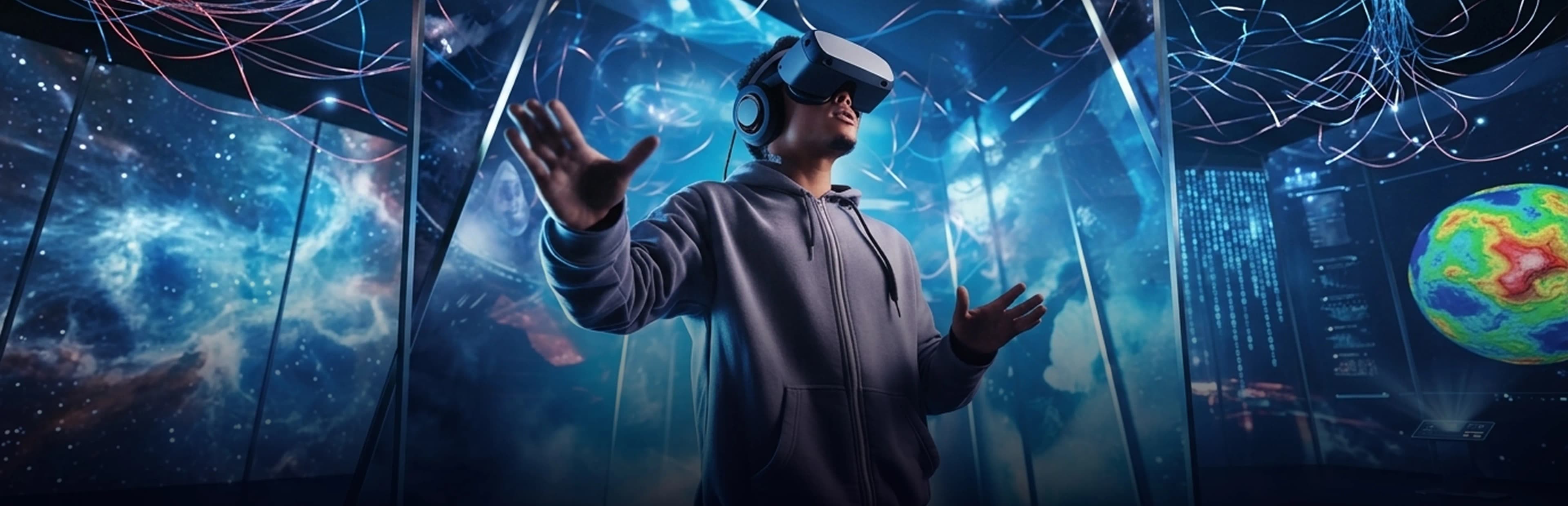
Mixed reality, or MR, merges real-world elements with virtual ones and simulates interaction between them in a living, dynamic environment. With regular screen overlays, there's no spatial dimension or real-time interaction, while with MR, virtual objects and interactions become deeply rooted in physical space and are integrated into one's natural interactions with their surrounding space. Use of mixed reality development includes: Training, product demonstration, remote collaboration and assistance, product design, surgery, retail and in-store and in-home commerce. MR utilizes the following technologies-cameras, sensors, spatial mapping, computer vision, and 3D content-to interpret and reconstruct user space: Digital content can appear realistically positioned or move with user inputs. Mixed reality is beneficial for companies hoping to engage users by allowing them to learn via firsthand, in-context experiences rather than a standard screen interaction.
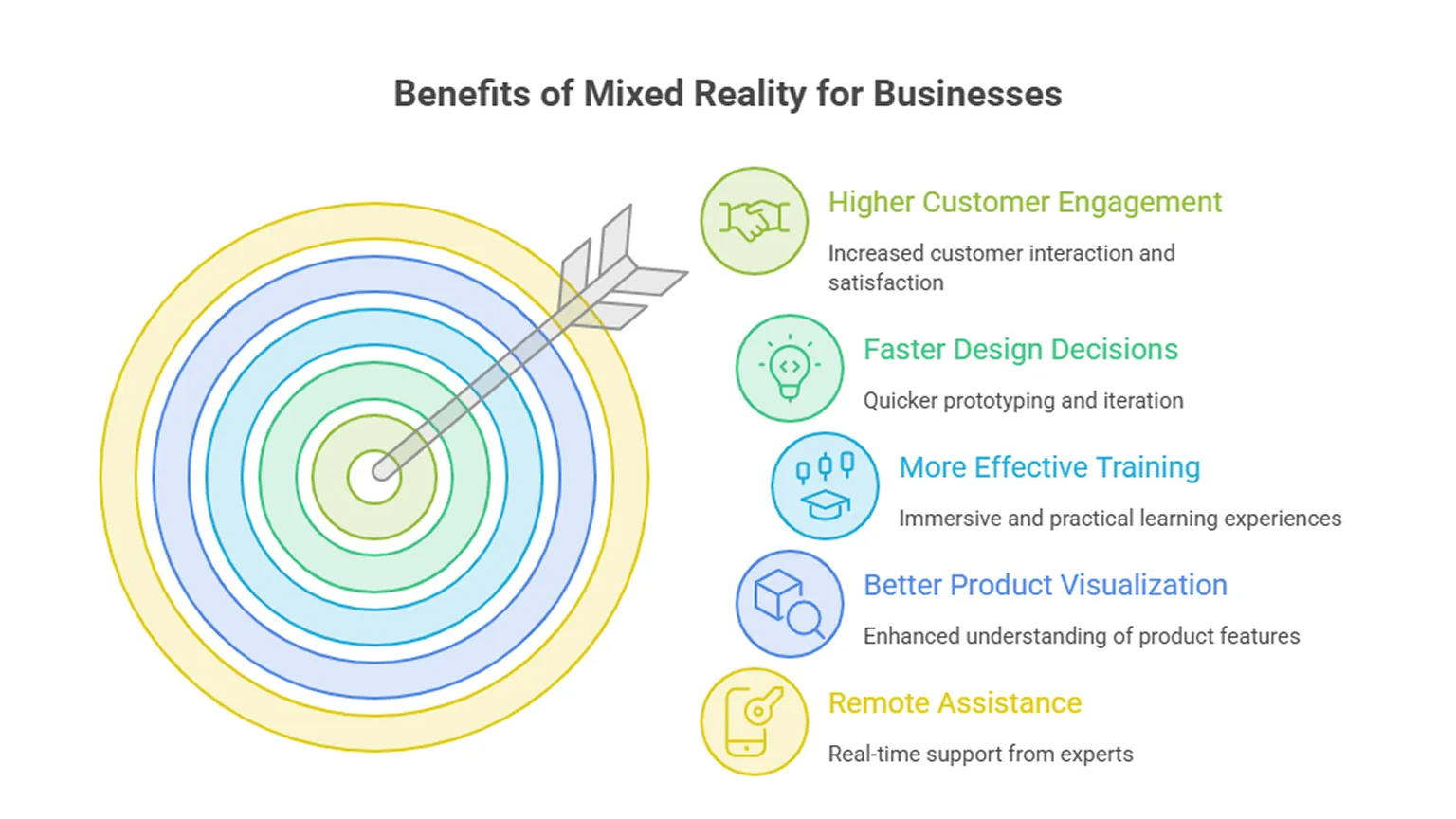
What are the Key Benefits of Mixed Reality for Businesses?
Businesses can use mixed reality to improve training, product visualization, collaboration, customer engagement, and everyday workflows. A Mixed Reality Development Company can design experiences around specific business goals, helping organizations use immersive technology where it can deliver practical value.
Better Product Visualization
Companies have the capability of using realistic 3D models of their products prior to manufacturing. This way, the teams can better comprehend their designs and physical specifications, and mixed reality gaming illustrates the performance of the interactive elements within the actual environments.
More Effective Training
Virtual simulations grant employees permission to execute complicated procedures without continually utilizing real equipment. Through mixed reality development services, companies put together an environment in which the learning activities could be performed in a controlled way.
Faster Design Decisions
Using digital prototypes lets teams view models on the correct scale and spot potential design flaws sooner. Therefore, mixed reality development enables faster collaboration between designers, engineers, and decision-makers before any physical changes are made.
Remote Assistance
MR technology can provide workers with immediate help from remote experts when they carry out technical work. Digital guides, annotations, and 3D models can appear in the operator’s environment and help reduce dependence on manuals and phone support.
Higher Customer Engagement
The interactive nature of product experiences will help clients better understand complex functionalities of products compared to regular pictures or videos. A Mixed Reality Development Company can create an experience that allows customers to study product offerings and compare and use products.
How Can a Mixed Reality Development Company Support Business Growth?
A Mixed Reality Development Company can help businesses turn immersive technology into practical solutions for customers, employees, and internal operations. The right approach focuses on business goals rather than technology alone.
Business-Centered Strategy
To start with, it's important to detect the challenge the company faces, identify its audience, and determine what the outcome should be. This helps to ensure that the MR experience will be purposeful and eliminate any difficulty in development.
Custom MR Solutions
There are many sectors where they implement different immersive experiences. Mixed reality development services can be adapted to different sectors, including training, product visualization, health care, manufacturing, retail, education, and others.
3D Content Development
Realistic 3D models help users understand products, machines, surroundings, and prototypes. Developers can optimize the models to ensure their performance on various supported devices.
Hardware Compatibility
MR applications can function on headsets, smart glasses, and other devices with various technical characteristics. Assistance from a Mixed Reality Development Company can allow one to streamline the experience according to the hardware and environment of the user.
Scalable Experiences
Organizations require solutions that evolve alongside their needs. A thoughtfully designed mixed reality development strategy permits businesses to add more features, digital assets, users, and novel use cases without the need to create a new experience.
What Are the Real-World Applications of Mixed Reality?
Mixed reality is moving beyond demonstrations and into practical business environments. Its ability to connect digital information with physical surroundings makes it useful wherever employees, customers, or professionals need to understand, visualize, or interact with complex information.
| Industry | Use Case | Business Benefit |
|---|---|---|
| Manufacturing | Assembly & equipment guidance | Fewer errors and faster operations |
| Healthcare | Medical training & 3D visualization | Better learning and practice |
| Retail | Virtual product visualization | Improved buying decisions |
| Education | Interactive 3D learning | Easier understanding of complex topics |
| Entertainment | Immersive experiences & gaming | Higher audience engagement |
Manufacturing and Engineering
Manufacturers can employ MR for machine visualization, component inspection, and assembly support. Mixed reality development services are also able to add step-by-step wayfinding that would give workers the information they need while letting them stay focused on the physical task.
Healthcare and Medical Training
Medical facilities can benefit from the use of immersive models aimed at understanding anatomy, procedures, and clinical situations. MR can aid training too by allowing students and specialists to examine 3D constructions and conduct selected operations in the lab.
Retail and E-Commerce
Retailers may provide consumers the ability to picture items in their homes prior to purchasing. Furniture, appliances, cars, and more get enhanced by interactive activities that make comparisons easier and decision processes less complicated.
Education and Training
Educational institutions can apply mixed reality to ease the process of learning experiences. For example, A Mixed Reality Development Company is capable of producing simulations or 3D models and educating learners via practical experiences.
Entertainment and Gaming
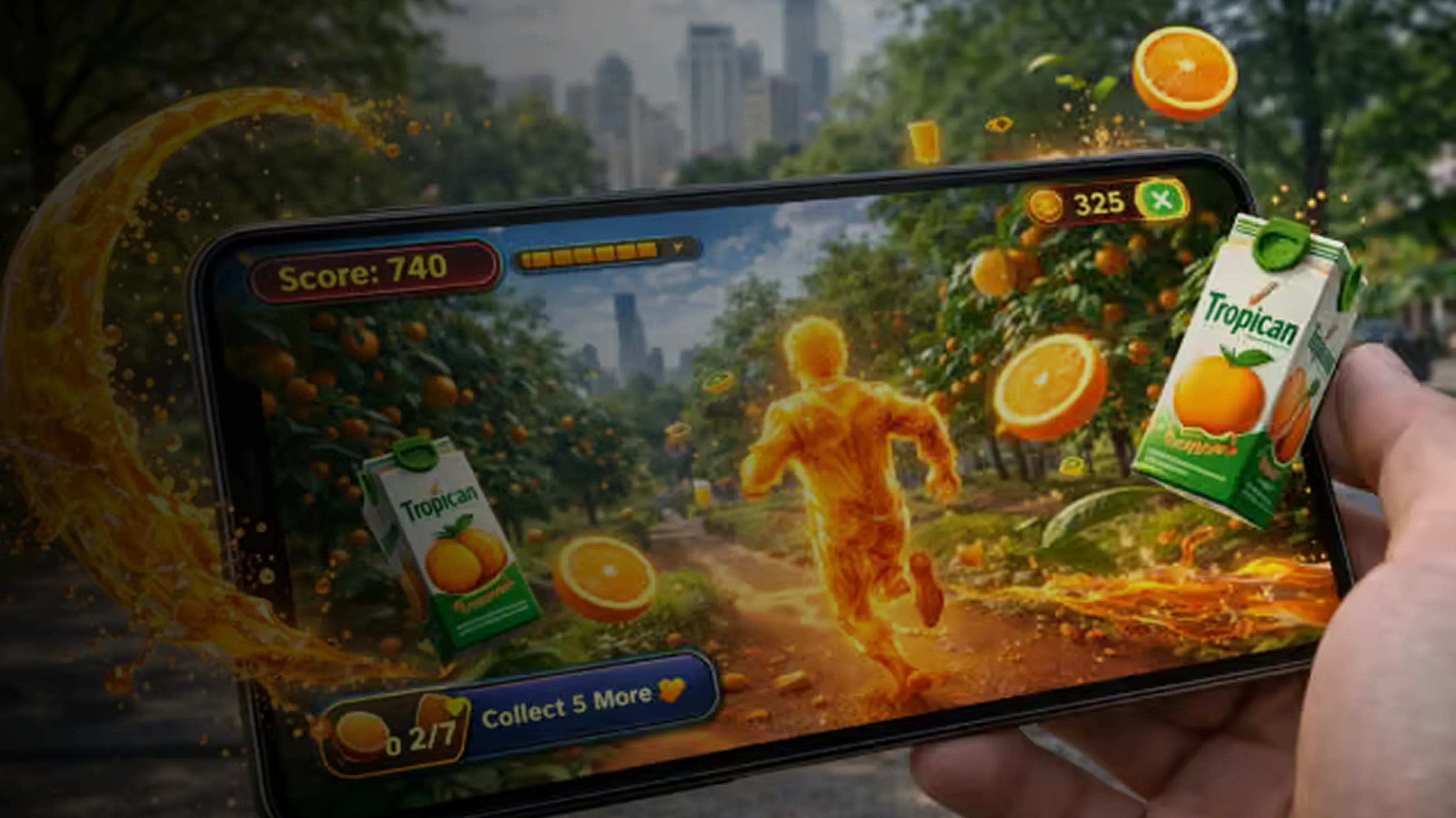
The entertainment sector can engage both the real-life setting as well as digital characters, objects, and challenges. Mixed reality gaming is able to produce experiences that involve real space and virtual information in an interactive manner.
What Are the Latest Mixed Reality Trends for Businesses?
Mixed reality is evolving as businesses move from experimental demonstrations toward practical applications. Recent developments in spatial computing, AI, immersive training, and XR hardware are making MR experiences more interactive and useful across different industries.
AI-Powered Experiences
Artificial intelligence plays an important role in the development of interactive experiences. Business organizations can utilize AI technology to enable natural interaction, intelligent virtual assistance, personalized information, as well as context-aware guidance.
Spatial Computing
In addition, spatial computing earns its place in the XR field. Today’s devices improve their understanding of the environment, manage to fix digital objects in real-world locations, and respond to changes in the real world.
AI and MR Integration
Thus, the combination of AI and mixed reality development may ensure better adaptability of applications. For instance, MR solutions can interpret user actions and provide necessary instructions.
Enterprise Training
The world of business is steadily turning towards immersive teaching in areas of technology, industry, health care, etc. Mixed reality development services allow for creating repetitive simulations that give employees an opportunity to rehearse standards and processes in non-physical environments.
Growth of Immersive Gaming
The video game world is still in search of ideas that would combine something valuable in the video game landscapes and in the real world. Mixed reality gaming industry enables to merge the physical location of gamers plus have some virtual characters and obstacles in the game.
How Does Mixed Reality Work?
Mixed reality utilizes a mixture of cameras, sensors, spatial mapping, computer vision, and 3D rendering to identify the user's environment. The technology can determine surfaces, distances, movements, and how objects are placed in a certain space, and embed virtual items into the environment. These items may stay in place and respond to the user's actions. For instance, a digitized machine part may appear next to actual machinery, providing further explanations on how to use the equipment. This feature of linking up digital information with physical locations makes mixed reality different from conventional screen applications and allows for more effective experiential training, observation, and collaboration in various fields.
What’s the Difference Between AR and Mixed Reality?
When it comes to augmented reality, it is all about utilizing digital information or visual elements on top of the physical world the user sees. Mixed Reality offers more than that, as it enables digital objects to recognize and function in the environment. The application of AR can show details of a physical device, and the one based on mixed reality can place a virtual object in the real world and engage with it. Although the differences may overlap at times, since many modern XR technologies are based on similar hardware and software, the major aspect that differentiates them is the capacity to perceive and interact with physical and digital objects. This is why mixed reality is widely used in many recent immersive simulations, product design projects, and technical or interactive guidance, which enhances the user experience.
Conclusion
A Mixed Reality Development Company is not only beneficial for implementing immersive technologies within different types of business sectors but also helps enhance their communication and operations regarding their products, service delivery processes, and the ways of interacting with consumers. Mixed Reality technology can also definitely help greatly in visualizing product information, making it more fun and simple for users. The growing popularity of spatial computing and AI contributes to the emergence of more innovative services and products. But companies that want to get their MR project off the ground need to think a lot before starting to work on it. They should start with identifying the problem they want to solve and then subsequently think about the functionality of the product, the possible technical solutions, and how they can be developed from a long-term perspective.
Written By Charu Sharma