Game development outsourcing is often more affordable and faster to start, while in-house development gives you full control and keepsin all information within your organization. There is no one-size-fits-all strategy, and the best choice always comes down to your budget, timeline, and capabilities, as well as how much of the game concept you wish to retain. This guide compares in-house vs outsourced game development on the 3 things that matter to both producers and founders: cost, control and delivery. You will learn when a hybrid is the right choice, how to select among game outsourcing studios and avoid pitfalls.
In-House vs Outsourced Game Development: Quick Comparison
| Factor | In-house team | Outsourcing |
|---|---|---|
| Cost structure | Fixed: salaries, benefits, hardware, office | Variable: pay per project, milestone, or month |
| Time to start | Slow: hiring takes months | Fast: weeks, once a partner is chosen |
| Control | Highest: you manage every task | Shared: you manage outcomes, not people |
| Scaling up or down | Hard and slow | Easy: change the contract |
| Specialist skills | Limited to who you can hire | Broad: partners often have niche experts |
| IP and security | Easier to protect | Needs contracts and access controls |
| Management load | Entirely yours | Shared with the partner |
What Is In-House Game Development?
In-house game development: your own people develop the game. This is where you hire designers, artists, engineers, and testers, and provide them with tools and direction. This is the classic studio model, and it's a great choice if you want to build on a tech for several years and have a stable, dedicated staff familiar with your players.
What Is Game Development Outsourcing?
By outsourcing game development, it means the game is developed by an external studio. It can be done in various ways:
- Task-based outsourcing: 3rd party is responsible for one item, such as 3D art, animation, QA, or porting.
- Concept to deployment: a game development company develops a project from start to finish.
- Co-development: your partner collaborates with your team, but requires you to use their tools and pipeline.
The partner owns the end product and investment in people. The partner is responsible for recruitment and investments and day-to-day management of its own teams to deliver game development services.
In-House vs. Outsourced Game Development: Cost Comparison
The true cost of in-house work. An outsourcer called Whimsy Games says that overheads (software, rent, hardware, taxes) would add 30-40% on top of base salary. So if a developer makes $80,000 a year, it would cost about $104,000-$112,000 to have them in your house, once those extras are factored in. Then there's the cost of hiring them in the first place, and of replacing them.
Game studio hiring may have a long lead time in more competitive markets. They can take months to find senior engineers and technical artists, delaying the project.
How much outsourcing actually is. Outsourcing replaces fixed costs with variable costs. The studio's rate includes its own overheads, its equipment, and its leadership. The same Whimsy guide estimates about £30-50 an hour for a Unity or Unreal engineer in Eastern Europe and about £20-40 an hour for art in some parts of Asia. These are one vendor's numbers, so get a few prices before budgeting. Outsourcing also has its costs, your briefing and debriefing time, revision rounds when the brief is unclear, and integration work when the partner's code or assets show up.
The rule of thumb. In-house is less expensive by the hour if your people are running at full capacity year-round. Outsourcing is less expensive if the work arrives in fits and starts, requires a specialty skill, or is time-sensitive.
Control and Quality
You have the most control when you work with your in-house team. You control priorities day to day, set the tempo of work, and maintain in-house design expertise. Feedback is immediate, because everyone is in the same chat or room. This is crucial for a core gameplay loop, where small design changes determine the feel of the game.
When you outsource, you change from managing people to managing results. You will have a little less daily control and much more risk, as quality is defined by the partner. Great partners have seen many projects, understand the landscape, and find your issues quickly. Mediocre partners give you work that does not match your style and ends up costing you weeks in rework.
You may help safeguard quality by:
- Prepare a well-written brief with references, a style guide, and technical constraints.
- Allow work in phases: first use a grey-box, then a vertical slice, then content.
- Your own source control, task tracker, and build pipeline for work transparency.
Delivery Speed and Scalability
Game development is not linear. You could have a handful of designers in pre-production, dozens of artists through production, and a small live-ops team after a game launches.
In-house teams are slow to expand and costly to downsize. Hiring takes months, and layoffs create morale and reputation problems. If you need ten more artists for three months, it is seldom worth hiring them.
The outsourcing company can ramp up or down by changing the contract. Existing teams have set processes, so they can often start working in weeks.
Time zones require planning. Whimsy observes that teams often see a 12-to-24-hour delay in responses when they are significantly remote from each other, and suggests at least two-to-three hours of comp overlapping. Weekly video calls and annotated screens stop the delays.
IP Protection, Security and Confidentiality
Having all your work in-house is helpful for safeguarding pre-production artwork, design, and code. If you outsource, you need to be clear on the rules from day one:
- Sign an NDA and contract that explicitly states you are the owner of all IP.
- Only share the data the partner requires and keep using access controls on repositories and file storage.
- Choose pay by milestone, so you have the advantage until the work is handed over.
- Find out how the studio handles data and what measures are in place to keep your files safe.
The Hybrid Model: Maintain Your Core, Delegate the Rest
In most cases, studios don't go down the either-or path. They retain game design, narrative, and lead engineering in-house, as those are what make the game, whereas the heavy lifting, asset creation, QA, porting, or live ops is outsourced.
It gives you creative flexibility on the experience and additional capacity when you need it. It also keeps the permanent team to a smaller, more stable number. Whimsy CEO believes the question is not really around whether outsourcing is cheaper or not, but whether your production pipeline can evolve with change. One approach is co-development with a team working within your pipeline.
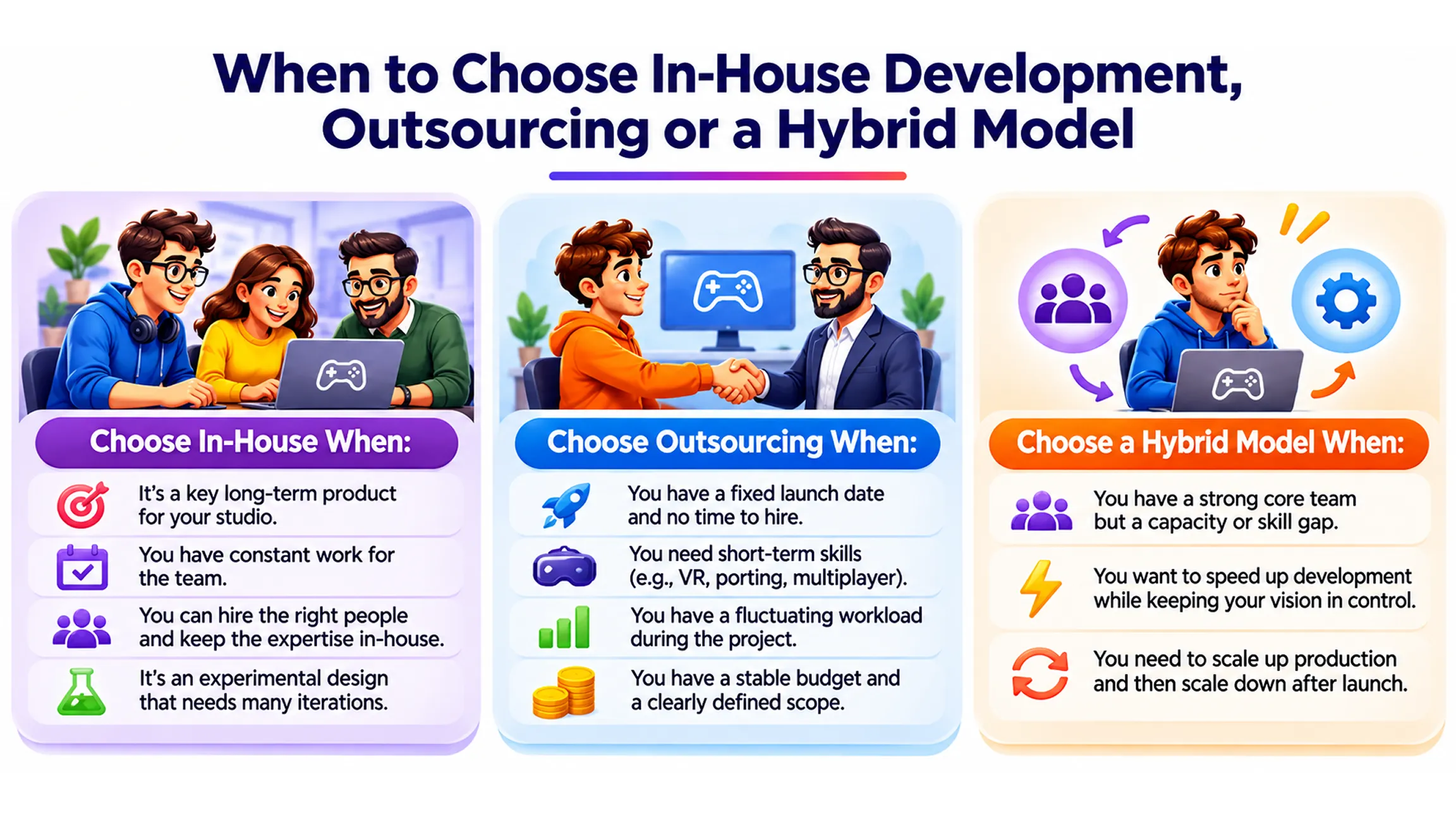
When to Choose In-House Development, Outsourcing or a Hybrid Model
In-house is the best option if:
- This game is the most important long-term product of your studio.
- All of you have constant work for the entire team.
- You can hire the right people, and you want to keep the smarts.
- This is an experimental design and requires many detailed iterations.
Outsourcing is better when:
- You are committed to a set launch date, and you don't have time to bring new hires on.
- VR, porting, and some specialised multiplayer work are skills you will not need for long.
- You have a fluctuating workload during the project.
- A stable budget for a well-established scope.
Hybrid appears to be the best fit when:
- You have a robust core team, but you have a capacity/skill gap.
- You want to accelerate while still holding on to your vision.
- You anticipate that you will increase your production capacity and then decrease it again after your product is launched.
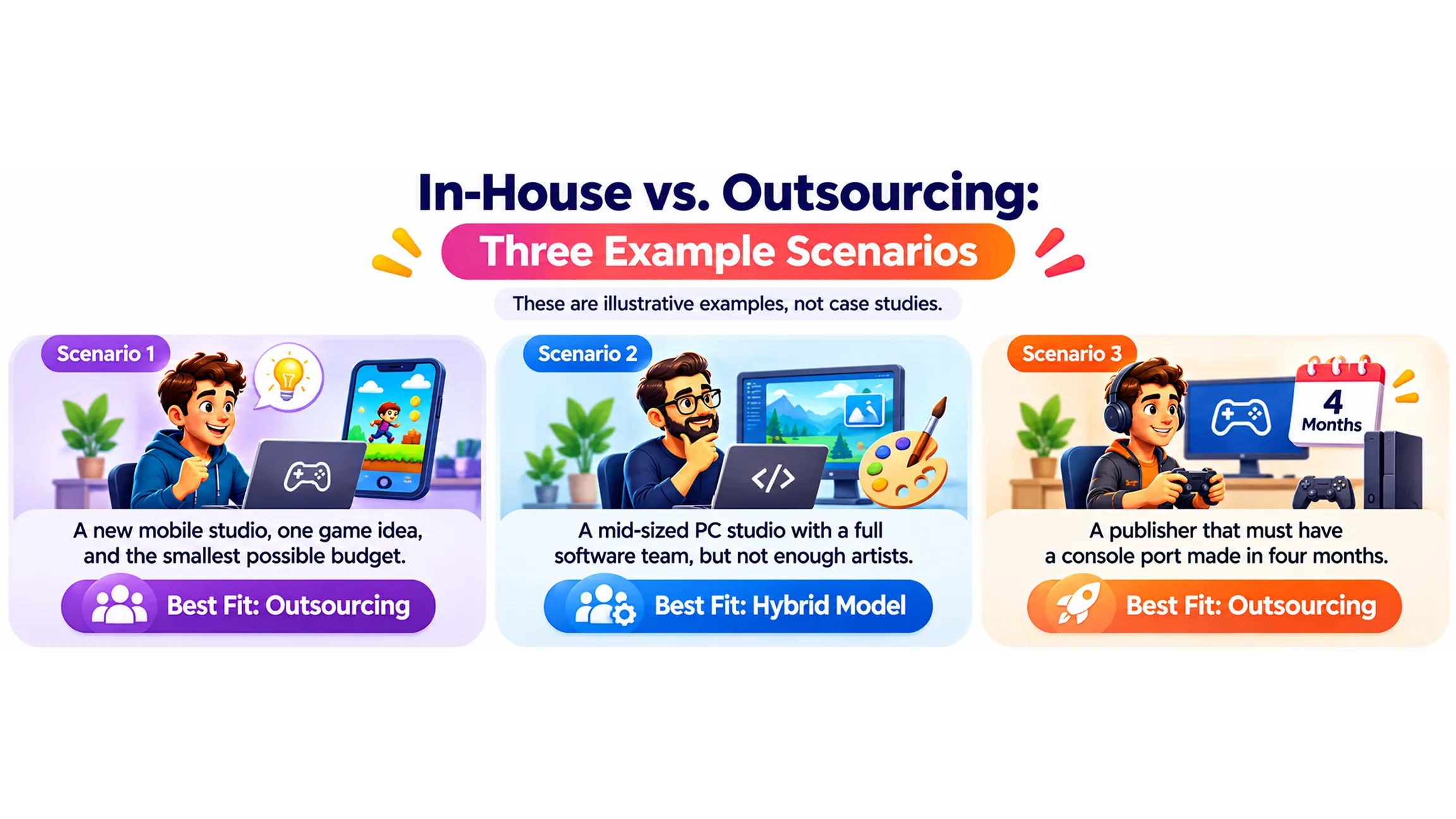
In-House vs. Outsourcing: Three Example Scenarios
These are illustrative examples, not case studies.
A new mobile studio, one game idea, and the smallest possible budget. Bringing a full team on early to develop a concept carries a high risk. Rather than outsourcing to a game development company and maintaining control over design & product, reduce upfront costs and accelerate the time-to-game.
A mid-sized PC studio with a full software team, but not enough artists. It retains engineering and design staff in-house, and rents 3D character and environment art (milestone-based). The core staff is maintained at a small size, with the art pipeline expanding when needed.
A publisher that must have a console port made in four months. It doesn't make sense to hire people who do consoles for one project. A partner with console development and submission knowledge already in place can perform faster.
How to Choose Among Game Outsourcing Studios
Consider the following before signing:
- Portfolio fit: have they shipped games in your genre, on your platform, and with your style of art?
- Team and process: Who will be doing the work on your project? How will progress be communicated?
- Integration: Can they work with your tools and pipeline as opposed to being a vendor in their own right?
- Communication: Ask about the overlap hours, review cycles, and who your day-to-day contact will be.
- References: Ask previous clients about deadlines, quality, and how they resolve issues.
- Terms of contract: Who owns the IP, our terms for payment, how many stages of the project there are, and what happens if the relationship comes to an end.
If you need an end-to-end partner, seek a vendor that offers game development services on a single platform: design, art, engineering, testing, and support so ownership is clear. A well-rounded partner will also help you plan a realistic game development timeline, question your scope, and let you know if any of the work should stay in-house.
Common Mistakes to Avoid When Choosing a Development Model
- Unclear briefs. "Keep it presentable" can lead to revisions. Supply references, restrictions, and acceptance standards.
- Basing the decision on price alone. The lowest quote can sometimes be from a junior member of staff or poor management.
- Micromanagement. An hourly check-in is not the path. Define progress milestones, and believe in the partner's managers.
- Final justice. Reassess work in phases.
- Design outsourcing of the core. You shall keep the idea and the feeling.
- As easy as it is to underestimate recruitment timelines and costs.
Conclusion
It's not black and white when it comes to in-house vs. game development outsourcing. In-house provides the benefits of familiarity, full control, and long-term in-house expertise. Outsourcing offers various levels of speed and flexibility as well as broader expertise without long-term resource commitments. The right decision will depend on your project deadline, expertise requirements, and budget, so take the same approach here: weigh up your needs and choose the right model.
Written By Vaibhav Karanwal