
The realistic game development timeline starts at 6-12 weeks for a hyper-casual mobile game and up to 3-5 years for an AAA title. Most commercial game development projects take longer: from 3-6 months for a casual game to 6-12 months for a mid-core mobile game, and 6 months to 2 years for an indie game for PC.
If your question is how long it takes to make a game, then the only helpful answer is in stages. This guide shows you the game development process timeline from scratch to support after the launch, then explains how different scope, team, platform, and revision requirements affect the timeline. It helps to be ready to discuss it with a game studio before you set the deadline.
Game Development Timeline at a Glance
2026 guides from game studios such as Game-Ace and Algoryte cover the same ranges of timelines for development, yet numbers vary depending on a team and project scope nd the type of game development services required. The table gives a brief overview of them.
| Game type | Typical time to launch | Typical team |
|---|---|---|
| Hyper-casual mobile | 6–12 weeks | 3–5 people |
| Casual mobile | 3–6 months | 5–8 people |
| Mid-core mobile | 6–12 months | 8–15 people |
| Mobile RPG | 12–24 months | 15–30 people |
| Indie PC or console | 6–24 months | 2–10 people |
| Large AAA game | 3–5+ years | 100s of people |
They span one full cycle of production, starting from a chosen design and ending at a finished product. These are separate from the soft launch, marketing campaign, and operations phases that lie above them.
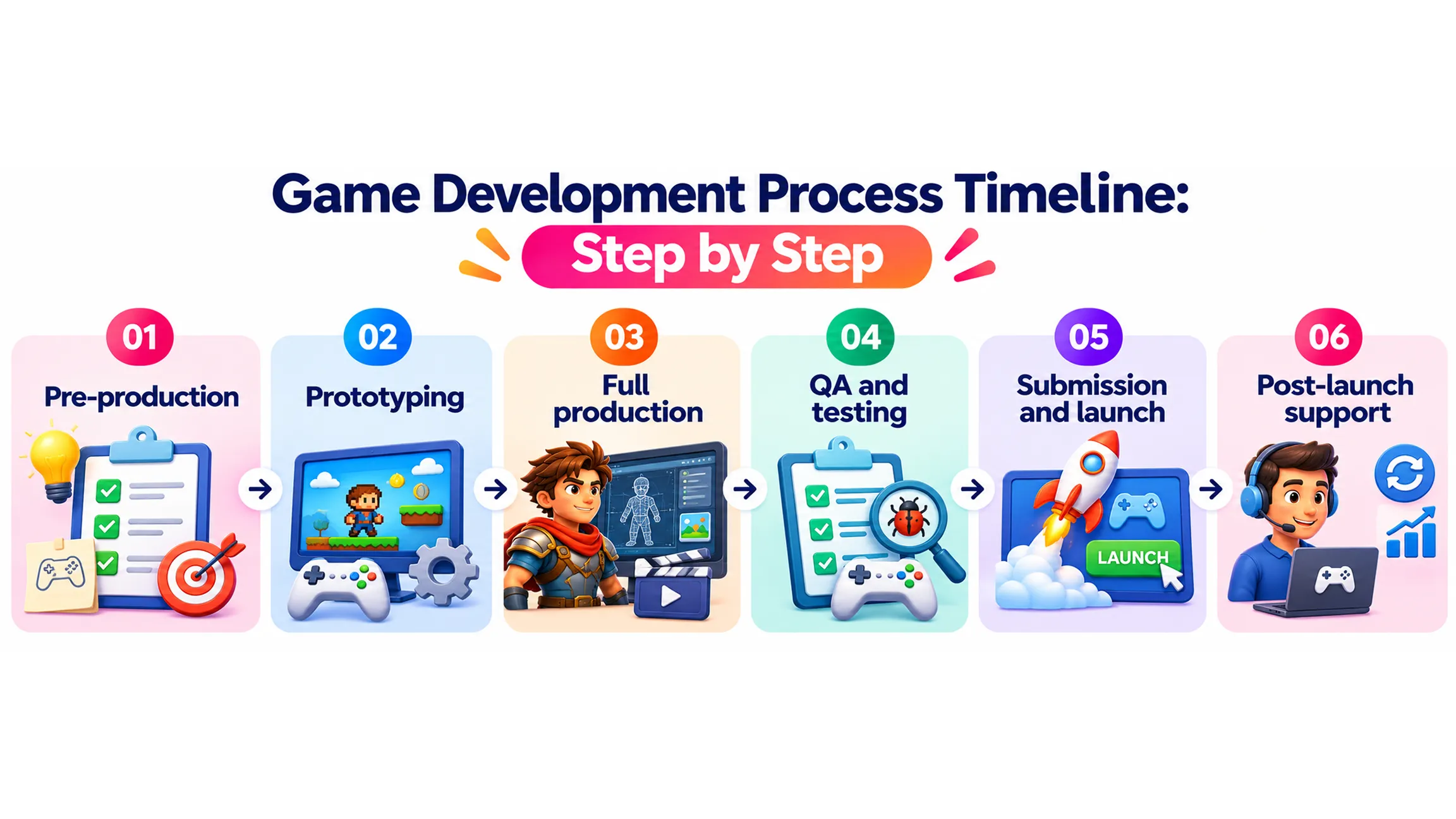
Game Development Process Timeline: Step by Step
Every game development studio follows more or less the same series of steps. What varies between a casual game and an RPG is the time spent on each stage, which directly affects the overall game development cost. Here you can see the typical duration of each step based on estimates from different studios.
| Stage | Typical duration | Main output |
|---|---|---|
| Pre-production | 2 weeks – 3 months | Game design document, technical plan, schedule |
| Prototyping | 3 weeks – 4 months | Playable test of the core loop |
| Full production | 2 months – 3 years | Feature-complete game |
| QA and testing | 2 weeks – 6 months | Stable, optimised build |
| Submission and launch | 1–3 months | Live release |
| Post-launch support | Ongoing | Patches, updates, new content |
However, stages may overlap; that is why it is not possible to simply sum up their time frames. For instance, testing takes place simultaneously with production.
Stage 1: Concept and Pre-production
This is the planning stage. The game concept, target audience, platform, art style, and mechanics are elaborated at this stage and put down in the game design document. At this stage, the team decides on technical details, engine choice, and backend decisions, and sets the milestone schedule and budget.
The time frame depends on the complexity of the game. Game-Ace says that a casual game takes 2-4 weeks, a mid-core game with a backend takes 4 to 8 weeks, while an RPG/MMO takes 8-16 weeks. Premature rushing through this stage is a typical error because any mistakes found there can be fixed much cheaper than during production.
Stage 2: Prototyping/Proof of Concept
It is needed to see if the core loop is playable and implementable before starting production. It consists of placeholders only.
Algoryte allows one to four months for design and prototyping, and several rounds can be required. In the case of a mobile product, Game-Ace estimates six to ten weeks for a casual MVP and ten to sixteen weeks for a mid-core MVP. Those studios that bypass this phase end up losing more time on the rescope later than what the prototype would have cost.
Stage 3: Full Development
The development process is the longest and consumes the most resources. Programmers code the game systems, artists create characters and environments, designers create the levels, and add audio. Many teams aim for an alpha, when the core loop and the major game systems are functional, followed by the beta, which is the game itself with full content, performance optimization, and monetization. The development time varies greatly depending on the complexity of the game, from a few months for a casual product to a few years for a big AAA game.
Step 4: Testing & Quality Assurance
QA consists of functional testing, performance, device compatibility, balancing, and, in the case of an online game, multiplayer stability. Algoryte places the testing step in the 2-6 months range; however, QA should be done throughout development, not at the end. Plan additional time for a wide device matrix in case of Android or console certification. Not performing QA or trying to squeeze it into the schedule is normally followed by bad reviews and costly fixes.
Step 5: Submitting to App Stores & Soft Launch
Store submission is an unchangeable part of the mobile timeline. According to Game-Ace, Apple’s review gives its decision within 24-48 hours in case of a simple build, but the first submission with in-app purchases or accounts can require one or two rework cycles. The same can happen in case of a first Google Play submission from a developer who opens a new account. Soft launch (limited release in selected markets to check out how good the retention is) requires an additional 4-8 weeks in case of casual & midcore games and a longer period for RPGs.
Stage 6: Post-Launch Support
Launch is not the finish. Bugs, platform maintenance, balance, and content keep coming until the game dies. According to Game-Ace, yearly support on live mobile games amounts to between 20% and 40% of the build work originally done, while live-service and RPGs fall towards the higher end or even above.
Factors That Influence the Development Process
Games of the same genre may be finished several months apart. There are four major reasons for this.
Scope & Complexity
This is the primary one. Complexity is influenced by the number of interrelated systems (economy, progression, social mechanics, live events), art assets, and the content created. Runner and RPG mobile games are both mobile games, but they can differ in development time by at least a year. Backend development is also a significant aspect that includes accounts, cloud saves, and matchmaking.
Size of Team and Experience
The more people, the less time it will take, but not in a linear way. According to Game-Ace, even doubling up a team of five casual members does not mean that the schedule will be halved because of handovers, code reviews, and integration. It is important not only how many people there are but also how experienced they are. Onboarding will take an additional one to three weeks.
Platform and Engine
Building for both iOS/Android and for PC/console means doubling development time because of platform certification, hardware fragmentation, and specific requirements of each particular store. Using the engine becomes important: Unity and Unreal have pre-built tools that make the development process easier, and a team that already knows how to use the engine will work quicker than a team that still needs time to learn it.
Revisions and Approvals
Inability to resist changes will make your development cycle much slower. Last-minute revision of the scope of work, redesign of the game's graphics after the first working prototype, new requirements in the middle of the project all those changes can easily delay you by several days or even weeks. The same is true for slow client approval: a single decision-maker works faster than a committee.
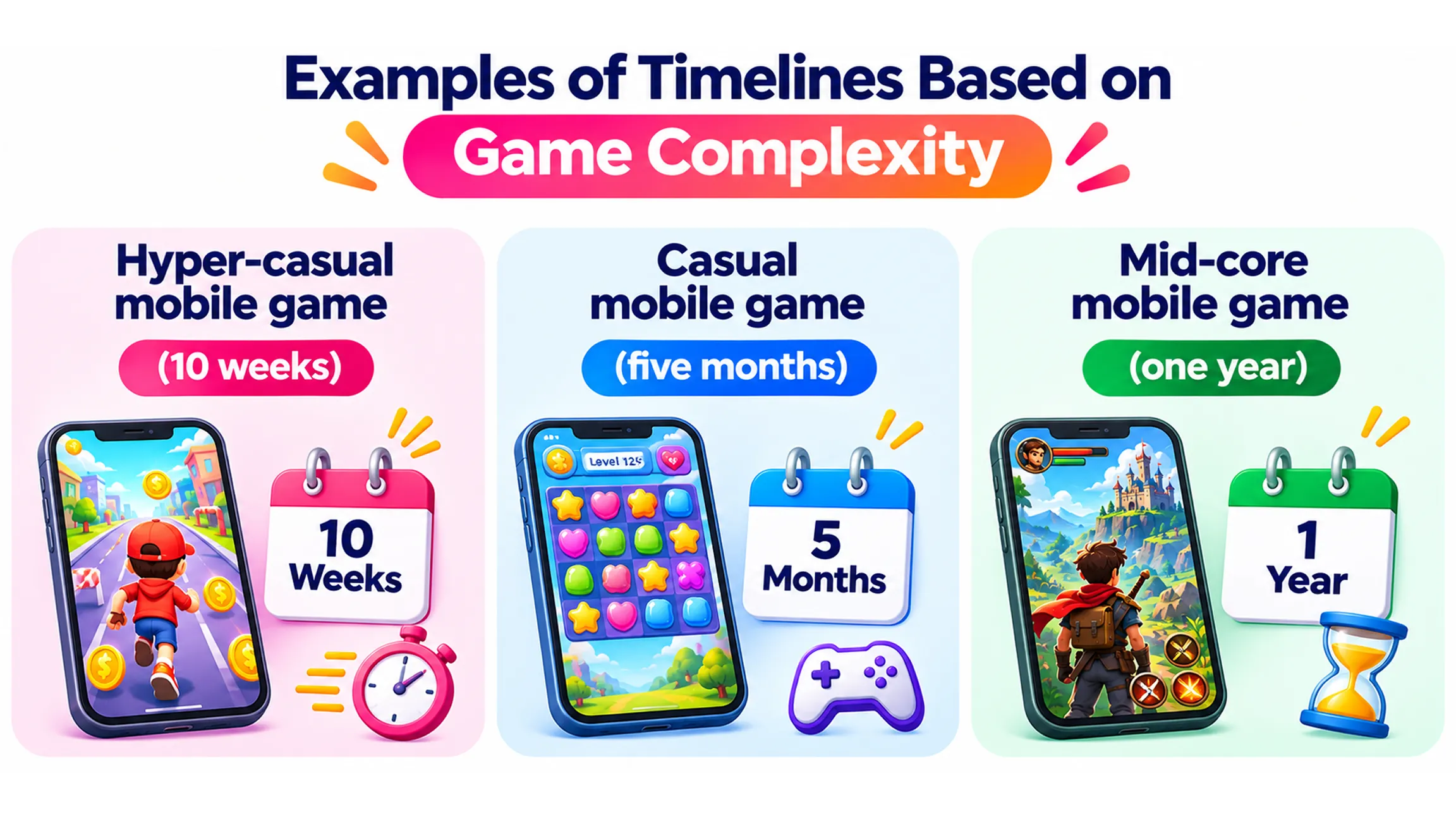
Examples of Timelines Based on Game Complexity
Below are three examples to show how all the stages can be connected. These are planning examples based on the above ranges and do not represent any quotes.
Hyper-casual mobile game (10 weeks). Pre-production will take one week, prototyping one to two weeks, production five weeks, and testing/submitting to the store another two weeks. A three-to-four-person team working on one mechanic and one art direction can develop at this pace.
Casual mobile game (five months). Pre-production is scheduled for three weeks; prototyping – four weeks. The process of production lasts three months, testing is done in parallel and hardening of the product lasts three weeks. Four to eight weeks are needed for submission and soft launch.
Mid-core mobile game (one year). Pre-production will last six weeks, and the vertical slice prototype will take eight weeks. Alpha stage will last four months and beta three months. Testing is conducted simultaneously and intensively in the second half of the cycle. Another eight weeks are needed for submission and soft launch.
How to Reduce Your Game Development Time Frame
Timelines are reduced by means of simultaneous activities and decision-making, but never through bypassing stages.
- Conduct simultaneous artistic and engineering activities. The engineers can implement the core game mechanics using placeholder art while the artists polish the visual design. According to Game-Ace, it is possible to save several weeks on casual games and even several months on mid-core ones.
- Freeze the design process earlier on. Consider any subsequent changes as change requests that influence the timeline.
- Create a prototype first. This will help avoid costly rescope in the future.
- Automate builds and tests. Use continuous integration and conduct daily smoke tests.
- Submit early. Prepare store information, privacy policy, and in-app purchase mechanics for the final build.
- Restrict scope, not quality. A targeted initial release may be delivered earlier, and updates will add depth to the game.
Creating a Realistic Schedule
A reliable schedule always requires a detailed design document, a list of milestones, and reasonable estimates of team capacity. The contingency buffer needs to be applied to the phases most prone to slipping, namely, production and QA. As a planning assumption, 15-25% is the norm, but this estimate must be higher in the case of new technologies or a first-ever development process.
If your company works together with another game development studio, do not accept the deadline without the detailed phased plan that reflects the dependencies, milestones, and risks. The partner providing end-to-end game development services will allow you to verify your schedule, taking into account scope, before making any commitments.
Conclusion
The game development timeline is not a number; it is rather the combination of phases defined by scope, team size, platform, and change management practices of the project. To create a realistic schedule, it is crucial to start with a concise design, validate the core mechanics in a prototype, make sure you have enough time to cope with late changes in schedule and prepare for submission, soft launch, and further support from the very beginning.
Written By Vaibhav Karanwal