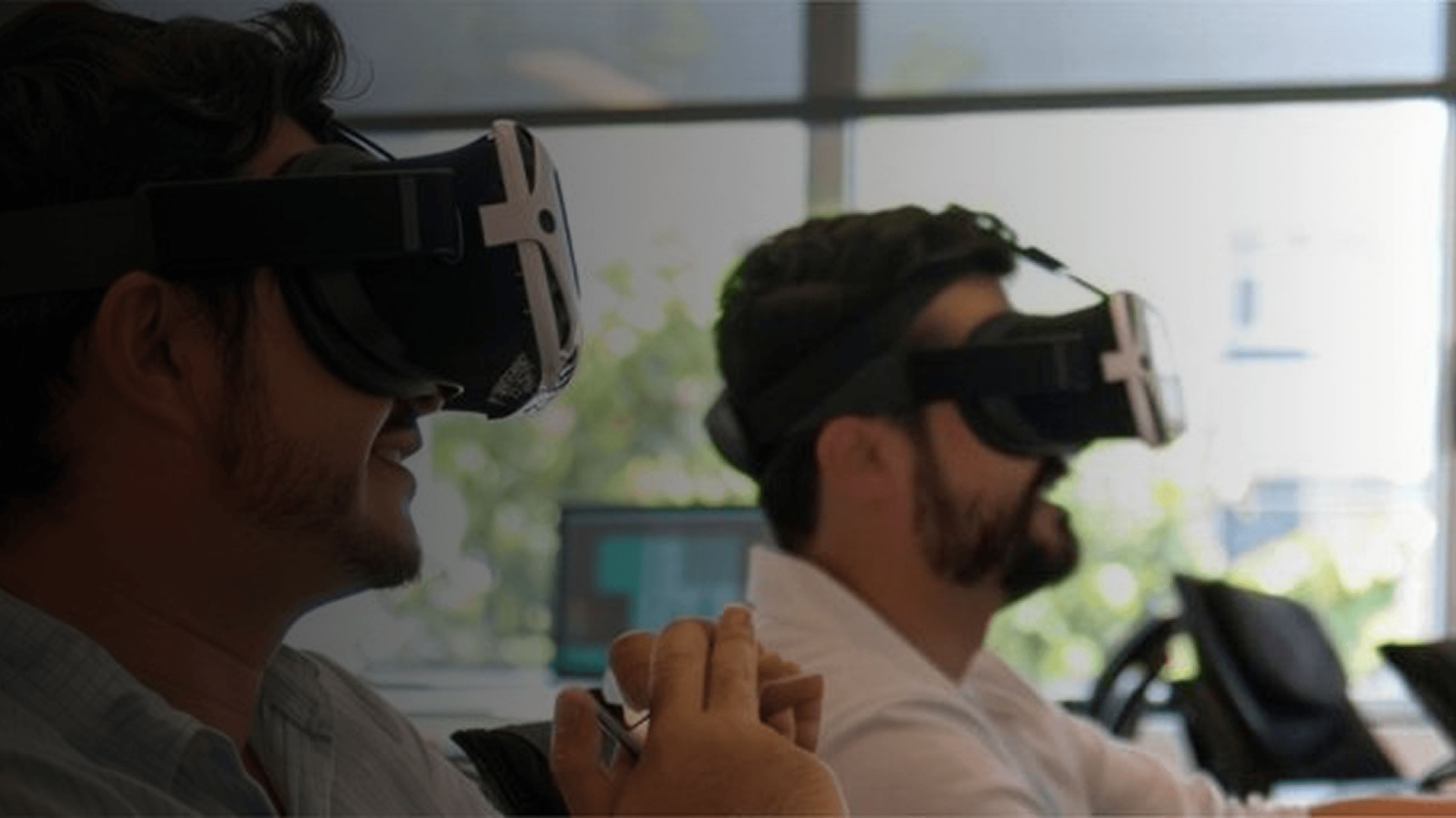
The HR training games based on decision-making give control to an employee over a tough situation instead of presenting him with guidelines to learn by heart. In order to make a decision regarding a conflict of interest and a safety-related decision in reality, an employee is not supposed to read a relevant policy. Instead, make the decisions within a game and see the consequences right away. Mind Maze game developed by Abhiwan Technology for Bajaj Finserv is an example of a corporate mind training game based on cognitive, decision-driven game mechanics.This article describes why decision-based games can help to develop better judgment skills compared to traditional passive training, the process of creating such games, and what information is required for a game studio to create one.
What Are HR Training Games for Decision Making?
HR training games for decision-making are those games that force a decision, reveal its outcome, and provide feedback, instead of asking a participant to remember a certain rule. Making such a game requires knowledge of a special technique, which can be described as part of educational game development, as it involves designing branching, but not of the game that will give just one way to the right answer. As an educational game development company, we give equal importance to decision-making mechanics and visual design to create engaging games that help employees develop practical decision-making skills. The process of development always starts with planning meaningful branches before the first screen is designed. That is quite different from the other formats of corporate training, as the task here is not only to transfer some information but to develop some skills of judging situations. Corporate training games force participants to face a really ambiguous situation instead of an obvious choice of right and wrong options.
What Is Decision-Based Learning?
Decision-based learning refers to a process whereby the learner makes a selection or choice as opposed to being taught passively through the absorption of information. In addition, the impact of the choice made plays an integral role within the process of instruction. Unlike conventional e-learning that focuses on testing the extent to which one has gone through some materials, decision-making becomes the main element in decision-based learning. This type of learning applies to skills such as judgment, ethics, leadership, customer management, and ambiguous decisions.
How Do You Teach Decision-Making Skills?
Skills related to decision making need to be improved by constantly applying them and getting feedback rather than being simply exposed to theoretical aspects or case studies. Proper training methods include putting a person in a situation where he or she needs to make a decision, showing the consequences of the decision made, and explaining what would have happened had another decision been made. This is what a properly developed gaming module is supposed to do. Role-playing and case study discussions are examples of traditional ways of learning which function in accordance with this principle yet may be difficult to organize effectively for a large number of employees.
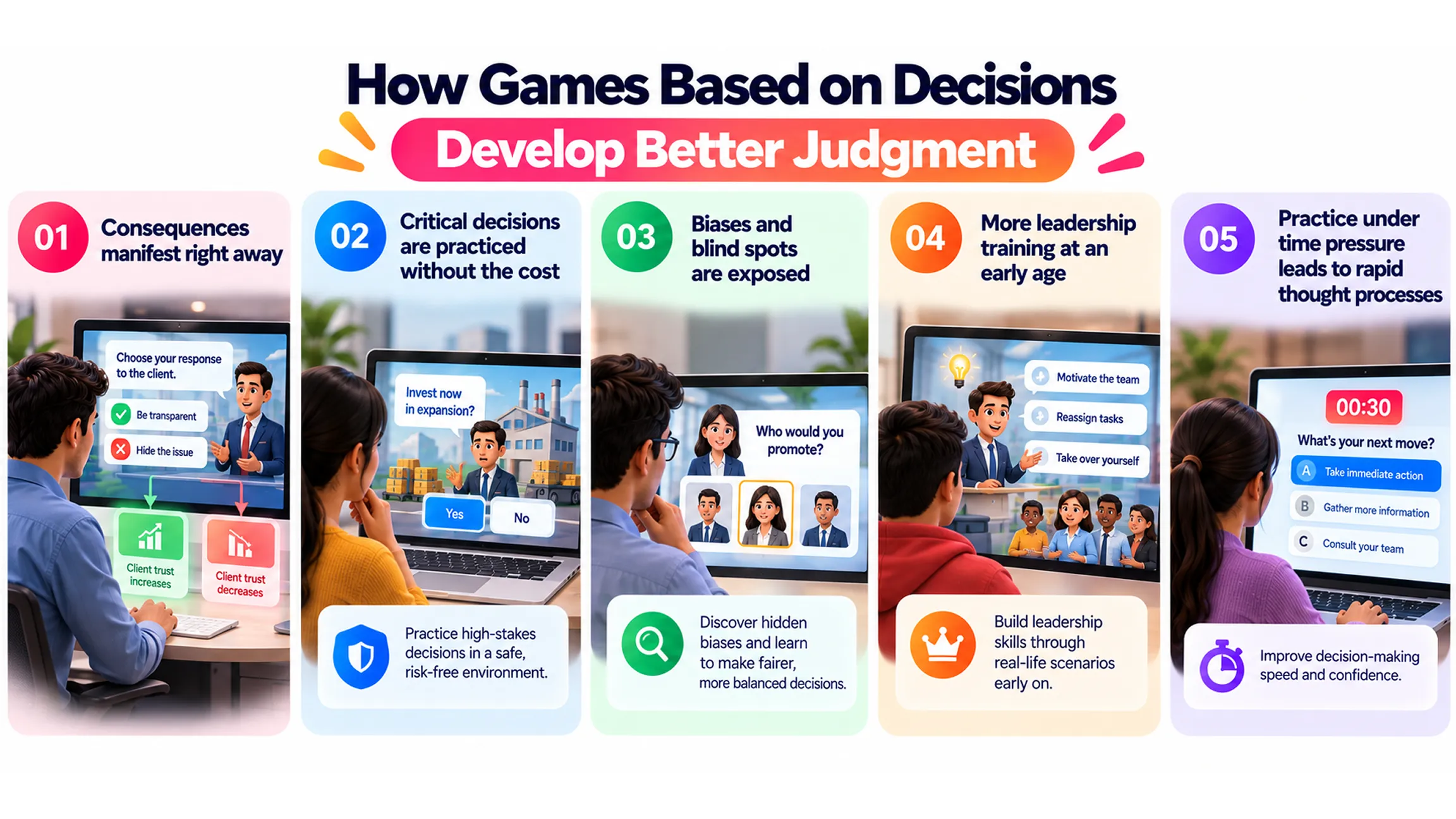
How Games Based on Decisions Develop Better Judgment
Developing judgment is harder than teaching facts, and the games-based method does so in practical ways.
Consequences manifest right away
If an employee makes an erroneous decision in the simulation, then he/she will see its consequence play out on the screen and learn from it, in ways he/she might not when given a lecture on best practices.
Critical decisions are practiced without the cost
When an employee faces a critical decision in real life, which would prove too costly if they made an error in real time, for example, when handling a safety issue during a deadline-driven situation, he/she can safely practice the decision in a game without consequences.
Biases and blind spots are exposed
By using a good scenario in educational game development, it is possible to expose biases in the decisions of an employee.
More leadership training at an early age
Future managers can be exposed to situations involving delegation, conflict, and resource management in a safe environment before stepping up to bigger decisions.
Practice under time pressure leads to rapid thought processes
Games can mimic the pressures of the real-life decision process in the sense that one is expected to make their decision in a limited amount of time, instead of having the opportunity to think about it for an unlimited period. This can help ensure that practice is somewhat similar to what employees may go through in their jobs.
Decision-Making Skills HR Training Games Can Develop
| Skill Area | Example Scenario | What Employees Practice |
|---|---|---|
| Conflict Resolution | Two team members disagree over a project decision | Listening, evaluating options, and choosing an appropriate response |
| Ethical Judgment | An employee notices a potential conflict of interest | Identifying risks and making responsible decisions |
| Leadership | A manager must delegate work during a tight deadline | Prioritizing tasks, communicating clearly, and managing resources |
| Safety Decisions | A worker must decide whether to follow a shortcut under pressure | Balancing urgency with safety procedures |
| Customer Handling | A customer becomes frustrated over a service issue | Staying calm, assessing the situation, and choosing the right response |
| Team Management | A team member repeatedly misses an important deadline | Addressing performance issues while maintaining team relationships |
HR Training Games: Facts & Figures
- One HR training game, which consists of a single scenario, usually takes about 6–8 weeks to create, whereas more complex games consisting of several scenarios and customized content take about 12- 20 weeks.
- A decision-based training game can consist of 2–5 or more alternative branches where employees are free to make different decisions and experience different consequences in the same scenario.
- Corporate training games can be connected to LMS and provide important statistics such as progress and performance of employees.
Approach of Abhiwan Technology for Decision-Based HR Games
Abhiwan Technology is an educational game development company that has used its knowledge in game development for cognitive and decision-making-based applications, such as Mind Maze, which is an employee mind training game made for Bajaj Finserv, and also other cognitive evaluation games made in collaboration with AIIMS and ICMR. The development process includes the identification of the kind of decision-making or judgment-making ability that has to be developed. It follows game architecture planning, design and development, testing, quality assurance, launch, and content updates post-launch. The studio uses Unity, Unreal Engine, and 3ds Max.
Conclusion
HR training games based on decision-making enable employees to practice their decisions through experience rather than just providing them with information to learn. In other words, employees can make decisions, observe their results, get feedback, and experiment with different solutions without facing the consequences in reality. The best games are developed by a company that approaches the development of decision-making as a separate science, meaning mapping out the most valuable scenarios and consequences and not merely gamifying a test. Abhiwan Technology's work on projects such as Mind Maze is an example of what gaming experience can bring to the corporate world.
Written By Vaibhav Karanwal