A welding simulator can help companies overcome the challenges of recruiting and training skilled welders. This is because it offers a safe learning ground for novice employees to learn how to weld and be ready for production. Many facilities spend several weeks training new employees on real machines, only to have a significant proportion quit within the first year. In addition, many experienced welders are currently retiring faster than new ones are being certified. Instead of treating the situation as an insoluble issue, manufacturers are opting for simulation technology to cut down the training period and guarantee standard skills throughout different shifts. Abhiwan Technology provides high-end welding simulation technologies. These enable manufacturers to train their staff in an easy, efficient, and risk-free manner.
The Growing Welding Skills Gap in the Manufacturing Sector
Different automotive, shipbuilding, and heavy equipment manufacturers face difficulties filling their welding positions, as many experienced workers retire faster than new qualified professionals are certified. The implementation of the virtual reality welding training simulator is becoming part of the solution, as it allows companies to train their new employees without having to engage a certified welder during every practice session. Companies utilizing a broader approach through industrial VR training early on have more success navigating this situation than companies who still depend entirely on dwindling supplies of experienced mentors to teach each new employee individually.
How a VR Welding Simulator Facilitates Faster Training
By using simulations, the training process is facilitated because it allows trainees to develop muscle memory without having to actually weld until they are ready to do so without any risk. A robust VR training solution system monitors torch angles, travel speed, and arc length instantly; therefore, errors can be corrected right away instead of after an instructor evaluates a waste weld. This process does not involve the use of gas, wire feed, or booths, and therefore multiple employees can train simultaneously instead of waiting their turn for the equipment.
The Benefits of Using a VR Simulator for Welding Training
These benefits go much farther than just expediting the initial training period, as manufacturers will notice when comparing welding simulator price to the continuous cost of training new welders.
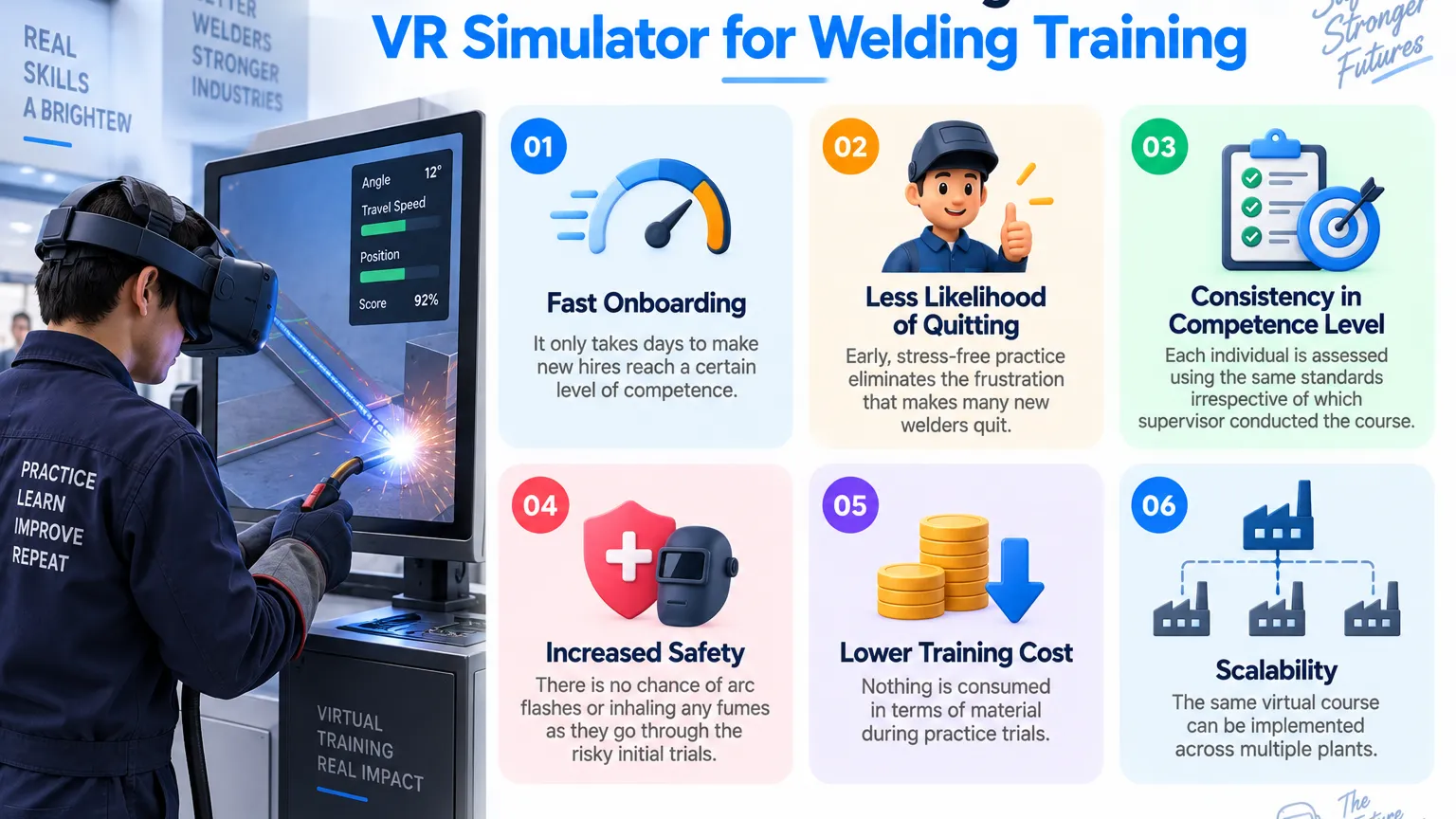
Fast Onboarding
It only takes days to make new hires reach a certain level of competence.
Less Likelihood of Quitting
Early, stress-free practice eliminates the frustration that makes many new welders quit.
Consistency in Competence Level
Each individual is assessed using the same standards irrespective of which supervisor conducted the course.
Increased Safety
There is no chance of arc flashes or inhaling any fumes as they go through the risky initial trials.
Lower Training Cost
Nothing is consumed in terms of material during practice trials.
Scalability
The same virtual course can be implemented across multiple plants.
Manufacturers conducting industrial VR training have found that employees who were trained virtually show up much more confident in their first live welding training session, compared to those who had never practiced the task before.
When evaluating the choice, knowing the welding simulator price and its cost savings from one bad hire alone makes the case easily.
Comparing Traditional Welding Training with Virtual Reality Welding Simulator Training
By comparing both methods, it becomes easier to know how a virtual reality welding training simulator helps.
| Factor | Traditional Welding Training | VR Welding Simulator Training |
|---|---|---|
| Onboarding Time | Weeks, limited by shared equipment access | Days to a couple of weeks, with parallel practice |
| Material Cost | Ongoing spend on filler metal, gas, and scrap | No consumables used during practice |
| Safety Risk | Burns, fume exposure, and eye damage possible | No live arc, fumes, or hot metal |
| Skill Consistency | Varies by supervisor and available practice time | Standardized scoring across every trainee |
| Equipment Availability | Limited by number of physical booths | Multiple trainees can practice at once |
| Scalability Across Plants | Requires duplicating physical setups at each site | Same virtual curriculum deployed company-wide |
| Certification Readiness | Full hours required on live equipment | Some hours may count toward certification, depending on the program |
How Abhiwan Technology Builds Custom VR Welding Simulators
Each welding simulator is not necessarily for purchase. Some may need solutions that would be developed considering their methods, certifications, materials, or manufacturing equipment. Abhiwan Technology provides a virtual reality welding training simulator for such cases. Our specialists study the training process and technical details of the manufacturer. Further, we create the simulator compatible with their system. Thus, the manufacturers get an opportunity to utilize our VR training solutions throughout their whole training process. Manufacturers also have the option to work on the virtual reality welding simulator prototype. It allows them to check how the tracking, scoring, and training performance would work according to the certification standards of the manufacturer. Moreover, the industrial VR training solutions from us could be planned depending on the required features and welding simulator price.
How to Choose a VR Welding Simulator for Manufacturing
In this case, one should pay more attention to some aspects than to just a demo. It is necessary to make sure that the VR training simulator allows using different welding procedures and positions that are actually employed by manufacturers, as generic demos of only flat-position MIG welding will not provide an accurate picture of what one requires while training new employees. In addition, an effective VR training solutions vendor should have a dashboard to control several trainees simultaneously, as these statistics are helpful when choosing the moment of moving to live equipment.
Does VR welding training count toward certification?
This is dependent on the specific certifying body and program. Some welding certification programs, like certain American Welding Society paths, do accept training hours conducted with the help of an approved simulator as an additional resource to the live training. However, the final test is performed on actual welding equipment. It is recommended to consult the respective body in advance to find out what percentage of training hours could be counted through the use of simulation. Regardless of whether the simulation hours directly translate into credits, the tangible skills learned will significantly cut down the time required to clear live certification tests. The comparison between the price of a welding simulator and the reduced time spent on expensive live training is often more beneficial than just certification considerations.
How long does it take to see ROI from VR welding training?
Manufacturers usually experience a visible financial gain during the first hiring cycle after implementing VR welding simulators, due to the fact that the reduced amount of consumables consumed, as well as reduced training time to productivity of new employees, allows saving money. With each hiring cycle of virtual reality welding simulators, the initial investment becomes lower as the cost is distributed among a larger number of trained employees. If the company works in several shifts or at several plants, the payback period will be faster.
Conclusion
Addressing the lack of welders for manufacturing operations involves a different way of thinking about how to train workers. A welding simulator provides an ideal solution to this problem since it allows manufacturers to train new employees without increasing risks or wasting any material in the process. As seen from this discussion, the methods described above demonstrate how simulation makes the training period shorter, equalizes skills assessment among different shifts, and creates a steady flow of welders. Regardless of whether a company decides to set up its own training program or collaborate with educational institutions, the right simulation system will greatly help in overcoming the shortage of skilled labor.
Written By Vaibhav Karanwal