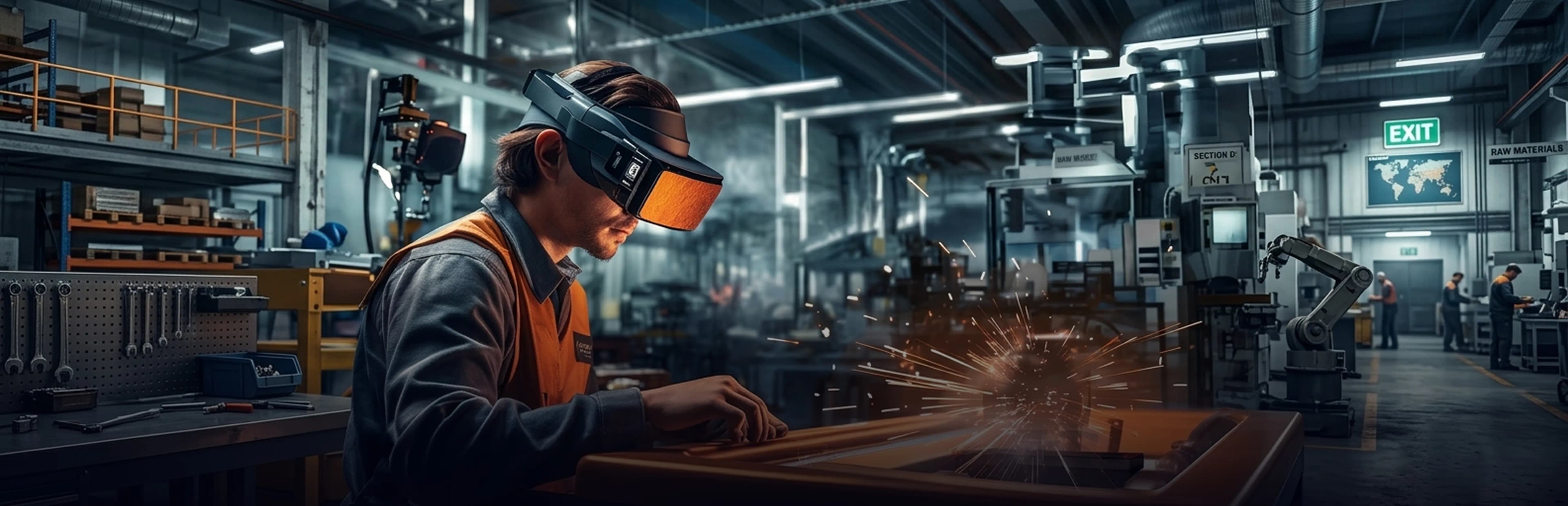
A welding simulator is changing how welders are trained in welding colleges, manufacturing industries, and training centers, offering a replacement for the wasteful trial-and-error method. Traditional welding training methods have always carried risks and costs, including raw materials, gases, equipment, and even potential injury. Considering the ever-growing demand for welders in the construction, automobile, and shipbuilding industries, there is a need for more effective methods of training. Abhiwan Technology specializes in creating custom AR/VR solutions that may be tailored to fit welding and industrial training needs. This paper is going to analyze problems associated with traditional welding training programs, advantages provided by the simulators, features to pay attention to, and the cost of these solutions.
What Problems Do Traditional Welding Training Programs Face?
The traditional approach to welding training implies the use of metal and gas, as well as real machines. Therefore, it has been associated with certain issues, and a virtual reality welding training simulator is often implemented to solve them.
High Costs
Consumables such as electrodes, filler metals, and gases add to the expense for multiple students.
Safety Hazards
Burns, fumes, and eye injuries are major hazards associated with live welding booths.
Equipment Limitations
Not all students have access to hands-on experience because a school has only a few welding booths.
Material Wastage
Practice welds result in wastage of metal material that could be used again.
Limited Practice Opportunities
Limited availability of physical booths constrains the number of opportunities for repeated technique learning by beginners.
Variability in Weld Quality Evaluation
Subjectivity of visual evaluation makes assessing weld quality inconsistent.
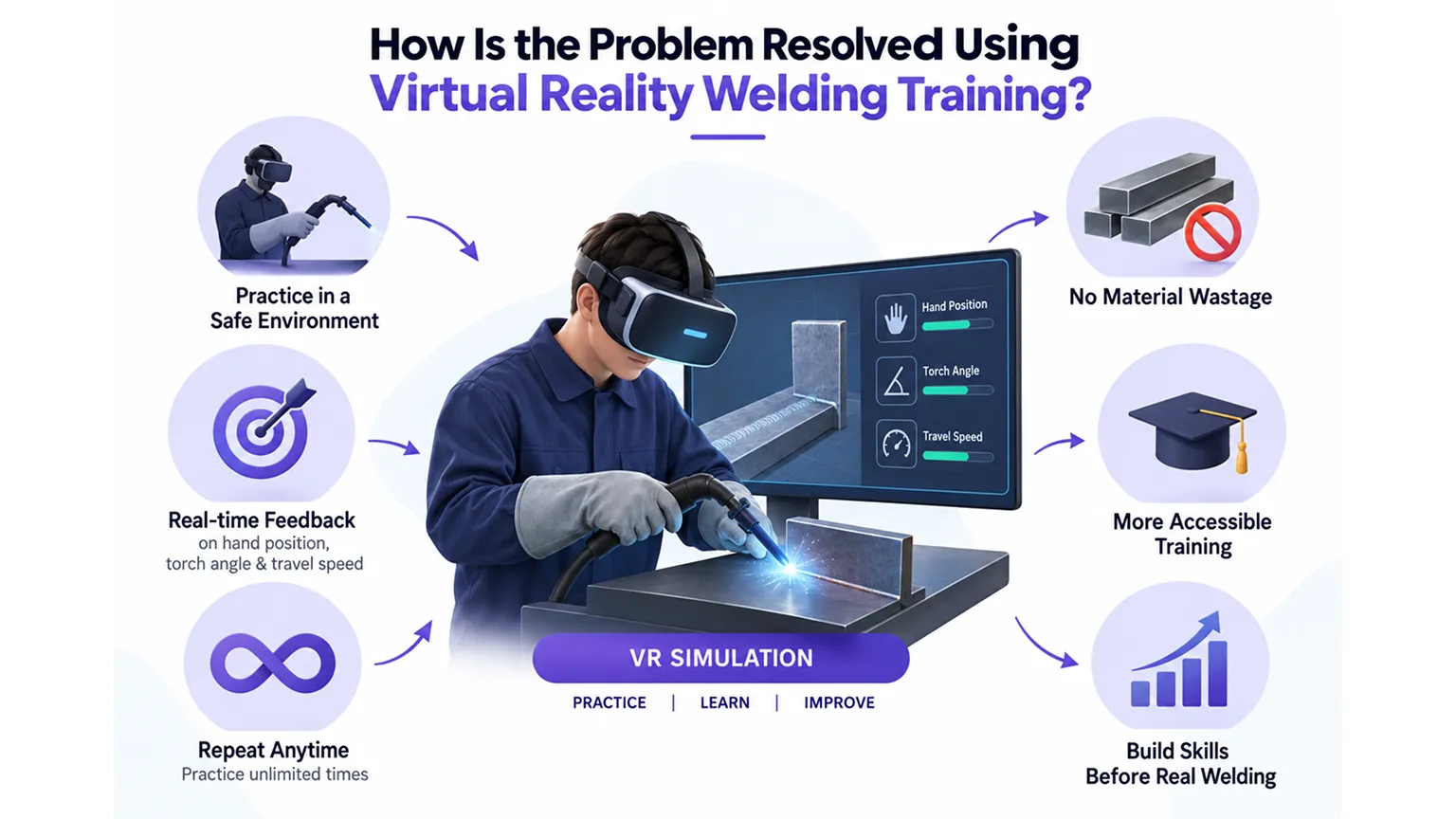
How Is the Problem Resolved Using Virtual Reality Welding Training?
Simulations overcome the challenges discussed above because learners get an opportunity to practice their welding techniques in a simulated environment prior to live welding. A proper VR training solution measures hand position, torch angle, and travel speed, which is impossible in a live setting during the first couple of times. Since there is no physical material involved, learners may repeat a certain joint or technique an unlimited number of times without any material wastage. This transforms training from a rare and monitored activity to one that is much more accessible to the learner.
Benefits of VR Welding Training
The introduction of a simulated experience brings about clear benefits that go much deeper than mere cost considerations.
Safe Practice
No open arc, fumes, or molten metal means that there is no danger while learning the process.
Flexible Revisions
Learners can repeat the weld pass without having to wait for access to the machine.
Minimal Material Loss
Nothing gets used up; thus, institutions save on filler materials and gas supplies.
Authentic Practice
Advanced haptics and visual effects render a realistic sensation of a real weld pool.
Performance Monitoring
Every exercise gets recorded, thus providing instructors with objective information.
Bias-Free Training
Every student is tested based on an identical standard; thus, instructor biases are avoided.
Efficient Learning
A single simulator can accommodate many more student hours than one welding booth.
Programs that opt for an industrial VR training model are known to be quicker in skill development due to the ability of students to fail safely and retry instantly without waiting for supervised access to the equipment.
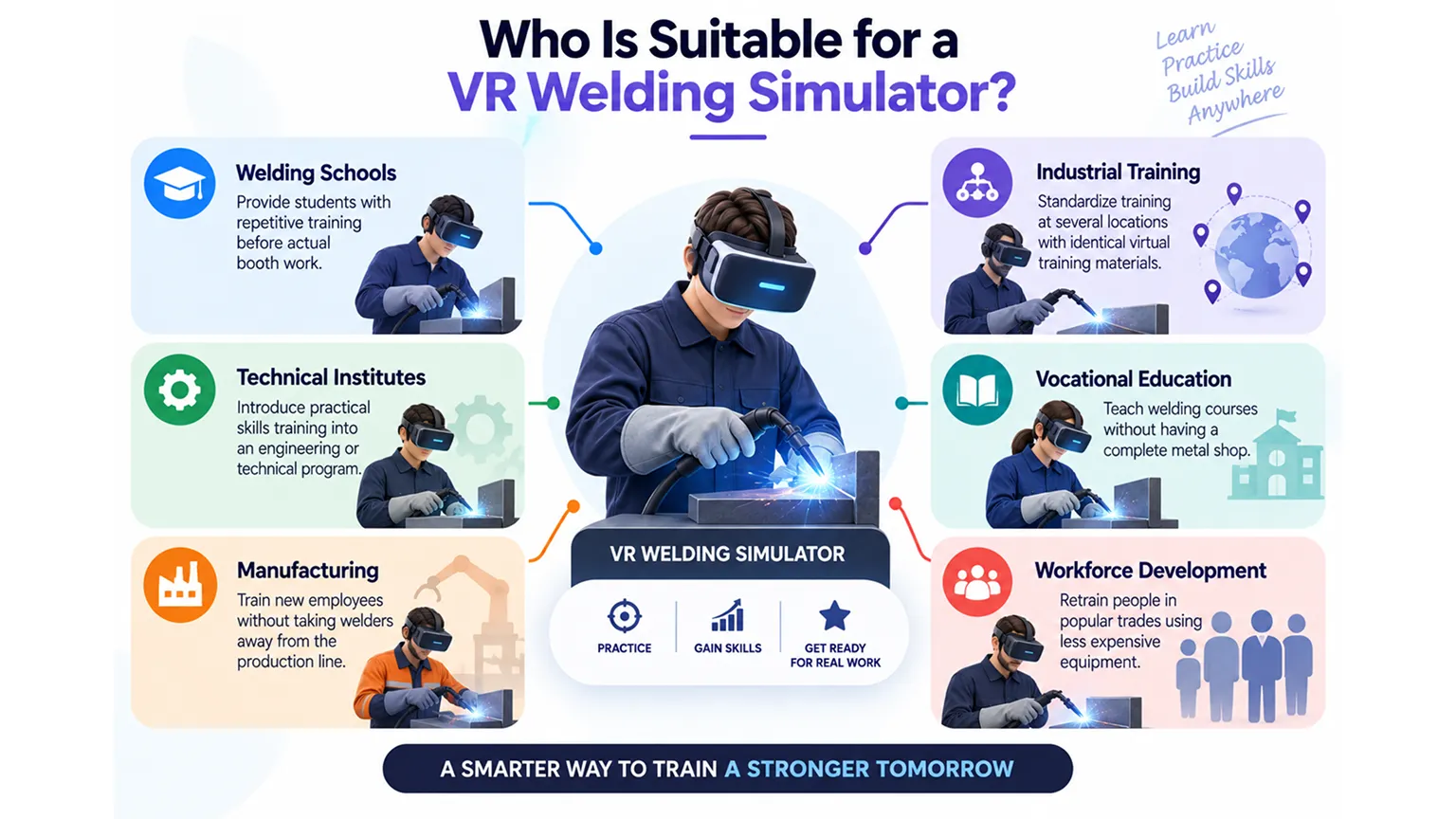
Who Is Suitable for a VR Welding Simulator?
The tool works well in almost any learning context, not only in trade schools. Any company that currently uses welding booths in training can take advantage of implementing a virtual reality welding training simulator into their training program.
Welding Schools
Provide students with repetitive training before actual booth work.
Technical Institutes
Introduce practical skills training into an engineering or technical program.
Manufacturing
Train new employees without taking welders away from the production line.
Industrial Training
Standardize training at several locations with identical virtual training materials.
Vocational Education
Teach welding courses without having a complete metal shop.
Workforce Development
Retrain people in popular trades using less expensive equipment.
Features That Make a VR Welding Simulator Useful
There are some simulators that are much better than others because not all of them offer the same level of features. Here is a list of what features should be in a virtual reality welding simulator.
Realistic Welding Settings
Booths, workpieces, and lighting similar to a real welding shop floor.
Different Welding Methods
Options to do MIG, TIG, stick, and flux-cored welding.
Virtual Tools and Equipment
Realistic models of torch, electrode holder, and helmet.
Hand and Tool Tracking
Motion capture to make technique transfer realistically possible.
Simulated Welding Positions
Flat, horizontal, vertical, and overhead positions as in real certification tests.
How to Create a VR Welding Simulator
From scratch, a simulator is created through the combination of several skill sets: 3D environment modeling, physics-based weld pool simulation, motion-capturing hardware, and, finally, an instructor-oriented report generator. The first step is setting the types of welding and certification processes that need to be included in the simulator because it influences almost all aspects of development hardware, simulation physics, and software scoring logic. Beginners in the field usually start their work by looking at existing VR training solutions to understand what kind of experience a final product is expected to provide before they write even a single line of code.
The fact that creating such a simulator requires a broad range of skills, including hardware development, physical simulation, and software engineering, means many training providers prefer collaboration with studios specializing in this sphere. Abhiwan Technology develops custom AR/VR training applications and can help to transfer training content into the form of a working industrial VR training application.
Why Businesses Choose VR Welding Training
While businesses have to be concerned with return on investment rather than innovative methods of training, for manufacturers and providers of welding training courses the case for simulation training is easy to make. The savings associated with a decrease in consumables used alone will pay for the system after the first year of intense use, especially when there are several classes going through the same equipment. Due to the consistency of training programs, companies can add more students to the course without purchasing extra welding booths. There is also the question of safety, with fewer injuries, fumes, and associated risks during training and lower insurance premiums. When hiring new welders from various locations, businesses can rely on the fact that their skill levels will be similar as a result of the standardized training program.
Simulation training systems can easily pay themselves off for the cost of welding simulator price within just a couple of groups of students.
What is the Cost of Building a VR Welding Training Simulator in India?
The cost of developing a custom-built simulator can differ greatly according to the requirements. A bare-minimum simulator offering just one or two types of welding with a scoring system may cost somewhere between ₹18.9 lakh and ₹47.2 lakh if developed by an Indian development team because engineering costs in India are generally lower compared to those in America or Europe. The development of a more complex simulator, which includes several welding positions, the integration of a haptic feedback device, and a dashboard for an instructor, can be estimated in the range of ₹56.7 lakh to ₹1.42 crore and above.
Other factors influencing the cost are the necessity to develop custom hardware, for example, a tracked torch or a helmet, along with the software or the integration with already available VR headset equipment. Teams building a full-fledged virtual reality welding training simulator should allocate additional time for testing hand tracking accuracy.
How much does a VR welding simulator cost to buy?
When we talk about the cost of purchasing a ready-made system (as compared to making one from scratch), the cost of a welding simulator will vary depending on brand, welding processes covered by the equipment, and the quality of the hardware. Basic tabletop welding simulators may go for around ₹9.4 lakh to ₹14.2 lakh, while more elaborate booth-based simulators costing ₹37.8 lakh to ₹75.6 lakh or more are also available.
The final cost will also be determined by the number of welding operations, haptic feedback, instructor’s dashboard, hand tracking, and VR device used. Any company that intends to develop its own solution can cooperate with Abhiwan Technology and figure out what features will be necessary.
Is Virtual Reality Training Effective for Welding?
Research findings and trends towards simulation indicate that virtual reality enhances early skill acquisition, especially by novices who require repetition of exercises to develop muscle memory for the correct torch angle and travel speed. The appropriate design of VR training solutions does not negate live welding, but it significantly decreases the number of attempts made by the learner before developing consistency. Most welding simulators start with a simulated environment and advance learners to live welding after achieving consistent virtual scores.
Conclusion
Incorporating a welding simulator into the curriculum is essentially an attempt to overcome the challenges posed by traditional learning. These include costs involved, the safety concerns raised, lack of access to equipment, and inconsistent scoring. The technology discussed in this paper can help minimize wastage of materials, standardize scoring, and train far more learners than one would be able to with the traditional shop floor approach, where only a few booths are available. Spend time comparing features, getting a live demo, and confirming continuous support before choosing any particular platform for your program. Abhiwan Technology has capabilities that would assist in the development of AR/VR solutions that suit your needs for welding and industrial training programs.
Written By Vaibhav Karanwal