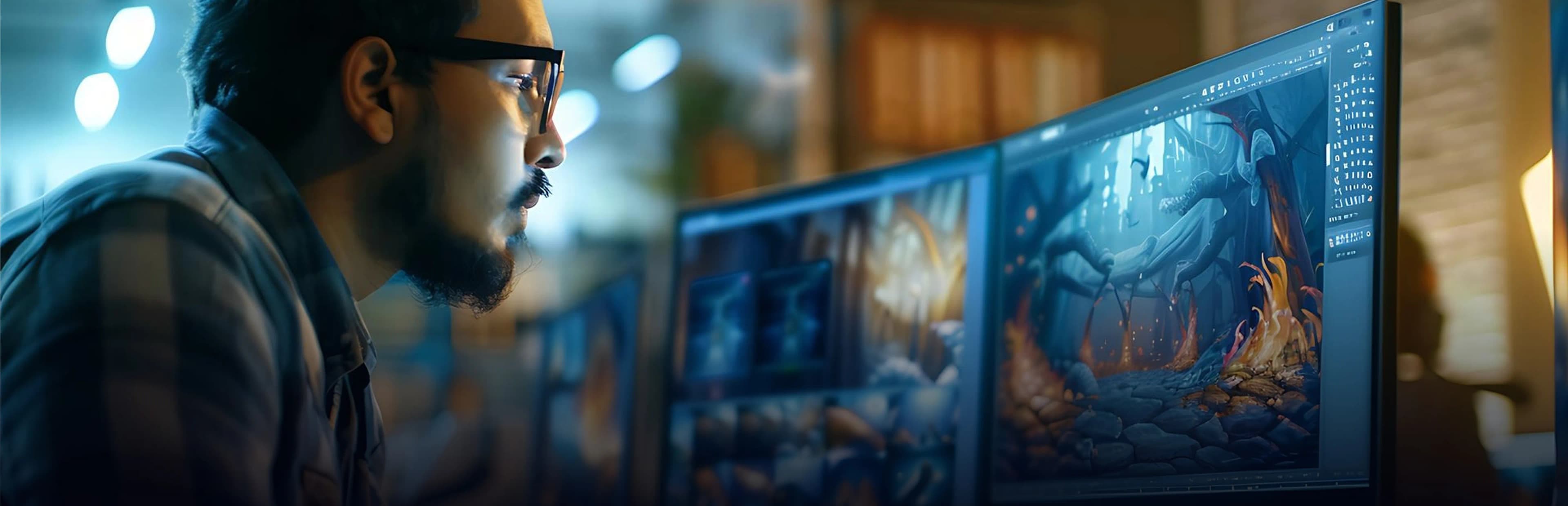
In the role of a 3D Game Artist, one takes basic ideas and brings them to life in the form of different assets used to make a game feel complete. 3D Game Artists are responsible for the visual quality, but also for player retention and technical performance of a video game. Every little detail, from character creation to rendering optimised models for a game engine, can affect the user experience in a video game. Being part of a team is different from being a freelance 3d game artist, as an artist working in a development team collaborates with different professionals such as designers, programmers, animators, and technical artists. The work of a 2d game artist is essential in making sure that the game concept is done correctly, whereas the 3D Game Artist is exclusively responsible for transforming 2D concepts into applied interactive 3D models. The most simplified explanation of the job is that it connects creative design with technical implementation.
What does a 3D Game Artist do?
The 3D Game Artist is a person who makes and prepares 3D game elements in accordance with a game’s style and technical needs. Their work may involve modelling, sculpting, texture creation, UV mapping, material design, rigging, lighting, etc.
A freelance 3d game artist can work in various genres and use different production methods depending on project goals. One game can be about creating characters, another - about creating environments, and yet another can focus on creating props for a mobile game. Such diversity may relate to changes in styles, timelines, and technical requirements.
The 2D game artist will provide concepts, sketches, interface elements, character suggestions, or environmental references to guide the 3D production. The 3D artist will develop these visual ideas into tangible assets that can be seen, animated, or interacted with in the game environment.
How a 3D Game Artist Improves Game Quality
Game quality comes from balancing visual detail, consistency, usability, and technical efficiency.
Better Models
A game artist 3d produces models that have precise shapes, favorable topology, and remarkable details perceived by gamers. This adds to visual credibility and eliminates geometry, which brings limited benefits.
Stronger Textures
A freelance 3d game artist produces texture maps that define qualities of the surface and the reaction of materials. Well-considered textures allow understanding objects with ease and ensure the same direction in art.
Accurate Proportions
Proportions are critical for characters, props, and environments to be realistic. Artists need to be sure that these proportions fit the references as well as gameplay conditions.
Visual Hierarchy
Artists use shape, scale, contrast, color, and materials to help players recognize important elements quickly.
Animation Readiness
While a 2d game artist creates a character through types of illustration, a 3D asset should allow for motion. Proper topology and deformation zones significantly improve rigging and animation.
Quality Control
A 2d game artist, in creating the game, is also involved in reviewing the concepts and comparing them to the final designs. Artists examine geometry, textures, scale, lighting, and engine behavior before inclusion of designs in the final version of the product.
3D Game Art for Player Engagement and Immersive Experiences
Strong visuals can influence how players explore, understand, and connect with a game. Well-planned game artist 3d workflows create memorable characters, immersive environments, and clear visual cues that make gameplay more engaging.
Memorable Characters
Unique characters allow players to promptly identify heroes, opponents, and supporting figures. A 3d game artist can help to create characters through the use of silhouettes, costume design, facial characteristics, and accessories.
Immersive Environments
An attractive environment inspires players to discover surroundings. The 3D Game Artist works on the design of architecture, props, plants, lighting, and other elements of the environment.
Emotional Visuals
Visual design expresses emotions without resorting to words. Colors, gestures, materials, light, and bodily movement generate various emotional states like excitement, tension, mystery, or calmness.
Clear Visual Cues
Players should be able to comprehend quickly what is possible to interact with or not. Shape, contrast, position, and color contribute to differentiating between objectives, collectibles, paths, dangers, and interactive objects.
Environmental Storytelling
The environment of a game can provide information without a long explanation. Things, constructions, damage, ornaments, and surrounding details can provide information about the location and strengthen the general narration.
Visual Variety
Repeated environments can make the game boring. A 2d game artist can create different ideas, and a 3D developer implements them into various locations, objects, and pictures.
What Role Does 3D Game Art Play in Game Performance?
Good game visuals need to perform efficiently across the target platform. A 3D Game Artist balances asset quality with polygon count, texture usage, materials, and real-time rendering requirements to deliver a smoother player experience.
Optimized Geometry
A game artist 3d defines the density of the polygons based on the importance of the asset and the distance of view. It helps maintain the clarity of the details visible, while reducing the amount of unnecessary geometry that might overload the rendering.
Texture Optimization
When applied without sufficient preparation, high-resolution textures use abundant amounts of memory. A freelance 3d game artist chooses the most appropriate resolutions, compression techniques, and texture arrangements of the assets according to the requirements of the game’s platform and visual style.
Level of Detail
LOD models make sure that various models of an asset are used at different distances. High-poly models are used when the player is nearby, and low-poly models are needed when the objects move away.
Efficient Materials
Rendering performance may also be affected by materials and shaders used during the game. Artists manage texture maps together with the properties of materials in such a way that the required visual look will be achieved without adding extra complexity to the rendering process.
Engine Testing
Assets should be tested in the actual game engine, not just in modeling software. A 2d game artist may provide artistic references only, while the 3D assets should be checked for performance related to light, materials, scale, and rendering functionality.
Platform Optimization
Many games are made for various devices with different technical specifications. A 3D Game Artist will create assets that are able to carry the same visual quality across all of the devices.
Which Tools Do 3D Game Artists Use for Game Development?
Modern game art combines modelling, sculpting, texturing, rendering, and real-time engine workflows. Choosing the right tools helps artists create detailed assets while keeping them suitable for production and gameplay.
3D Modelling Software
Modeling software is one of the most important components needed in the process of making game assets. A 3D Game Artist can pick between software such as Blender, Maya, or 3ds Max in order to create 3D models of characters, props, environments, and other types of assets.
Digital Sculpting Tools
Sculpting tools are widely used to create minute details that cannot be made by modeling. A freelance 3d game artist can make skin folds, wrinkles, muscles, marks, etc. on his characters and objects in order to make them more realistic.
Texturing Software
Texturing software allows defining the look of an object or its material properties. A game artist 3d can create different textures like wood, metal, skin, cloth, or stone.
Game Engines
Game engines give designers the chance to see how objects perform in a real-life gaming setting. Unreal Engine and Unity are famous for their real-time development capabilities and enable designers to check the lights, materials, animation, as well as the object location.
Rendering Tools
Rendering tools provide artists a way to see the lighting, materials, shadows, and quality of the picture. All the above previews allow artists to notice potential problems, thus ensuring that assets are ready for the production stage.
Optimization Tools
By means of optimization tools, designers can discover assets creating big load on the equipment. A 2d game artist may contribute visual references, while the 3D crew is responsible for profiling and other evaluation processes.
How Much Does a 3D Game Artist Make?
How much money a 3D Game Artist can earn depends on the following factors: their experience, location, specialization, quality of their portfolio, size of the studio, and employment type. In the USA, 3D artists usually have an annual salary between $60,000 and $95,000. Senior specialists and those who work in rare niches may receive higher compensation. Freelance 3D artists can offer their services for modeling, texturing, creating characters, working on environmental assets, or doing complete projects. Rates of freelancers range from $25 to $100+ per hour depending on the level of expertise and complexity of the tasks being performed. Hence, we can see that the income of 3D artists varies a lot.
Can ChatGPT Make 3D Models?
ChatGPT can help with many aspects of the 3D modeling workflow, such as creating asset ideas, writing modeling guidelines, showing how to do things on Blender software, preparing scripts, and helping artists with any technical issues. Nevertheless, it is not only about creating basic geometry when it comes to making a game-ready model. A 3D Game Artist has to ensure that topology, proportions, UV mapping, textures, materials, rigging, optimization, and game engine compatibility are in order. Therefore, AI is a supportive tool, but not a substitute for the whole process of creating art and working with techniques. Humans still have a lot to do as far as ensuring uniqueness, visual cohesion, consistency with gameplay principles, and production quality.
Conclusion
A 3D Game Artist is crucial for maintaining the quality of the game graphics, keeping players engaged, and improving the technical performance of the game. The responsibility includes designing both vivid characters and elaborate environments, making textures, improving the geometry, and testing game assets in the game engines. Achieving good results consists of finding a balance between detail and efficiency and avoiding unnecessarily complicated assets. As real-time rendering technology is developing and AI technologies are being introduced, artists should develop their technical skills together with their traditional creativity. The major objective of 3D game art is to make images supporting gameplay, delivering simple ideas, creating an immersive world, and providing a smooth experience to the players when playing.
Written By Charu Sharma