VR training vs traditional training isn't a competition with a single winner. VR wins for safety, repeatability, and per-learner cost at scale. Traditional training wins where trainees require hands-on, physical tools, discussion with a group, or low-volume, low-risk content. The majority of industrial teams leverage both.
This industrial VR training comparison considers learning, safety, cost, and scale. It then covers the limitations of VR training and the questions you need to ask before doing a VR training pilot. You'll find real-world examples from factories, warehouses, and an honest appraisal of where the evidence is solid and where it's mostly vendor fluff.
VR Training vs Traditional Training at a Glance
| Factor | Traditional training | VR training |
|---|---|---|
| Format | Classroom, manuals, videos, shadowing | Simulated scenarios in a headset |
| Practice | Limited by equipment, time, and trainer | Repeat as often as needed |
| Safety | Real hazards during on-the-job practice | Simulated hazards, no real exposure |
| Consistency | Varies by trainer, site, and day | Same scenario for every trainee |
| Upfront cost | Lower | Higher: content and devices |
| Cost at scale | Stays high per learner | Falls as more people use it |
| Data | Attendance and test scores | Steps, errors, time and hesitation |
| Real-world feel | Full | Partial |
| Best for | Concepts, discussion, real-tool practice | Risky, rare, or highly repeated tasks |
Key Differences Between VR and Traditional Training Methods
The old-fashioned kind of industrial training involves classrooms, slide shows, manuals, videos, demonstrations, and on-the-job shadowing. It relies on trainers and access to actual equipment. It's well-known, content can be varied, and it works well for explaining concepts.
VR training immerses the learner in the world of work or the job. They work on a virtual machine, make choices, and receive the results. The system can log what they did and award a score. Industrial VR training solutions often take your existing procedures and equipment and make them into scenarios.
The big distinction is active practice. Generally, training gets a basic explanation of the task and expectations, then later builds it up with experience. Virtual Reality can allow trainees to actually perform the task, make mistakes, and try again before they do it in the real world.
Learning Effectiveness and Knowledge Retention
Firstly, most trainers say that people remember more if they practise a task than if they are only told about it. Learning in class is transient, and VR allows people to practise steps and decisions. Providers such as ATXR say that VR is better at making training persist because learners make decisions and see results.
There is a danger of being too quick here. The retention figures quoted are often supplied by vendors, and outcomes are largely defined by the quality of the simulation aligned to the real job. A badly designed simulation doesn't necessarily educate well, no matter how engaging it seems.
The most effective way is to run the test. Track a pilot group versus a control group, trained by the traditional methods, and then track assessment results, quality, time to proficiency, and job performance a few weeks down the line. That's your data for your operation, and that matters more than any broad statistics.
When you run that pilot, measure at three levels. Knowledge: can the trainee describe the method by taking a short test? Skill: can the trainee perform the task accurately under supervision on actual equipment or in a graded simulation? Results: on the job, a month or so later, fewer errors, fewer incidents, and faster completion? There are lots of interventions that only measure at the first level. This is the cheapest and the least valuable.
Practical Training Exercises and Simulations
Certain activities are difficult to practice due to the high cost of equipment, equipment that is always busy, or equipment that is located in a remote area. With VR, that obstacle is eliminated. An apprentice can practice a pump, crane, or switchgear thousands of times, and a trainer can change the environment between trials.
They can be used to simulate low-frequency, high-impact events, for example, an alarm going off during a normal job, a valve sticking, or a problem occurring just once a year. Conventional training is often silent on these issues, as they are difficult to reproduce.
Augmented Reality should be considered as well. For real machine work, you can throw AR guidance steps onto the equipment, which combines hands-on and live work.
Workplace Safety and Risk-Free Training
The benefits are clearly summed up by safety. There is no real risk to learners practising lock-out and tag-out, working at height, confined-space entry, and chemicals. They see clearly what the risks are and what the consequences of errors would be, but no one gets hurt.
Classroom-style on-the-job training remains risky, because the learner has to be in proximity to live hazards in order to learn. Observing an experienced worker is useful, but it exposes the trainee and relies on the experienced worker behaving safely. VR allows the trainee to start with a base level of safe behaviour before moving into proximity to the hazard.
This is not to say that people can avoid working in the real world. VR is not a substitute for practice in the workplace; it merely gets you there.
VR can reveal dangerous habits as well. A simulation could assess whether the trainee looked for potential energy sources, whether they were wearing the appropriate protective gear, or whether they approached a machine from the safe side, and the simulation can replay those actions. Those habits go unnoticed in a classroom until they're not okay.
Employee Engagement and Skill Development
PowerPoint is a real favorite of most managers, but simulations keep people interested, too. Younger people and those who are hands-on really like the instant feedback, objectives, and opportunities to keep practicing until they get it right. Tracking scores and progress provides a minor challenge.
VR for learning and development with skill progression: VR allows learners to work through multiple levels of difficulty. New operators can start with the basics, moving on to faults and emergencies, and experienced operators can train on unfamiliar plant without the need for a classroom course.
It's not enough to get people in the door, though. A boring simulation or uncomfortable headset will not retain them any longer than a boring slide presentation. Keep sessions short and focus on design.
Repetitions and scoring come free with the simulation, so trainers get more time to coach those who need it instead of demonstrating a few basics over and over.
Training Costs and the ROI over Time
Old-school training is cheaper at the beginning but is an ongoing expense. Every session requires trainer time, travel, room hire, and lost production. Every new group of people experiences those same costs.
You pay for content, devices, and integration up front, but adding another learner is cheap. PwC conducted a report, previously summarised by AutoVRse, which estimated that current VR costs are similar to classroom-based training at around 375 learners and are approximately 50% cheaper at around 3,000 learners. ATXR makes this point as well, claiming VR in general is significantly cheaper on average for 2-3 years for companies that train frequently or across multiple locations.
Do a quick break-even calculation. Let's say a VR module costs you $60,000 in year one to build and maintain. If your classroom delivery is $300 per trainee to cover trainer time, travel, and time out of the classroom, and $40 per trainee for the VR after the build, you have a $260 difference per trainee, meaning your VR module will pay for itself after 231 trainees ($60,000/$260). Those are just example numbers; swap in your own. Consider the benefits that don't show up in training budgets: errors, rework, downtime, and incidents. These benefits are much more difficult to measure, but they are often the most important.
Compare the two approaches by listing the total costs.
- Conventional: trainer time, travel, room hire, print or video material, production interruption, and video repeats for each new group.
- VR: content creation/design & 3D build; headsets & accessories; LMS integration; device management; support & content updates.
Don't leave anything out on either side. Teams typically include trainer cost for the classroom but leave out the idle time; they include build for VR but leave out update costs.
Training Duration and Scalability
VR training can be onsite, bite-sized, at the point of need, and in manageable chunks. You don't need to take whole groups of staff away from the line for a day. Staff can get stuck straight in and develop their skills before they even start.
This is where VR wins. Once you've created the learning, we can roll it out to as many of your sites, languages, and locations as you need, and you can update content centrally. Scaling in classrooms involves spreading trainers and availability of facilities, which increases cost and quality variance.
No free lunch. You need each learner to have a headset, space, and some time on a device; a bunch all at once requires enough hardware or a scheduling plan.
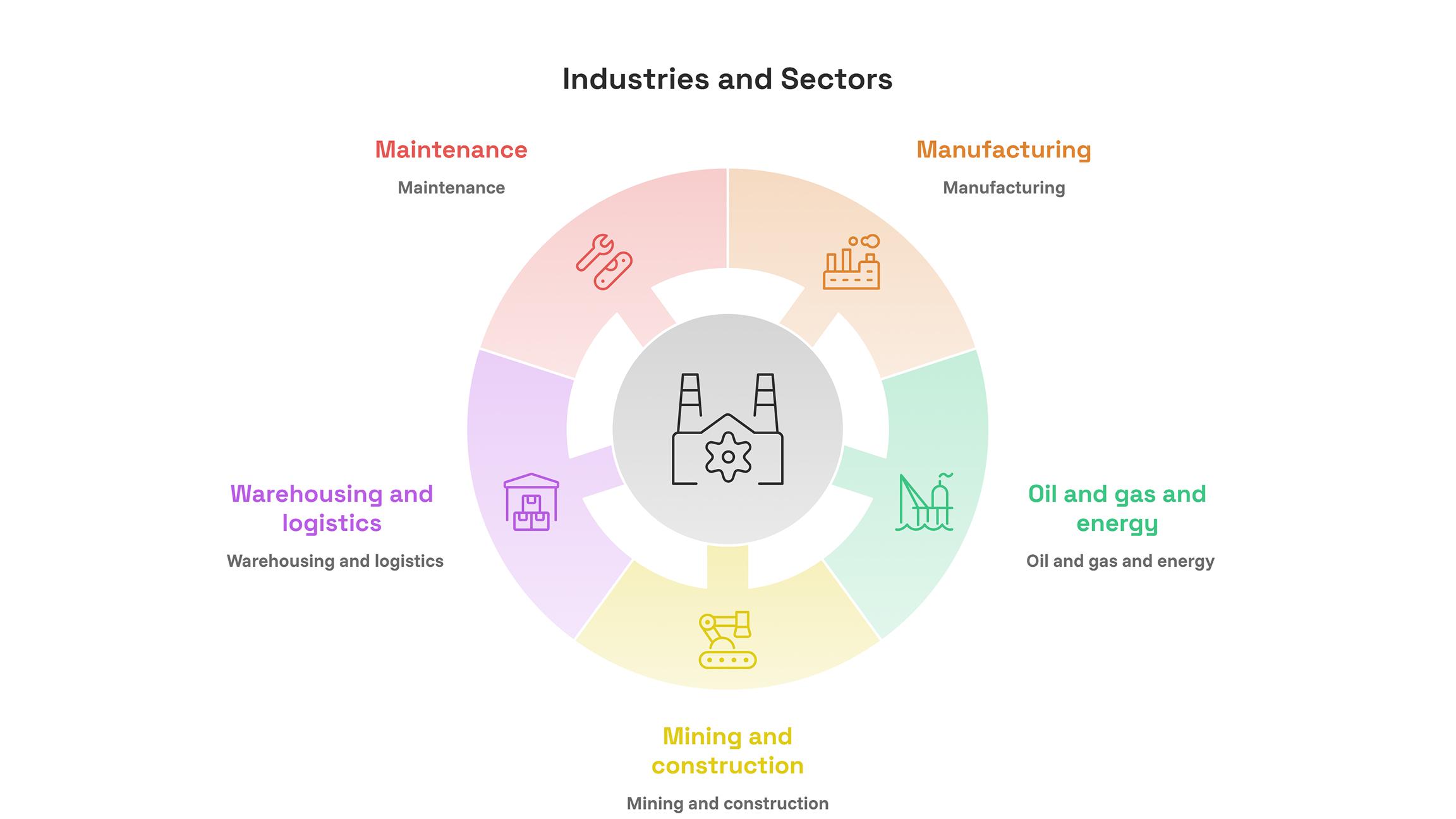
Real-World Industrial Training Applications
- Manufacturing: machine operation, changeovers & quality checks. New operators learn the process before joining the line.
- Oil and gas and energy: lock-out procedures, pressure systems, substation work, emergency shut-downs sometimes at remote locations where travel can be expensive.
- Mining and construction: machinery, elevated work, and hazard awareness.
- Warehousing and logistics: forklift routes, safe lifting and dock procedures for large numbers of seasonal staff.
- Maintenance: Practice AR-guided procedures on actual equipment and walk through uncommon repairs in a virtual environment.
A handy guiding principle from ATXR: Custom VR really earns its keep when lots of people do one or two important things over and over. A single lecture to a few is generally not one of them.
Example: Lockout/Tagout Training Using VR vs Traditional Methods
Here's an example of one task being taught two ways. Conventional way. A safety trainer delivers a half-day class with a slide show and demonstration on one actual machine. As the machine is being operated by someone else, only 3 or 4 people attempt the steps, with each person given just 1 try. A trainer's group size is limited by her or his available time, and each class is duplicated for each new shift.
VR pathway. The instructor hands out headsets, and each person completes the same process on a VR machine: locate each source of energy, secure it, lock and tag the source, and prove the machine is de-energized. If they miss a step, the machine energizes, and they see what was supposed to happen. They keep going until they pass, and their supervisor sees.
In practice, most sites would have them together: VR for the repeated practice, then a short supervised check on the real machine.
Disadvantages and Limitations of VR Training
VR is not for everything.
- Upfront expense. Content and devices require investment, and a small user base makes a custom build not worthwhile.
- Limited hands-on feel. A simulation cannot teach the forces needed to turn a stiff valve or the feel of a real tool.
- Reproducibility. If the simulation is not representative of your equipment and procedures, it can instill bad habits.
- Ease of use. VR can cause dizziness, and sessions could be long and tiring.
- Update. Contents are modified to reflect the different procedures.
- Hardware management. Devices require charging, cleaning, storing, and managing.
- Requires less discussion. Group debate, mentoring, and judgement skills are often better on a face-to-face basis.
When Traditional Training Is the Better Choice
Conventional training is the right option for teaching a concept, helping with a case study, coaching, and anything that requires tangible, practical tools. And it's the right solution for small organisations that only require an occasional course, where a VR build simply wouldn't be viable.
It is also the correct last step. A worker should be tested on working equipment before being signed off, regardless of what they did in the simulation.
When VR Training Is More Effective
Immersive training is usually the stronger choice when:
- The task is dangerous, uncommon, or physically hard to perform.
- The equipment is costly or non-disposable.
- You have many sites, or everyone needs the same training.
- In regulated work, or safety-critical work, this consistency matters.
- You should have measurable data on how they perform, not just whether they attended.
Old approaches work if the group is small, the topic is conceptual or conceptual-reality, or real tool use is the end goal.
Factors to Consider During VR Training Implementation
VR training implementation goes better when you treat it as an operations project, not a gadget purchase. Consider these factors:
- Choose the appropriate use case. In your first, or pilot, project, pick a task that is dangerous, expensive, or time-consuming to complete now.
- Consult trainers and staff. They know the gaps in your current training.
- Verify the content. Be sure that your experts review each scenario for accuracy in practice.
- Plan the hardware. Select gear appropriate for the content, the environment, and any protective equipment. Plan charging, cleaning, and storage.
- Connect to your LMS. It should automatically feed into your training records within your usual system of record, conforming to the standards your solution supports.
- Set up the IT portion. Make sure security, device management, data security, and networking policies have been checked.
- Initial measures next. Determine time to competence, scores, errors, or incident rates and record a baseline.
- Run a pilot. Use one module and one team; get them to give feedback and fix problems.
- Editing deadlines. Who will update information if the procedures change? How long will it take?
- Help the people. Provide a brief overview to new people and allow anyone to stop when they get exhausted.
Why a Blended Training Approach Works Best
These teams are still most successful with a blend. A typical flow: a brief classroom session teaches the concepts and rules, VR enables the trainee to practice the procedure and seldom-seen events, a supervisor reviews the recorded performance, and then the trainee practices on real equipment with a coach before signing off. Each approach does its thing.
Choosing the Right Industrial Training Provider
If you're keen to get a taste of VR but don't want to create all the content from scratch, find a partner that provides industrial training solutions, including content design, 3D, LMS plug-and-play, and support. Request examples in your industry, what support covers, and what a pilot would look like. Your provider should also be able to advise when traditional training works better.
Conclusion
Choosing between VR training and traditional training depends on your organisation's training goals, workforce requirements, and operational challenges. While VR offers a safer, more consistent, and scalable way to practise complex tasks, traditional training remains valuable for discussions, conceptual learning, and hands-on experience. Combining both methods can create a more effective learning environment where employees gain practical knowledge before working with real equipment. Start with a specific training requirement, evaluate the potential benefits, and measure the results through a pilot programme. With the right industrial training solutions, businesses can improve workforce readiness, strengthen workplace safety, and build skills that support long-term operational efficiency.
FAQs
Written By Charu Sharma