
Game testing and QA involve identifying bugs before players notice them. Before the game goes live, it should be tested for functionality, compatibility, performance, regressions, usability and balancing, networking, and compliance with payment and store guidelines. All bugs identified should be logged and rated in terms of severity and then addressed or acknowledged.
This guide describes what should be tested, how bugs should be rated, how to do regression testing, and when to call a build good to ship. This guide follows the process of testing video games, which goes from the first playable to the release candidate version, and will help you brief your game QA partner or develop your own process.
Why Game Testing and QA Matter Before Launch
Users will not forgive crashes, loss of progress, or purchases, and the period immediately following the game’s release becomes crucial for the game’s reviews and ratings. The other factor is the store requirements. The build can be banned or its availability reduced due to a lack of privacy links, crashes during the first run, or unstable performance metrics.
Proper game quality assurance is not about detecting bugs. This process allows us to determine the risks of a release. QA provides an assessment of how the game performs, which features work, which don’t, and what issues remain unresolved. It is an important part of game development services, and the decision about release goes to the producer.
The Game QA Process at a Glance
The typical game QA process runs concurrently with development until the release. Every studio names those phases in its own way, but the structure is the same and forms an important part of the overall game development timeline.
| Stage | What happens | Main output |
|---|---|---|
| Test planning | Define scope, devices, risks, and exit criteria | Test plan and device matrix |
| Early testing | Check prototypes and first builds | Early bug reports and design feedback |
| Continuous testing | Test each new build and feature during production | Bug database and trend data |
| Alpha and beta testing | Test the complete game, internally and with outside players | Stability and content feedback |
| Regression testing | Re-check fixed areas and core flows | Confidence that fixes did not break things |
| Release candidate testing | Final full pass on the build to ship | Release-readiness report |
| Post-launch monitoring | Watch crashes, performance, and feedback | Hotfix and patch priorities |
Types of Game Testing Required Before Launch
No single type of test can be applied to a game. The following table identifies the types and purposes.
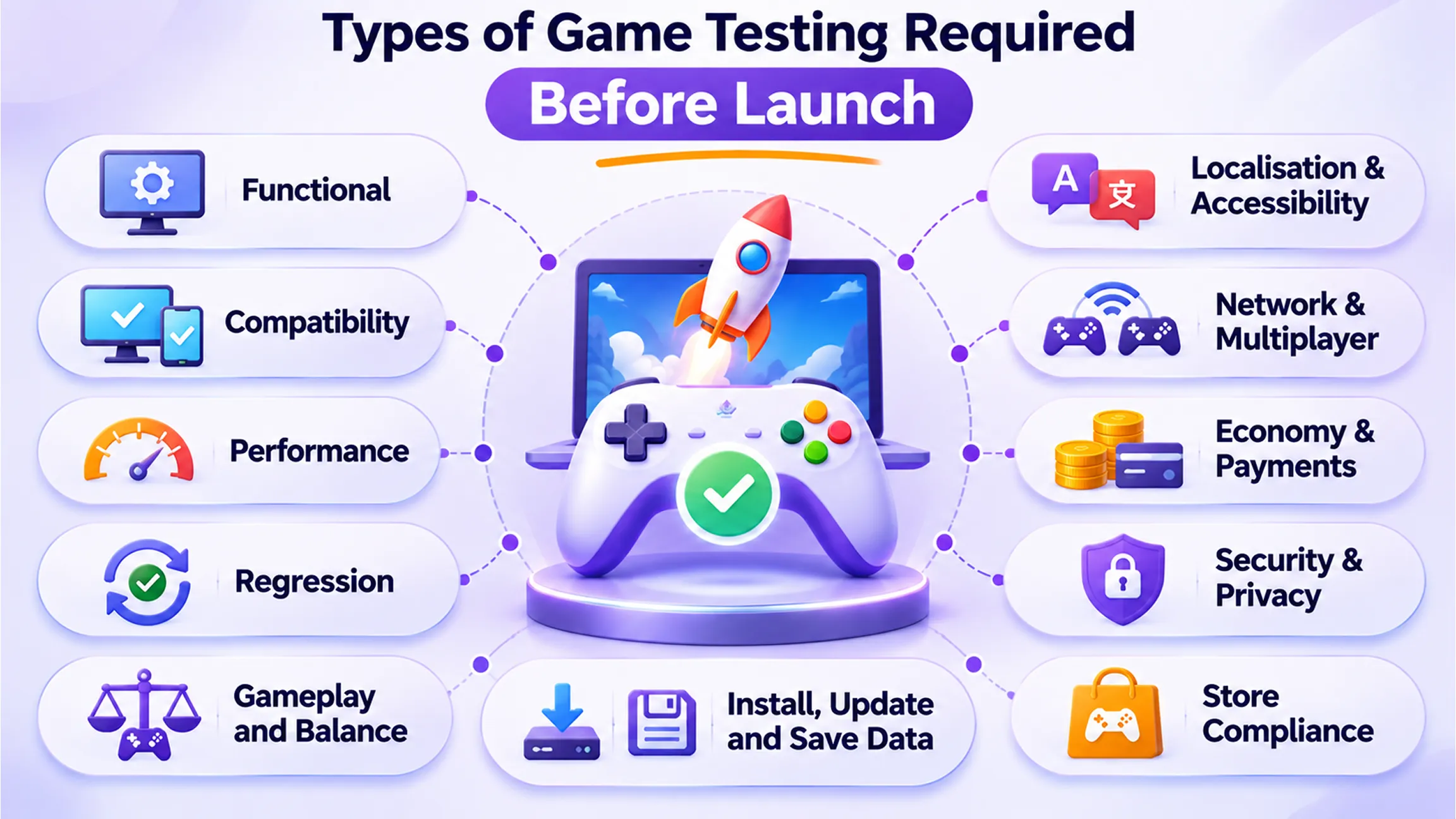
| Category | Question it answers |
|---|---|
| Functional | Does every feature work as designed? |
| Compatibility | Does it work on the devices, systems, and settings we support? |
| Performance | Is it smooth, stable, and within memory and load limits? |
| Regression | Did a change break something that used to work? |
| Gameplay and balance | Is it fair, understandable, and fun? |
| Localisation and accessibility | Does it work for players in other languages and with different needs? |
| Network and multiplayer | Does it hold up under real network conditions? |
| Economy and payments | Do purchases, rewards and currencies behave correctly? |
| Security and privacy | Is player data protected and handled legally? |
| Store compliance | Will it pass review on each platform? |
| Install, update and save data | Does it install, update, and keep progress safely? |
Functional Testing
Functional testing tests whether each of the features works according to the design. The tester tests all aspects, including menus, controls, levels, quests, achievements, saving and loading, settings, and everything else in relation to the design document.
Good functional testing is not limited to the happy path. The testers need to test unusual inputs, fast button presses, skipping steps, going back and interrupting a task, among others. Serious issues often happen at the interface of two or more systems, like a quest that cannot be accomplished following changes in the inventory.
Test for the following:
- First-time experience and tutorials.
- Gaming loop end to end.
- Progression, unlockables, checkpoints, and saving and loading.
- Menus, settings, controls, and remap controls.
- Achievements, rewards, leaderboards, and daily events.
- Error messages and fail states.
Compatibility Testing
Compatibility tests whether the game is compatible with all the hardware, operating systems, and configuration settings that you support. In mobile gaming, it involves different mobiles, display sizes, chipsets, and OS versions. In PC gaming, it involves different graphics cards, drivers, resolution settings, and input devices. In console gaming, it includes different platforms, regions, and storage configurations.
In its mobile testing checklist, QAwerk mentions that crashes caused by manufacturer skins on the Android version of the game can be undetected on emulators but quite visible on the actual device, so one should test on actual devices rather than simulators. Develop a device matrix based on your target audience demographics, which includes outdated and cheap devices alongside the latest devices.
Additionally, test for:
- Different screen sizes and aspect ratios, including notches, foldable displays, and ultrawide monitors
- Different input devices, such as touchscreen, controller, keyboard, and mouse
- Operating system upgrades and interruptions, such as calls and notifications
- Cloud saves and cross-device/cross-account login functionality
- Different regions, languages, and time zones
Performance Testing
Performance testing gauges how the game reacts to stress: frame rate, frame timing, memory usage, loading time, power consumption, and temperature. A game might meet all requirements but be unplayable due to stuttering or overheating.
Check against goals determined before testing: minimum frame rate, maximum memory usage, load time limit, and crash rate limit. Test with prolonged sessions lasting at least half an hour using middle-to-low-tier hardware to catch thermal throttling and memory leaks which would not be noticeable during shorter tests. In case of an online game, conduct load and stress tests to discover server limitations.
Regression Testing
Regression testing verifies that recent code updates have not affected previously working features. Each bug fix or new feature may have side effects; hence, it is a constant process, not a final one.
Practical Regression Testing Strategy:
- Create a suite for regression testing. Identify the critical paths: installation, initial startup, tutorials, core gameplay loop, save/load, buy/quit
- Test all the fixed bugs to ensure they’re still fixed, and nothing around them has changed
- Carry out smoke testing for each new build to make sure the build launches and the major flow works
- Automate the repetitive processes. The login process, navigation of menus, and basic flows can be automated
- Conduct a regression testing pass before releasing the product. Cover all critical points in high-risk areas and all high-priority devices
Gameplay, Balance and Usability Testing
A game can be technically sound but still difficult and annoying. To verify that progression is appropriately paced, tutorials educate about the right things, controls feel appropriate and rewarding, and that players can navigate the game, we need testers and playtesters. This phase requires human input, which is why this process is largely manual and uses actual human players.
Localisation and Accessibility Testing
If you are selling your game in several languages, make sure that you test each one. Watch out for clipping of strings, missing translations, incorrect characters, format failures, and localization issues related to culture and law. Regarding accessibility, check subtitles, color contrast, remappable controls, and accessibility options.
Network and Multiplayer Testing
In online games, it is important to test under realistic network conditions, not in an ideal office environment. Try simulating network delay, loss of packets, disconnects and reconnects, lobbies, matchmaking, server failovers, and simultaneous access by large numbers of players. Test exploit and cheating scenarios where players try impossible actions, to make sure that the server handles them.
Economy, Payments and Monetisation Testing
Wherever there is money involved, thorough testing is a must. Test payments, purchase restoration, refunds, subscription changes, currency balance, rewards, and random drop mechanics. Ensure proper display of prices, terms, and odds as appropriate, and ensure that a failed transaction doesn't leave a player paying for an object that was not received. Finally, test any possible attacks to the economic system, including duplicate items.
Security and Privacy Testing
Ensure the security of your accounts, tokens, and user personal data, that your privacy policy works; and that you are following child data privacy requirements wherever applicable. Analyze the data collection practices of third-party SDKs.
Store and Platform Compliance Testing
Every platform will have specific policies regarding technical specifications, content, privacy, in-app purchasing, and rating. As per QAwerk, some of the usual reasons behind rejections include crashes on launch, broken links for the privacy policy, false metadata, and lack of "restore purchases." For example, Google Play requires new personal developer accounts to go through closed testing with actual testers over a particular duration before production release, along with publishing stability requirements that might impact visibility, like crash and ANR rates from users' perspectives.
The way to do it is to do a walkthrough as the reviewer does. That includes installing the exact build on a clean machine, playing the onboarding, buying, opening the privacy policy, getting a phone call while playing, backgrounding and foregrounding the game, and uninstalling the app.
Install, Update and Save Data Testing
Check for issues with new installations, updating from older builds, interrupted installation, and low storage space. Ensure that save data persists after updates, that cloud saves work correctly, and that uninstallation and reinstallation work as intended. Nothing makes players angrier than losing their progress.
Bug Tracking: Writing Reports Developers Can Use
A bug that can't be reproduced will not get fixed. Bug tracking requires a good system of writing and filing reports in a database such as Jira, An Azure DevOps tool or similar.
A good bug report contains the following:
- Title: Short and specific
- Build and environment: Version number, operating system, hardware, etc
- Steps to reproduce: Numbered, sequential, beginning from a known point
- Expected behavior: What should happen
- Actual behavior: What happened
- Occurrence: All the time, some of the time, or just once
- Severity and priority: Severity refers to how critical the bug is, and priority refers to the urgency of fixing the bug
- Evidence: Screenshot, video, log files, crash dump
Keep it simple: new, assigned, fixed, ready to verify, verified and done, and reopen if the fix didn’t work. Go through the bug list in a triage session, so that you know what is urgent and who is working on what.
Severity Levels and Priority in Game Testing
Severity is about how serious the bug is. Priority tells you how important it is to fix it. These are connected, but not the same. A typo in the title screen has low severity because it’s cosmetic. But it has high priority because everyone sees it.
| Severity | What it means | Example | Typical action |
|---|---|---|---|
| Critical (S1) | Blocks launch, crashes the game, corrupts or loses save data, or breaks payments | Crash on launch, purchase charges but gives no item | Fix before release |
| Major (S2) | Breaks an important feature or path, with a hard workaround | Quest cannot be completed, matchmaking fails for a region | Fix before release or approve a documented exception |
| Moderate (S3) | Affects a feature but has a reasonable workaround | Menu option does not save until restart | Fix if time allows, otherwise schedule |
| Minor (S4) | Small issue with little effect on play | Misaligned icon, minor text error | Fix in a later update |
| Trivial (S5) | Cosmetic or very rare | Slight animation glitch | Backlog |
Agree on these terms before beginning the test process so that decisions are not made under pressure from deadlines. Include a priority field, for example, urgent, high, normal, and low, and a principle that all critical or major bugs need to have an owner and decision prior to release.
Game Release-Readiness Criteria
Release decisions should be based on criteria in writing, not on a hunch at the end of the schedule. An appropriate set of exit criteria could be:
| Area | Example criterion |
|---|---|
| Open bugs | No open critical or major bugs, and any accepted exceptions documented and signed off |
| Test coverage | All planned test cases run on the release candidate, and all priority devices covered |
| Regression | Full regression pass completed with no new critical failures |
| Stability | Crash-free session rate and long-session soak tests meet the target |
| Performance | Frame rate, memory, load time, and battery targets met on each device tier |
| Compatibility | Supported devices, OS versions, and regions verified |
| Payments and data | Purchases, restores, and save data tested end-to-end |
| Compliance | Store requirements, age ratings, privacy policy and legal text checked |
| Localisation | All shipped languages checked in context |
| Operations | Monitoring, crash reporting, support and a rollback or hotfix plan ready |
Treat the chart as a template; establish your own thresholds. Small premium game and live online game require different standards. The important part is that there is an agreement about the standard before the last week.
Release candidate rules can also be useful. If the build is marked as the candidate, only blocker-fixing patches are allowed after that; each patch should trigger a focused re-testing. Late patches that slip through are one of the most frequent sources of launch day problems.
Manual vs. Automated Game Testing
Automation fits repetitive and high-volume tasks: smoke testing, logging and menu flows testing, initial purchase flows testing, build testing, and performance benchmark testing across all platforms. It happens on every build and reveals regression issues.
Manual testing fits judgment about the game: whether the game is enjoyable, whether the tutorial is understandable, whether the battle is fair, and whether strange combinations of actions break anything. Exploratory testing, when a tester tests without a test case, uncovers a lot of strange bugs that test cases would not uncover.
Most companies combine manual and automated testing.
When Should Game Testing Begin?
Do your testing from day one, rather than waiting until near the end. Doing so lets you catch any design flaws and architectural issues that might be easy to fix. Incrementally add tests, starting with simple smoke tests and functional tests on early builds and moving through to functional and performance testing in production and then compatibility, regression, and compliance testing nearing the release. Putting off everything until the final month crowds the schedule, leaving you unable to deal with the most difficult issues.
Choosing the Right Game QA Partner
Some game developers create their own QA team, others use external game testing services, and most employ a combination of both approaches. The external partner is useful when actual device testing, additional capacity at launch, specialized skills such as localization or multiplayer load testing, or an objective assessment of the risks associated with the release are needed.
In picking a game QA partner, consider:
- Relevant experience: Games on your platforms and in your genre
- Real access to devices: A real device lab or a concrete way to support your matrix
- Reporting clarity: Reproducible bug reports, definitions of severities, and periodic reports
- Process compatibility: The ability to operate within your bug tracking system, build pipeline, and communication systems
- Flexibility: The ability to ramp up before launch and ramp down after launch
- Security: Protection of your unreleased builds, such as NDAs and access restrictions
In case you need QA that is closely integrated into your development process, you can turn to game development services providers that also provide game QA services, who can coordinate testing with development so that testing plans, device matrix, and release criteria are set up in advance. Ask any provider to show you some reports, their approach to severity disputes, and typical pre-launch cycle.
Common Game QA Mistakes
- Late testing. The issues discovered during the last weeks are the hardest to fix.
- High-end devices only. Most gamers use old hardware.
- Regression skipped. The fixes create more problems than they solve.
- Vague severity definitions. Everything gets categorized as critical, or nothing gets.
- Bad bug reports. Unreproducible and unaccompanied reports only waste everyone’s time.
- Not accounting for extended gameplay. Memory leaks and overheating happen after long periods of playing.
- Not remembering store guidelines. You get delayed because of that.
- No release criteria. The decision gets political rather than based on facts.
Conclusion
The approach to game testing and QA should be a process which begins early, follows the plan, and ends with well-defined release criteria. Make sure that all of the important categories are tested, define the severity of all bugs,d do the regression for each change, and make the release decision based on evidence. Irrespective of whether you are doing your testing yourself or working with a game QA partner, the objective remains the same.
Written By Vaibhav Karanwal