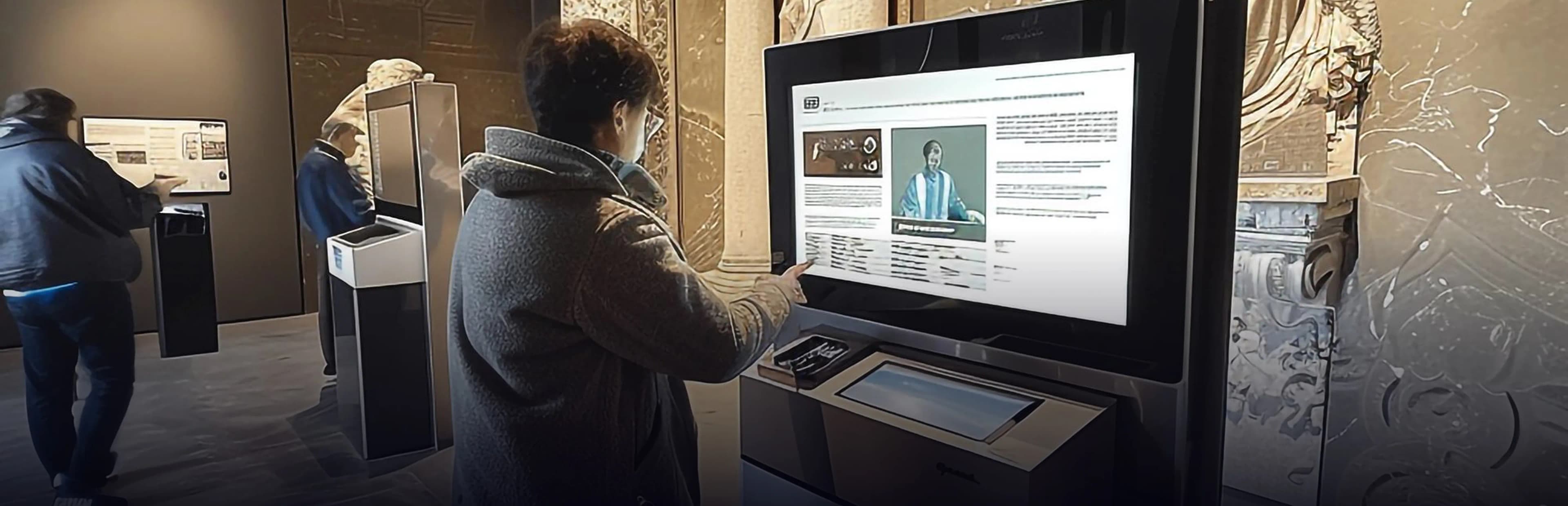
Interactive museum kiosks are changing the way visitors explore history, art, science, and culture. Instead of relying only on printed descriptions and traditional displays, museums are increasingly using digital experiences to make exhibits more engaging. An interactive kiosk conveys information to guests by letting them explore, touch, watch, listen, and interact with the information at their convenience. Such kiosks can include different digital maps, timelines of history, 3D models, videos and films, quizzes, multilingual materials and artefact descriptions, and many features that enable storytelling and provide additional information without filling the museum’s space with physical items. However, when choosing a supplier, museums do not only look for a provider of a touchscreen. It is critical to choose the right partner with a good understanding of user experience, interactive content, UI/UX, hardware, and analytics.
What Are Interactive Museum Kiosks?
Interactive museum kiosks are digital touchscreen installations that allow visitors to interact with museum content. Unlike static digital signage, these systems let users actively control what they see and explore.
Museums can use interactive kiosks for:
- Exhibit information
- Digital storytelling
- Interactive timelines
- Museum maps and wayfinding
- Virtual tours
- 3D artifact exploration
- Educational games and quizzes
- Multilingual information
- Accessibility support
- Visitor surveys
- Ticketing and self-service
- Event information.
Top Interactive Museum Kiosks Companies
1. Abhiwan Technology
Abhiwan Technology is one of the top interactive kiosk companies that provides interactive and immersive digital solutions across industries. The company is skilled in game development, augmented reality and virtual reality, artificial intelligence, digital twin technologies, metaverse solutions, and other digital technologies. Moreover, the company offers both interactive experience products and industry-related digital solutions. The combination of interactive technologies, 3D technologies, augmented reality and virtual reality, and custom software can help museums create experiences that are more immersive than just providing information using generic tools. This means that organizations may turn to Abhiwan and look to them as a custom solution provider rather than just a vendor of kiosk hardware.
2. KIOSK Information Systems
KIOSK Information Systems is a kiosk solution vendor well-known for its kiosk hardware and software solutions. It is regarded as one of the major vendors in the field of interactive kiosks. The company has obtained recognition from the kiosks manufacturer association. KIOSK Information Systems' experience in self-service and interactive kiosk projects allows companies to find out what they need in the form of established kiosk architecture. For museums, an organization like this will be suitable when the project has to do with good, reliable hardware, touch screens, peripherals, and long-term deployment.
3. Olea Kiosks
Olea Kiosks is noted for providing customized and standard kiosk solutions. The Kiosk Manufacturer’s Association has classified it as one of the top kiosk companies. Custom-made hardware can be highly beneficial for museums because each exhibit has distinct space issues, branding, audience flow, and interaction requirements. Museums may need a wall-mounted touchscreen for a small exhibition or a freestanding kiosk for a bigger show, or even customized hardware designed to highlight a particular artifact.
4. Meridian Kiosks
Meridian Kiosks is another company recognized among top players in the interactive kiosk market. Research indicates that Meridian Kiosks is one of the companies offering interactive kiosks along with the likes of Advantech, NCR Voyix, and Olea Kiosks. With its entry into the global kiosk scene, Meridian needs to be evaluated by organizations assessing commercial kiosk hardware solutions.
5. REDYREF
Another established vendor in the kiosk market is REDYREF, which is reported in various industry reports and is listed in the Kiosk Manufacturer Association’s database of companies. This company can be of value to those who are looking for the customizable options of kiosks. Configurable systems can provide museums with the ability to create solutions for visitor information, online guidance, and other digital experiences. When choosing a vendor like REDYREF, museums should pay attention to the flexibility of customization, compatibility of software solutions, display demands, accessibility, and service.
Important Features of Interactive Museum Kiosks
Choosing the right interactive kiosk companies requires looking at various factors.
Touchscreen Interaction
Touch provides an opportunity for visitors to gain access to information in a self-guided manner. Easy navigation is a way to make a large amount of information readily available without overwhelming the user.
Multimedia Content
Museums ought to mix written content with pictures, sound, video, animations, and even 3D representations. This can help explain complicated historical or scientific matters.
Interactive 3D Models
3D models can enable visitors to manipulate and examine digital models of museum exhibits. This can be considered useful in cases when the original object is too delicate or cannot be examined in a direct way.
Digital Wayfinding
Big museums may make use of kiosks that help visitors find ways to galleries, exhibits, restrooms, cafés, exits, and other facilities. Interactive maps can recommend a route following the interests of visitors.
Multilingual Support
Museums attract many foreign visitors. A kiosk may provide information in different languages without the necessity to invent and install different plates in any language available.
Accessibility
Accessibility must be considered from the very beginning of kiosk design. The layout of the interface, legibility of the text, audio options availability, intuitiveness of the navigation, positioning, and assistive features serve to provide users.
Analytics
Interactive systems can collect useful, privacy-conscious information about how visitors interact with exhibits. Museums can use this data to understand which content receives attention and which experiences may need improvement.
How Museums Benefit From Interactive Kiosks
Utilizing interactive kiosks provided by interactive kiosk companies can enhance the visitor experience in different ways and help museums maximize their physical locations.
A regular exhibition may have limits in terms of its capacity to provide descriptions, images, and other information. However, an interactive kiosk allows the exhibition to deepen its content without expanding physically.
For instance, a museum may display an object in a glass case and place a touchscreen next to it. Visitors wishing to learn more about the particular subject may interact with the kiosk.
Hence, there are various levels of engagement involved. Visitors wishing to briefly overview the subject matter may move on, while those interested in it may learn more about it.
Future of Interactive Museum Kiosks in 2026
Museums are experiencing a shift towards more personal and immersive interactions through technology. Touchscreens now form part of a bigger technological ecosystem and can include aspects like AR, sensors, projection, spatial computing, as well as 3D techniques.
The emergence of engaging cultural experiences illustrates how technology has impacted relations with exhibits. For example, in 2026, the DATALAND exhibition opened with interactive AI-based installations that change based on the reaction of the visitors.
At the same time, organizing and content management remain important, as museums sometimes have to deal with several interactive installations. Thus, distributed installations give museums more flexibility in managing and monitoring the content.
This indicates that the future of museums will not feature bigger screens; there is a shift towards more meaningful interaction, enabling people to find the information they need and get involved better through storytelling.
Conclusion
Interactive museum kiosks can transform traditional exhibits into engaging digital experiences. Visitors are empowered in terms of the way they consume information, and museums are able to provide a greater amount of information without getting overcrowded in terms of physical space. Kiosks can assist in a variety of things and can be used in touchscreen exhibits, maps, 3D models, multimedia stories, tests, augmented reality, and interactive simulations.
Choosing the best provider depends on the project objectives. The above-mentioned companies can be consulted if a museum needs custom solutions for interactive software with the above-mentioned technologies.
Written By Vaibhav Karanwal