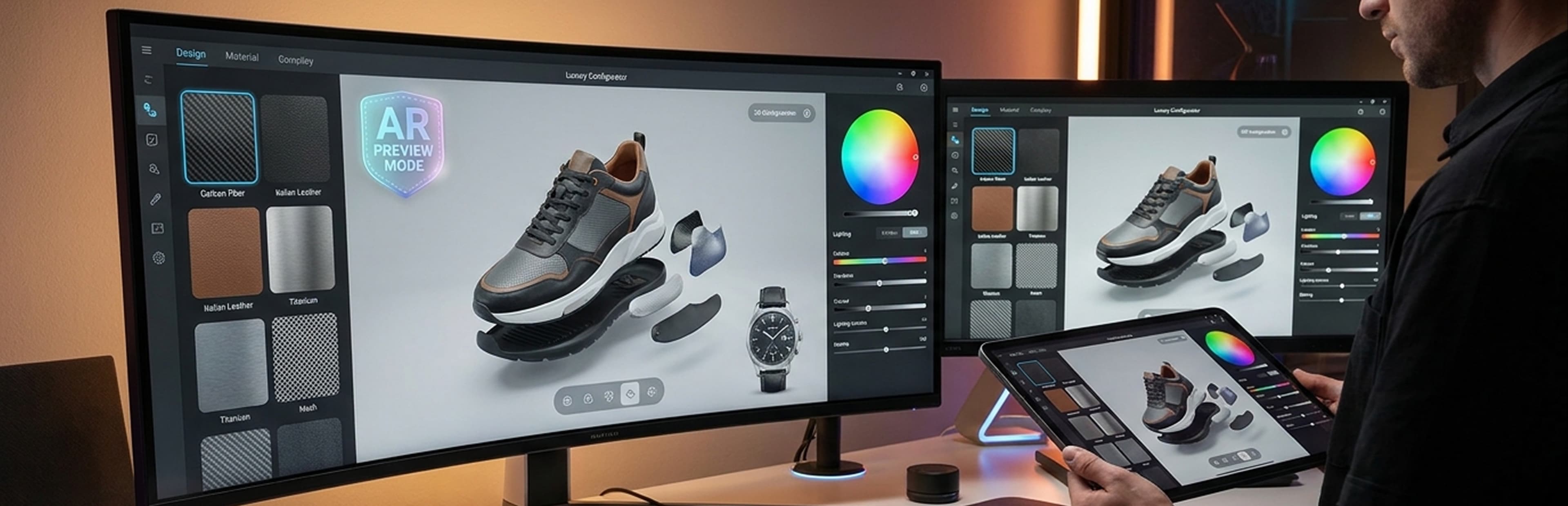
Ecommerce Product Configurator technology is changing how online stores present customizable products. Rather than expecting customers to navigate through a complicated array of dropdowns and envision the end product, brands can give consumers more transparency in their product selection process. Using a product configurator, customers will be able to select colors, materials, sizes, components, and various accessories and instantly see their choices applied to the final product. Specifically, this tool will permit customers to examine available product options, calculate costs, and visualize the final version of his/her product. This can simplify the buyer decision-making process for such complicated purchases as buying a car, furniture, jewelry, clothes, and home goods. Shopify observes that shoppers can benefit enormously from the real-time visualization and greater clarity and transparency in terms of pricing provided by product configurators. The market of configurators in 2026 will be represented by specialized platforms, suppliers of visual commerce solutions, developers of 3D technology, and companies dealing with custom development projects.
Top Ecommerce Product Configurator Companies
1. Abhiwan Technology
Abhiwan Technology is one of the top unity 3d configurator service provider company. This company offers services such as game design services, 3D applications, AR/VR development, interactive experiences, and development of customized digital goods. Companies looking to design an ecommerce product configurator can consider Abhiwan Technology for interactive and custom 3-D product experiences based on product offerings and specific business needs. A customized configurator helps customers move products around, zoom in on them, alter colors, change materials, add components, and see multiple combinations in real-time. Depending on the nature of the project, the technology can also be linked to product specifications, prices, e-commerce systems, and other backend services.
2. Threekit
Threekit is a visual commerce platform that specializes in product design, 3-D visualization, and AR. Companies seeking a digital way of letting their customers interact with their product offerings can use the technology. Year 2026 indicators prove that Threekit is leading in terms of enterprise visual commerce and ecommerce/CRM integrations. One more advantage of using such a platform as Threekit is that companies do not need to individually build every configuration function and may use a unique visual commerce solution.
3. Zakeke
Zakeke is a platform that helps businesses personalize their products and visual commerce. It is especially great for businesses that want to add product personalization in their e-stores. According to industry comparisons, Zakeke is a solution that supports integration with platforms such as Shopify, WooCommerce, Magento, and BigCommerce. Zakeke is useful for products where customers can change the design, colors, text, pictures, and other characteristics. This benefit is particularly useful for Shopify merchants since the customization process can be incorporated into the customer's journey.
4. Expivi
Expivi is a visual commerce and product configuration platform that is famous for its integration of 3D product configuration with pricing and product configuration rules. It can be beneficial for companies that sell products with complicated associations and pricing regulations. Here, the main function is based on logical functions, not just visuals, because in some instances it would be impossible to combine some options together.
5. Roomle
Roomle focuses strongly on 3D product configuration, space planning, and the furniture experience with Roomle. Furniture is one of the best examples of using an e-commerce configurator since customers need to visualize how different furniture items, their sizes, and materials can fit together. With the help of an interactive experience, clients can see combinations of furniture and products even before purchasing them. Hence, Roomle is relevant to every furniture brand or interior company and any business selling modular items.
How an Ecommerce Product Configurator Works
An ecommerce product configurator connects product options with an interactive interface. The customer starts with a base product and selects available options.
These could include:
- Color
- Material
- Size
- Shape
- Components
- Accessories
- Finishes
- Personalization
- Engraving
- Dimensions
The visual representation changes as the customer makes selections. For a simple product, the configurator may only need a few options. For a complex product, the system may need configuration rules to determine which combinations are valid.
Unity 3D Configurator vs Web-Based Configurator
When it comes to making a product configurator, options of technology are available to companies.
Unity 3D configurators are good for products that need more complex 3D graphics, moving images, possibilities of interaction, and lifelike environments.
Unity has a strong ability to render images in real time and generate 3D images.
However, web-based configurators may be more beneficial for ecommerce, as customers can access them through a web browser directly.
Web-based 3D experiences often use such technologies as WebGL and Three.js.
The choice of solution should depend on the nature of the product and the consumers to be targeted.
If the core goal is just product customization for ecommerce, a web-based solution is better.
If the project needs advanced visual features, Unity or other technologies can add more functionality.
Shopify 3D Product Configurator
A Shopify 3D product configurator for Shopify can integrate interactive customization into a current e-store. Shopify provides product and variant functionalities, while the ecosystem includes numerous applications for 3D, AR, and product configuration. The Shopify App Store contains about 300 apps in its 3D/AR/VR category alone that include product configurator functionality.
Using a Shopify configurator, the customer can customize the product and send the chosen options to the shopping cart.
Depending on the solution, features can include:
- 3D product previews
- Color selection
- Material selection
- Component switching
- Dimension changes
- Personalization
- Real-time pricing
- Add-to-cart integration
- AR visualization
- Conditional configuration rules
Some Shopify configurators are tailored specifically for product selection and pricing updates on product pages. Thus, businesses have to decide if they need ready-made or custom Shopify configurators.n.
Benefits of a 3D Product Configurator
A 3D product configurator can improve the ecommerce experience in several ways.
Better Product Visualization
Customers are able to see a product from all angles as opposed to examining 1 or 2 photos. This is especially advantageous for expensive and customizable products.
More Confident Purchasing
By observing a product that has already been configured, customers can feel more assured. This is especially relevant in the case of products that are bulky and cannot be returned easily. According to a Shopify study, visualization is important in helping customers to become more confident in their purchases of customized products.
Product Personalization
Customers can customize their own product, thereby increasing their involvement in the process. It increases engagement because users actively participate in designing the final product.
Faster Sales Process
For companies that traditionally rely on the sales reps to provide customers with the necessary tailored quotations, these tools can make the sales process smoother. With the help of Shopify 3D Product Configurator, customers can check their alternatives before contacting the sales department.
Better Product Understanding
When customers can interact with the product, it makes it much easier for them to grasp its complexities. 3D visuals can illustrate how different components are combined into the whole.
Industries That Can Use Ecommerce Configurators
Furniture
Shopify 3D Product Configurator is particularly effective in furniture. It enables customers to personalize their choice of material, color, dimensions, sections, and layout.
Automotive
Vehicle configuration apps allow customers to choose the color, wheels, interior, accessories, and additional parameters of the car.
Jewelry
Jewelry can be personalized by customers through different types of metals, gemstones, sizes, engraving, and other characteristics.
Fashion
Fashion companies can provide personalization services using colors, types of materials, prints, monograms, and other elements.
Consumer Electronics
Customers can select options related to color, memory, accessories, and product combinations.
Manufacturing
With the help of configurators, producers can provide their customers with the possibility of selecting machine components.
Home and Interior Products
Various types of home products, like flooring, kitchens, lighting, windows, and doors can benefit from interactive configuration and visualization.
How to Choose an Ecommerce Product Configurator Company
Before choosing a development company or platform, businesses should consider the following factors.
Product Complexity
First of all, clarity should be achieved regarding the number of different configurations available for the product. A product with a maximum of three options can be simple and not require advanced systems to work.
3D Quality
The quality of the three-dimensional model is important. Bad quality models will spoil the entire perception of the experience. Thus, you must ask about three-dimensional modeling, texturing, materials, lighting, optimization, etc.
Ecommerce Integration
Make sure the configurator works well with the e-commerce platform you use. For example, Shopify merchants should be aware of how configurations process different options, variations, carts, payments, and checkout.
Performance
Three-dimensional experiences can require too many browsing resources. Models and textures should be optimized to make sure the configurator is loaded fast and works smoothly.
Mobile Experience
A high amount of e-commerce traffic comes from mobile devices. That is why the configurator should work properly on mobile devices, including responsive design..
Pricing Logic
If different configurations have different prices, the system should update the price accurately. For complex products, businesses may also need rules that prevent incompatible combinations.
Analytics
Tracking customer interactions can help businesses understand which options shoppers prefer.
Useful data may include:
- Most selected colors
- Popular materials
- Frequently chosen accessories
- Abandoned configurations
- Completed configurations
- Add-to-cart rates
This information can help businesses improve product offerings and marketing strategies.
Conclusion
An ecommerce product configurator can transform a traditional online product page into an interactive shopping experience. Rather than asking clients to envision what combinations would look like, brands could allow consumers to make their own products and see the outcome in real time. The previously mentioned businesses are a mix of custom development firms, visual commerce solutions providers, firms specializing in three-dimensional applications, as well as e-commerce suppliers. All approaches have upsides, and businesses should choose a solution according to the complexity of the product, three-dimensional needs, type of e-commerce platform, pricing policy, possible integrations, and financial capacities. A 3D configurator can be helpful for advanced interactive and immersive solutions, whereas browser-based 3D solutions could be the best option for direct e-commerce propositions. For Shopify vendors, a Shopify product configurator can bring customization to the store and create opportunities for clients to transition from product browsing to checkout. Shopify continues to grow in thousands of applications in the 3D and AR/VR area, with multiple applications for product configurator implementation.
Written By Vaibhav Karanwal