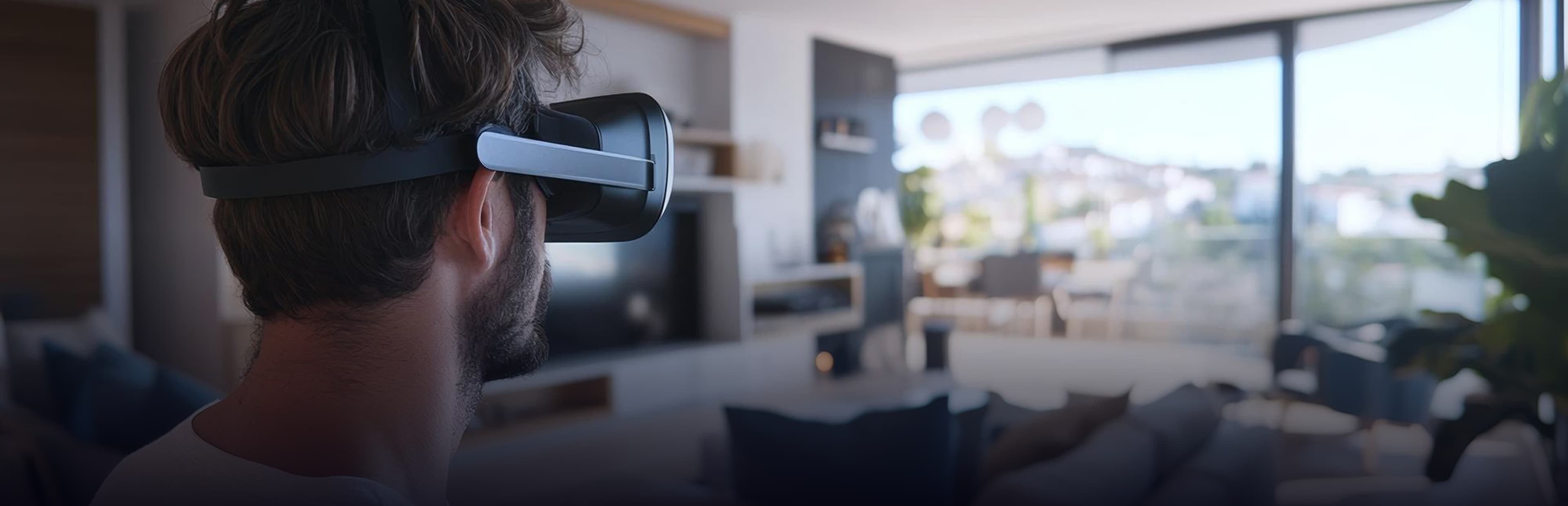
An interior VR tours development company puts together advanced digital spaces where people can become acquainted with a specific interior before it has been actually created or renovated. Virtual reality tours include 3D visualizations, realistic materials, lighting, and interactive navigation, which help people better understand spaces. Abhiwan Technology provides virtual environments for residential, commercial, retail, and real-estate purposes. The research performed in 2026 indicates a growing trend in terms of using virtual reality for the interior design industry, as the technology helps improve the perception of spatial relationships, achieves effective visual communication, and makes design evaluation easier. According to the research conducted and published in Procedia Computer Science, virtual reality solutions, rendering engines, and environment simulation systems can contribute to a better understanding of interior design solutions.
What Is Interior VR Tours?
Interior VR tours are interactive computer services which will enable the customer and designer to virtually visit or construct the proposed space/property. While typical images show a picture of the space, the VR tour enables moving within the interiors and having a view of layouts from different angles while inspecting furniture, lighting, materials, architectural features, etc. An interior VR tours development company will develop the virtual environment using architectural drawings or CAD data, BIM, or 3d elements, images, or 360-degree images, which will make an interior design virtual interior design services helpful in showcasing complicated and detailed spaces remotely.
Further, the environment will be enhanced by means of optimum performance and smooth navigation within various compatible technologies. Clients and designers understand the spatial relations in a better manner and also provide options for space evaluation in the early stage of designing, which makes virtual interior design services more helpful and can be used for presentations remotely.
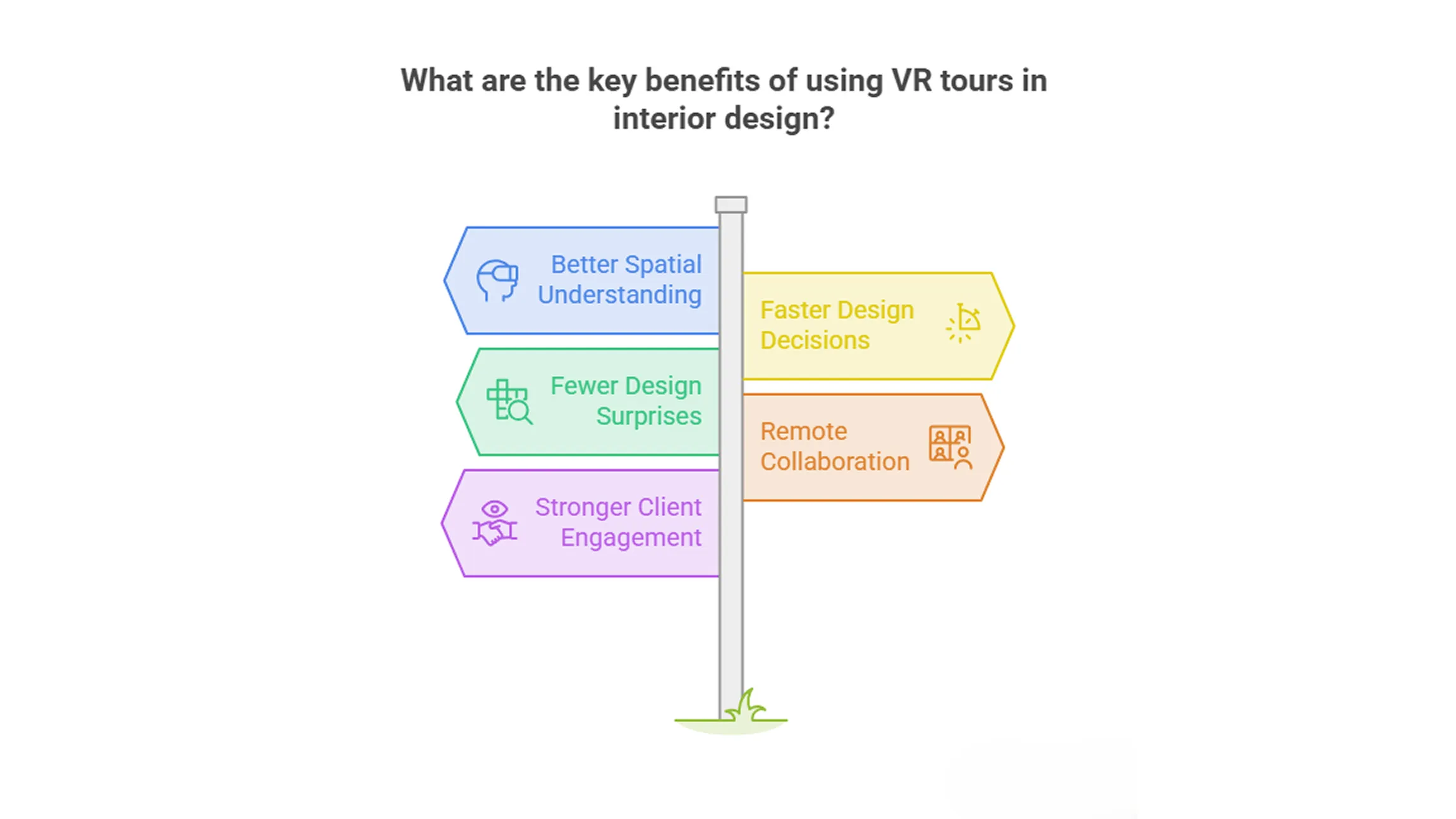
What are the Key Benefits of Interior VR Tours?
The value of immersive visualization goes beyond making an interior look attractive. It can help teams communicate design ideas, identify concerns, and make decisions earlier in the project.
Better Spatial Understanding
In a VR setting, people can conceive space in more human terms. They can perceive proportions of rooms, ways of movement, arrangement of furniture, height of ceilings, and connections of different areas much more intuitively than with flat images.
Faster Design Decisions
Clients can envision different layouts, materials, and light conditions using the same VR environment. This way, an interior VR tours development company can help lessen doubts about the designs and facilitate comparison.
Fewer Design Surprises
Static renders demonstrate how a room appears from a single angle. In contrast, VR enables individuals to explore the space from many angles, solving any problems with movement, visibility, proportions, and the arrangement of objects before working on the real room itself.
Remote Collaboration
Design teams are able to have virtual spaces with clients at different locations. Therefore, virtual interior design services offer a solution for remote consultations, and the best online interior design services can enhance digital design reviews and lessen the dependency on physical site visits.
Stronger Client Engagement
An interactive method of displaying data makes interiors more alive and not only a bunch of images. Thus, the best online interior design services give their clients amazing opportunities to demonstrate the ideas to them.
How Are Interior VR Tours Developed?
A successful VR experience depends on both visual accuracy and technical performance. The development process usually moves through several connected stages, with each stage affecting the final experience.
Space Discovery
The initial task is to define the purpose of the work, targeted users, which design files are available, on what platforms the solution must work, and what the level of interaction must be. The best interior VR tours development company defines the right visualization technique based on the details provided by the client.
3D Environment Creation
Different varieties of architectural drawings like BIM information, references, and floor plans are turned into a detailed 3D environment. The dimensions and proportions of the model must be accurate; this is because even minor mistakes in modeling lead to a wrong perception of the space.
Materials and Lighting
Textures, materials, furnishings, and other elements create a living environment. Lighting is especially critical for how a room appears in terms of spaciousness, warmth, brightness, and functionality.
VR Integration
The navigation, transitions between rooms, hotspots, panels with information, and other interactive features are incorporated into the environment. Depending on the project, the experience could be made for browsers, mobiles, desktops, or VR headsets.
Testing and Optimization
Highly detailed settings may require a lot of processing power. So developers optimize models, textures, lighting, and the way objects are rendered in order to ensure smooth performance of their applications while keeping key visual aspects intact.
Applications of Interior VR Tours Development Company
Interior VR is useful wherever people need to understand a space before visiting, building, renovating, or approving it. Its role can vary depending on the industry and project objective.
Residential Interiors
Clients can visualize the kitchens, bedrooms, living rooms, bathrooms, and entire houses that are being proposed for construction. The best online interior design services can easily showcase layouts, furniture options, colors, and finishes.
Commercial Spaces
Various companies, such as offices, restaurants, shops, and showrooms, can use virtual walkthroughs to analyze layouts and customer traffic, which will allow them to sort out the functionality before making any changes in real life.
Hospitality
Hotels and resorts can showcase sleeping rooms, lounges, eating facilities, and amenities using virtual bedrooms, while virtual interior design services can assist developers in exploring these spaces and proposing design adjustments to them before implementation.
Real Estate
Virtual property tours permit customers and investors to check out the layouts of real estate online and without being there physically. By 2026, virtual tour companies are likely to be adopting even more advanced methods and introducing a variety of virtual tours together with plans and measurements of the rooms.
Showrooms
Digital showrooms can provide customers with an option to see various products in realistic settings. That is very important for products such as furniture, floor coverings, lighting fixtures, kitchens, etc.
What Features Should an Interior VR Tour Include?
Not every project needs the same level of immersion. The right features should be selected according to the users, space, and business objective rather than added simply because they are technically possible.
Realistic Visualization
Correct elements: materials, textures, furniture, lighting, and proportions enable attendees to feel the appropriate environment. Realistic imitation of the designed environment is crucial when the technology is used to receive approvals for designs.
Interactive Navigation
Attendees of the event should be able to navigate the area smoothly. The controls should be simple enough, and movement between rooms should be easily managed.
Design Variations
A helpful VR environment is able to present many design alternatives. Every user gets an opportunity to analyze different variations (e.g., flooring, wall finishing, furniture placement, colors, lighting, etc.) without creating a totally new environment.
Cross-Platform Access
The compatibility of browsers and mobile devices makes it possible to distribute a virtual experience easily. The best interior VR tours development company is likely to offer solid headset support when one requires enhanced immersion for demos and presentations.
Performance Optimization
Visual quality of the content should not hinder usability. The interior VR tours development company has requisite expertise in optimizing the models and assets to ensure efficient loading and responsiveness.
Technology Behind Immersive Interiors
Different projects require different technology stacks. A lightweight panoramic tour may rely mainly on 360-degree imagery, while a fully interactive experience requires real-time 3D development.
| Technology | Purpose | Benefit |
|---|---|---|
| 3D Modeling | Creates digital interiors | Better visualization |
| Real-Time Engines | Powers VR interaction | Smooth experience |
| BIM | Uses building data | Greater accuracy |
| 360° Capture | Creates panoramic tours | Quick property viewing |
| VR Headsets | Enables immersive viewing | Stronger spatial experience |
| Web & Mobile | Enables easy access | Wider reach |
| Interactive Features | Adds hotspots and options | Better engagement |
3D Modeling
The basic framework for an interior is given by the 3D models themselves. The 3D models outline the layout of walls, ceilings, floors, furniture, fixtures, and other elements that can be spotted by the users during the tour.
Real-Time Engines
Real-time engines enable users to engage with different spaces instead of passively observing them. The best interior VR tours development company uses the latest technologies for navigation and lighting, interaction, animation, and optimization of devices.
BIM Integration
BIM models provide architectural information that can be helpful in creating realistic environments. BIM and VR can work together to provide accurate presentations of unbuilt spaces.
360-Degree Capture
For existing interiors, it may not be required to build everything from scratch, as panoramic photography or scanning will also work. This choice depends on whether the project needs photographic representation or a fully editable 3D environment.
Latest Facts and Trends
VR is beginning to take on a much more active role in the design process, rather than just being a presentation tool. A study done in 2026, which was published in Frontiers in Virtual Reality, tested an interactive VR office setup system with 50 subjects. This study found that the presentation format had an effect on aesthetic perception, leading to changes in the assessment of interior options for interiors.
Another study done in 2026 regarding VR in the design industry found that the use of VR combined with algorithms, rendering engines, and environment simulation showed a lot of advancements. One of the studies done in 2025 reported that the use of BIM and VR based on phone apps helped improve understanding of the space for more than 80% of subjects.
All this points to the fact that the services offered by the top interior VR tours development company are moving towards interactive evaluation instead of visual presentation.
How much does a virtual tour cost?
Depending on various factors including the size of the property, the number of rooms, the method by which the tour was captured, the visual quality, and the amount of interactivity involved, the price of virtual tours can vary widely between $100 and $10,000+. A simple 360-degree tour could be $100 to $500, while a professional home tour with multiple rooms in it, customized hot spots, branding, and extensive navigation would range between $500 and $3,000. For a highly customized virtual reality experience, including detailed 3D models, realistic materials, lighting, animations, configurators, or headset support, costs may even exceed $5,000 or $10,000. The price might also depend on the hosting and maintenance of the tour, other revisions, as well as custom integrations. Overall, the price of virtual tours depends on the scope, specifications, number of locations, and the degree of immersion you are paying for.
What is the best software for creating 360 virtual tours?
The right software will vary depending on the complexities involved in the different tours. For example, Matterport is ideal for creating virtual tours of properties and digital twins. Kuula is used for assembling a series of 360-degree images into interactive tours. If you want a high level of customization with opportunities to use hotspots, multimedia icons, navigation options, and VR technology, then you should use 3DVista. If you just need a simple property tour, then there is no need for complicated software. In contrast, if you need to build a custom virtual environment, recreate materials, manufacture product configurators, or apply some advanced navigation options and VR features, you need to choose a specific development tool.
Conclusion
An interior VR tours development company transforms interior ideas into interactive spaces, making them more convenient for navigation, comprehension, and assessment. VR makes it possible to get a deeper understanding of scale and spatial relations compared with visuals presented in static form. Existing research conducted in 2026 shows the relevance of immersive technology in interior visualization and design assessment processes. Abhiwan Technology merges architectural visualization, 3D environment creation, virtual reality, and interactive software development to produce immersive interior experiences.
Written By Charu Sharma