
Modern shopping malls are becoming larger, more complex, and more experience-focused. Visitors may need to find stores, restaurants, restrooms, parking areas, entertainment zones, or special events across multiple floors. Traditional signs and printed directories may not provide the fast and flexible experience shoppers expect today. This is where interactive kiosk development can help mall operators create a smarter wayfinding experience. By using an interactive kiosk, visitors can locate stores, navigate the local mall, receive directions, learn about available promotions, and obtain useful information via a touch-screen interface. For shopping centre owners and businesses alike, finding the right kiosk solution can ease navigation and enhance the possibilities for customer engagement and marketing.
What Is an Interactive Kiosk for Mall Navigation?
An interactive kiosk for mall navigation is a digital system with a touch screen allowing a customer to locate and find information in the shopping mall. Rather than contacting someone, reading a directory, or exploring a map, customers can simply interact with the kiosk. They can search and choose the store, see its location, and hear directions.
An excellent example of a kiosk is when a visitor enters “sports shoes” into the kiosk. The kiosk can display relevant stores, show their floor and location, and guide the visitor toward the selected destination. This is how an interactive information kiosk functions and looks like an interactive information point that enables plenty of things for customers: navigation, advertising, marketing.
Why Do Malls Need Interactive Kiosks?
Navigating through a large mall can be a challenge for people visiting the mall for the first time. There can be instances such as relocating stores, the arrival of new stores, or temporary events. It is difficult for traditional directories to change along with the flow of the mall. Using digital kiosks ensures that visitors have access to maps that can be updated as per their needs.
Faster Store Discovery
Shoppers can directly seek a shop without just wandering and looking for signs everywhere.
Better Visitor Experience
The use of digital maps in the mall will make the experience less annoying for visitors compared to traditional methods of guiding customers. Interactive kiosk companies play an important role in improving the visitor experience.
Less Pressure on Information Desks
Visitors won’t be dependent on the mall’s employees for locating their destination using a map. For all these reasons, interactive information kiosks play an important role in every industry.
Better Promotion Opportunities
A navigation kiosk can also display offers, events, campaigns, and brand promotions alongside location information. This is one of the important reasons most of the brands are using services from an interactive kiosk development company.
Flexible Information
Mall operators can update store information, promotions, maps, and other content without replacing physical signage.
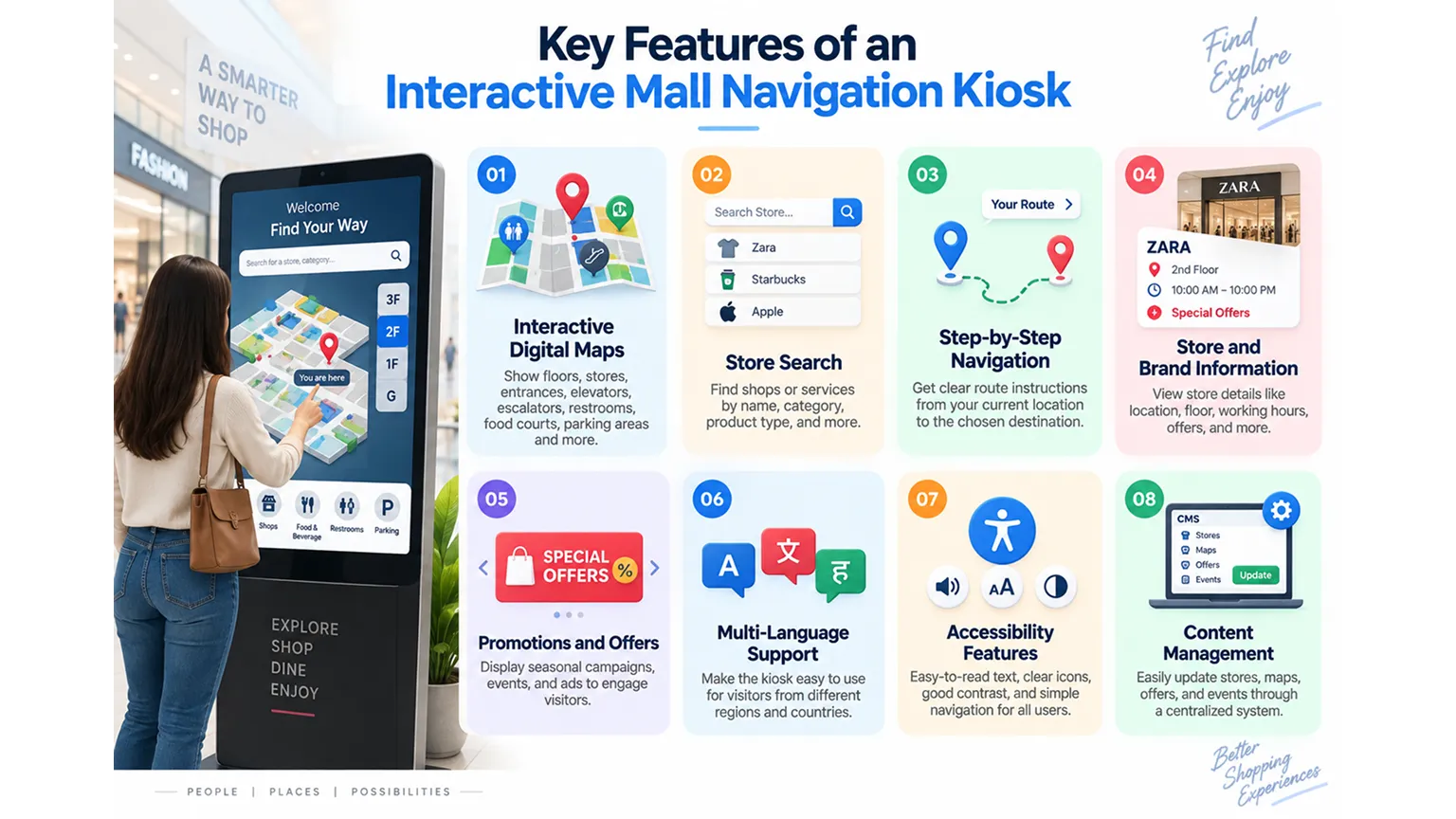
Key Features of an Interactive Mall Navigation Kiosk
The success of a mall kiosk depends on more than the physical screen. The software, interface, mapping system, content management, and backend integrations all need to work together.
1. Interactive Digital Maps
A digital map gives visitors a visual understanding of the mall layout. It can show floors, stores, entrances, elevators, escalators, restrooms, food courts, parking areas, and other important locations. For multi-level malls, the interface should make it easy for visitors to switch between floors and understand where they are.
2. Store Search
This function enables customers to search for the desired store. The system allows searching for various shops or services by name, category, product type, etc. This is especially valuable when there are hundreds of shops located in the mall.
3. Step-by-Step Navigation
Once the destination is decided, the apparatus can show the route between the visitor's current location and the chosen destination. Digital wayfinding systems can assist in navigating the space by providing searchable maps and route instructions.
4. Store and Brand Information
A kiosk is capable of providing various details related to the chosen shop, such as information related to the type of store, number of floors, location, working hours, offers, and promotional content. Thus, navigation enables a shopping experience.
5. Promotions and Offers
You can display various promotions and seasonal campaigns, events, and ads on kiosk screens. Therefore, it is possible to use the same system for both navigation and visitor engagement.
6. Multi-Language Support
Large malls often serve visitors from different regions and countries. A multilingual interface can make the kiosk easier for a wider audience to use.
7. Accessibility Features
Kiosks should be designed with text that is easy to read, easy-to-understand icons, good contrast, natural navigation, and other accessibility features for user comfort.
8. Content Management
Mall operators should be able to easily make changes regarding stores, maps, offers, events, and so on. A centralized content management system would help facilitate such changes.
How Interactive Kiosk Development Works for Mall Navigation
A successful kiosk project requires more than installing a touchscreen. The software should be designed around the mall's layout, visitors, business objectives, and hardware environment. Most of the interactive kiosk companies follow these steps while developing the kiosk,
Step 1: Requirement Discovery
The first step is to understand the mall environment and project objectives. The development team should consider the number of stories, types of stores, user needs, existing systems, and the location of kiosks, as well as the required features.
Step 2: UI/UX Design
The user interface must be simple enough for the users to understand without any training. This can be done with the help of big touch buttons, understandable icons, clear information, logical menus, and simple navigation.
Step 3: Kiosk Software Development
The third step involves the creation of the software to run the kiosk, depending on what is required. The software can include map navigation systems for the store, store directories, search capability, offers, APIs, databases, analytics, or integration.
Step 4: Testing and Validation
The fourth step consists of testing the software and hardware. Mall kiosks work for a long time and take a lot of visitors. Therefore, testing should include all usability and software stability.
Step 5: Deployment
Once the kiosk application has been tested, it can be configured for the selected hardware and deployed at the required mall locations.
Step 6: Support and Updates
Mall information changes regularly. New stores open, existing tenants move, promotions change, and events are added. Ongoing technical support and content updates can help ensure that the kiosk continues to provide accurate information.
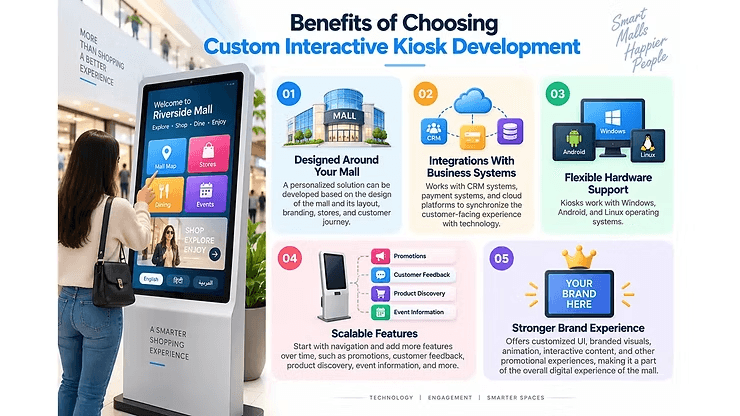
Benefits of Choosing Custom Interactive Kiosk Development
A ready-made kiosk may work for basic requirements, but custom interactive kiosk development can provide greater control over the user experience and business functionality.
Designed Around Your Mall
A personalized solution can be developed based on the design of the mall and its layout, branding, stores, and customer journey.
Integrations With Business Systems
Abhiwan's interactive kiosk can work with CRM systems, payment systems, and cloud platforms that help businesses synchronize the customer-facing experience with technology.
Flexible Hardware Support
According to Abhiwan, the kiosks will work with Windows, Android, and Linux operating systems.
Scalable Features
Although the kiosk may initially provide navigation, eventually it can also offer additional features such as promotions, customer feedback, product discovery, event information, etc.
Stronger Brand Experience
The kiosk can offer customized UI, branded visuals, animation, interactive content, and other promotional experiences, making it a part of the general digital experience of the mall.
Why Abhiwan Technology Is a Strong Choice for Mall Kiosk Development
When comparing interactive kiosk development company, decision-makers should look at more than the physical kiosk hardware. Software expertise, UX design, integrations, testing, deployment, and long-term support are equally important.
Abhiwan Technology provides kiosk solutions suitable for stores, malls, events, promotions, and various busy environments. The company has developed various systems that enable self-service, navigation, and customer interactions. For malls and shopping centers, Abhiwan designs kiosk solutions for customers to easily navigate through the building and locate stores and deals in a straightforward manner.
Its wider kiosk services include:
- Retail experience kiosks
- Mall and shopping centre kiosks
- Product discovery kiosks
- Self-service ordering kiosks
- Brand activation kiosks
- Event and exhibition kiosks
- Interactive advertising kiosks
- Customer feedback kiosks
- Promotional campaign kiosks
How Mall Operators Can Use Kiosks Beyond Navigation
The biggest opportunity is to make the kiosk useful throughout the visitor journey.
Store Discovery
Visitors search for the name of the store or category and may learn of some shops that they might not have had an intention to visit.
Restaurant Discovery
Various information regarding the food court and the restaurant will help in locating places serving food quickly.
Event Information
Kiosks help in showing events that are taking place, exhibitions, entertainment programs, or seasonal campaigns.
Promotional Campaigns
With the help of the kiosks, the brands can promote the new offers to the people who are present in the mall at the time.
Customer Feedback
Kiosks for collecting opinions from the customers help the mall management obtain insights into customers' expectations. Abhiwan provides services in this area too as part of its kiosk services.
Product Discovery
A kiosk dedicated to retail could be of great help to customers who want to find products and make comparisons
How Much Does Interactive Kiosk Development Cost?
The cost of an interactive kiosk development company project depends on the features, hardware, software, integrations, design requirements, and number of kiosks. A basic kiosk with a simple directory may require less development than a complete mall navigation platform with interactive maps, multi-floor routing, store search, promotional content, analytics, APIs, and centralized content management.
Important cost factors include:
- Number of kiosk units
- Screen size and hardware
- Number of mall floors
- Interactive map complexity
- Navigation features
- UI/UX requirements
- Backend development
- API integrations
- Content management
- Analytics
- Multi-language support
- Maintenance and support
Conclusion
A shopping mall is more than a collection of stores. It is a large customer environment where navigation, discovery, and engagement can directly influence the visitor experience. Interactive kiosk development gives mall operators a way to replace static directories with searchable maps, digital directions, store information, promotions, and other interactive experiences. The suitable option must be simple to operate, dependable in high traffic volume, adaptable to communicating changes in mall details, and scalable for the future. Abhiwan Technology offers personalized development of kiosks for malls, retail settings, events, advertising, and other purposes. It’s a sensible investment for a smart mall navigation experience to go for a well-designed kiosk solution.
Written By Vaibhav Karanwal