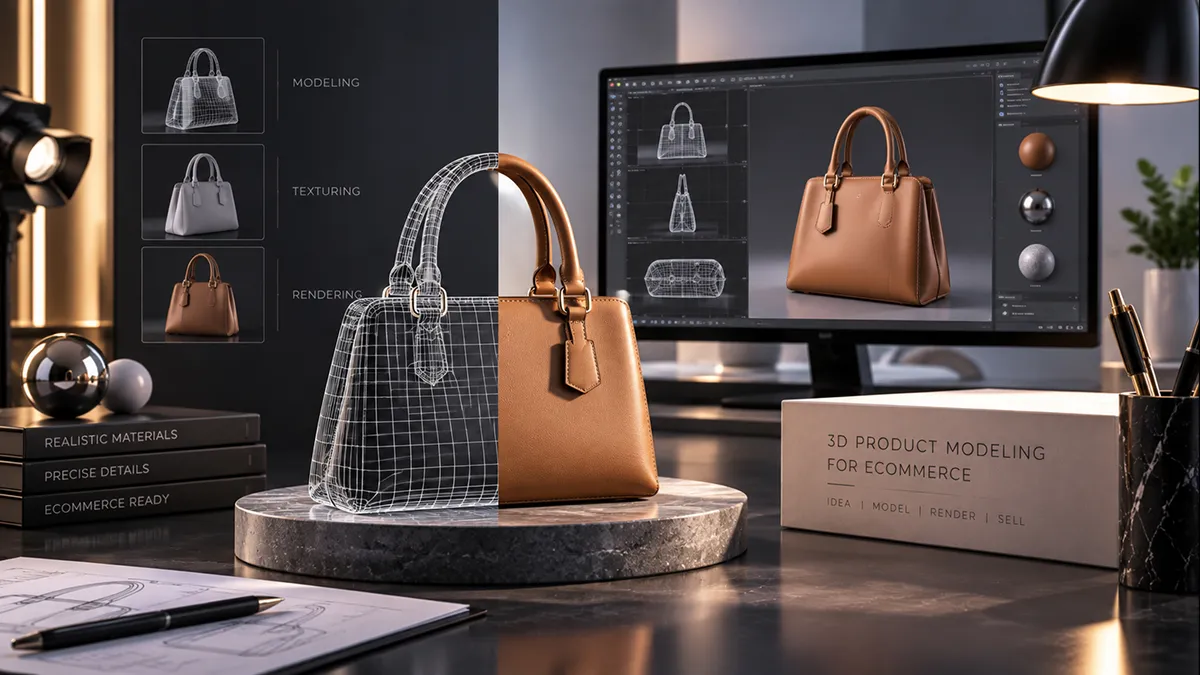
3D product modeling for eCommerce is rapidly gaining ground over conventional product photography as the new norm in online shopping portals where conversion of website visitors into paying customers is desired. Unlike a few photos taken from a few angles, customers can spin an item, zoom in on specific areas, and even place it in a virtual space before deciding to buy. This is important, as a product page rich with visual content creates better trust and ensures there are fewer refunds. Abhiwan Technology offers 3D product modeling and visualization solutions that help organizations create interactive product visuals for digital marketing and eCommerce. The article discusses what 3D product modeling is all about, how it drives growth, and what to look for when hiring a partner.
What is 3D Product Modeling for eCommerce?
This is where a product's actual physical measurements, materials used, and even its color are transformed into a digital model that people can manipulate on a product page: rotate it, examine it closely. Companies usually opt for 3D Product Modeling Services to do this, since static product pictures are being replaced by an interactive experience. Just think back to how many times you made a purchase online while not having access to all sides of the product; if there wasn't a 360 video or 3D product modeling service in place, you probably had some lingering doubts about whether it was going to look just right when you received it. In contrast to several photos of a product, a person can manipulate a 3D product and examine every little detail, such as stitching on a handbag or a wood grain on a table leg. And those extra guarantees translate into sales: no need to guess if a product is going to look good in real life.
Reasons Why 3D Product Modeling Contributes to the Growth of Your Business
The improved product page will have a direct impact on your store's revenue, not merely on its looks. Consumers who can check out a product in detail from all possible angles will be more likely to make a purchase because they will be more sure of what they buy. In other words, working with a professional 3d product modeling company enables you to use images in ads, marketplaces, social media posts, and so forth without the need to conduct new photoshoots, reducing costs associated with content creation in case your product line is expanding. This should not be considered merely a redesign but rather as an operational change. An asset created in 3D format can be placed from many different angles with many different lighting solutions for many different places, which a traditional photoshoot cannot achieve without returning to the studio.
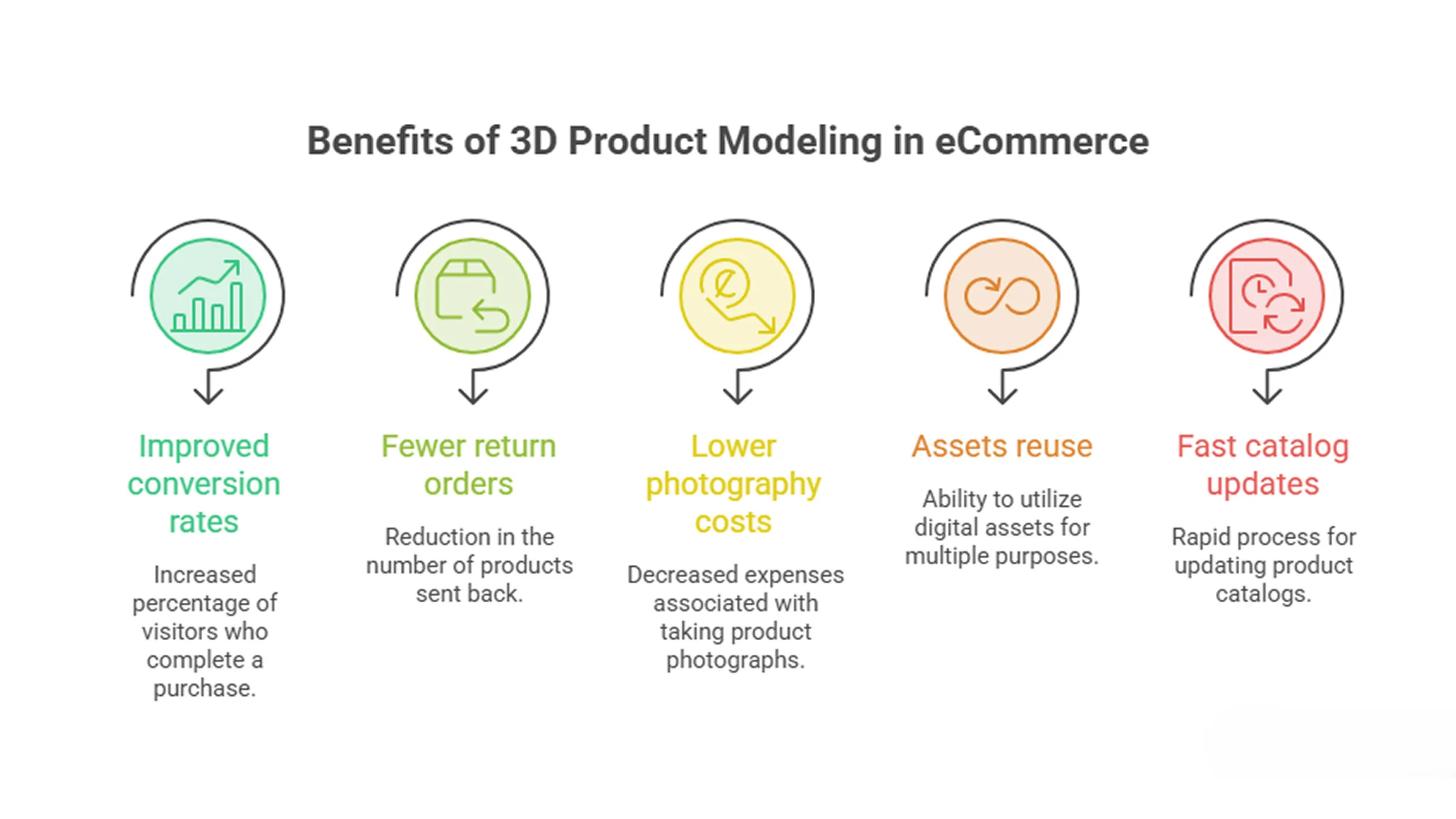
Benefits of 3D Product Modeling in eCommerce
However, the effects of 3D modeling go further than improving the product page appearance. The following points will describe how this technique creates value for the business.
Improved conversion rates
Due to the possibility of interacting with 3D images, customers will be able to examine the item from different sides before purchasing it, getting more information about its shape, design, materials, and other characteristics.
Fewer return orders
Thanks to the ability to see more information about the item, the customer will receive a clearer understanding of the product’s size, proportions, and appearance. Thus, there will be fewer cases when the purchased item does not meet their expectations and will have to be returned.
Lower cost of taking photographs
Using one 3D model allows you to create images of the product from various angles, backgrounds, and scenes without conducting multiple photoshoots.
Assets reuse
Once created, a 3D product can be used in all types of digital channels, including product pages, advertising materials, marketplace listings, etc.
Fast update of catalogs
Digital 3D models can help in the creation of variations of products, including different materials, coloring, or finishes. You will be able to add the variations in the digital model without conducting another photo shoot.
The supplier of 3D Product Modeling Services you work with should be able to give you insight into the relevance of these benefits to your particular catalog size and type of products.
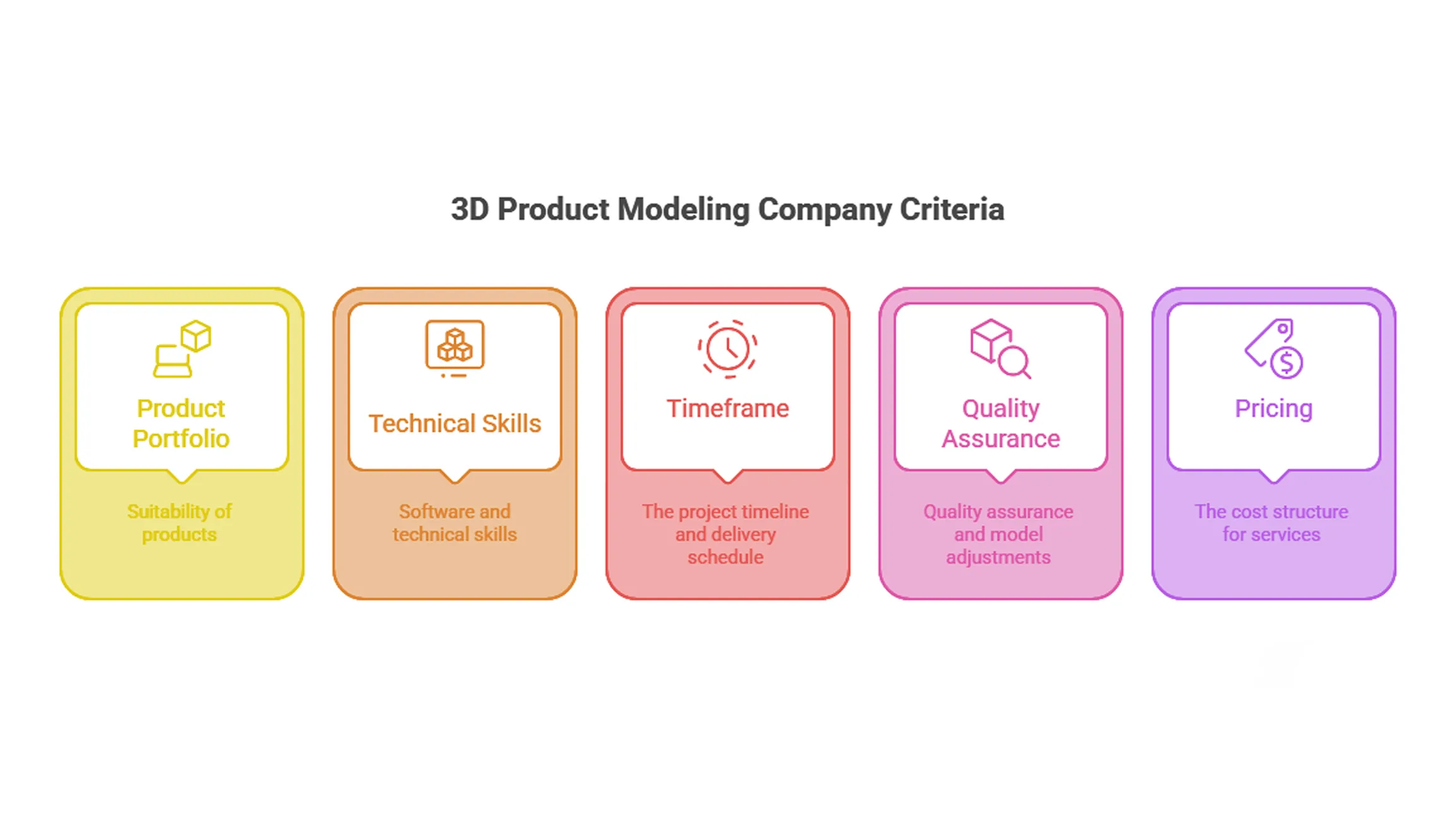
What to Look for in a 3D Product Modeling Company
It is common practice among many businesses to search online for top 3d modeling companies in India, as it hosts an abundance of professional 3D firms, but you shouldn’t rely on general ranking as a criterion when looking for a particular vendor suitable for your catalog. There are some simple criteria that are more important than ranking.
Product Portfolio and Suitability of Products
Ask to provide samples of completed 3D models that resemble your product rather than just nice-looking hero shots. A good 3d product modeling company should be able to provide models that are created using different materials, for example, glass, fabric, or metal.
Software and Technical Skills
Check what software the studio uses to model and render images, as the quality of the output and compatibility of the files with your platform will differ significantly depending on this. Specify whether their models are compatible with your e-commerce platform out-of-the-box.
Timeframe
Clarify the realistic deadlines for your catalog as a whole, since a wide product line requires a scalable production process rather than one-off custom designs. The rushed 3D product modeling for eCommerce projects tends to be of low quality due to problems with texture and proportions.
Quality Assurance and Model Adjustments
Ask about the quality assurance process of the company and how adjustments are made to the models. A credible service must have the quality control procedure in place for the dimensions, textures, materials, lighting, and file specifications.
Pricing
Ask how the prices change according to the number of products you have. It is expected that the per-product price decreases with the growing number of items. It is reasonable to compare several quotes from different top 3d modeling companies in India.
Most Common 3D Product Modeling Services for eCommerce
There are different levels of depth required in 3D modeling for various products. An all-inclusive 3D product modeling company usually provides these services.
- Static 3D rendering services as a replacement for regular product photography
- 360-degree product spins to explore the products interactively
- AR-enabled models for try-before-you-buy features on your smartphone
- Customizable models for products having a variety of colors and materials
- Product videos created using the same 3D model
How Abhiwan Technology Helps in 3D Modeling of Products for eCommerce
Abhiwan Technology deals with online retailers looking to go further than photography but not wanting to reduce the pace of catalog additions. As a 3D Product Modeling Services company, Abhiwan Technology creates models straight from the customer's real product specifications, taking care of scale and material composition. This point is essential because even a little deviation of a model from reality may undermine the customer's trust, which is contrary to the purpose.
Among the numerous top 3d modeling companies in India that companies may choose from, Abhiwan Technology helps to extend an existing catalog by creating models of new products when needed. Such cooperation becomes especially important once a company has created several hundred SKU models.
What are The 4 Modeling Techniques?
There are plenty of techniques for 3D modeling. However, 4 basic techniques are mentioned most frequently across the industry. In polygonal modeling, shapes are created using polygons that are joined together. It is the most widely used technique when it comes to creating assets for games and products. NURBS modeling involves the creation of mathematically based curves and is used in cases where precision is a key factor. Parametric modeling, which is most popular in CAD software, involves the creation of objects based on parameters that can be adjusted, and the design will change automatically depending on the changes of dimensions. Digital sculpting is like sculpting in virtual reality and allows an artist to modify surfaces of the model freely.
What is an example of 3D modeling?
An example of 3D product modeling for eCommerce in our daily life would be a furniture shop that allows a customer to rotate the model of a chair or sofa on-screen before purchase. Another example of 3D modeling in our daily life could be the AR technology used by a shoe company to display the 3D model of a sneaker in our own rooms with the help of phone cameras. 3D modeling is also used in video games to create characters and cars, but not as product modeling.
Conclusion
As internet consumers become accustomed to a new level of product visualization and interactivity, the decision to invest in 3D product modeling for eCommerce becomes not an opportunity but an inevitable step. This post outlined the basics of the process, benefits it offers, and key aspects that should be considered when selecting a 3D modeling service. Product Modeling and Visualization Services of Abhiwan Technology will be useful for eCommerce companies to create 3D visual representations of their products online. Comparing a couple of providers based on their portfolio, pricing, and turnaround time will produce significantly better results than choosing the best one in the search. It is usually the best idea to start with a small batch of products to see how good the provider is.
Written By Charu Sharma