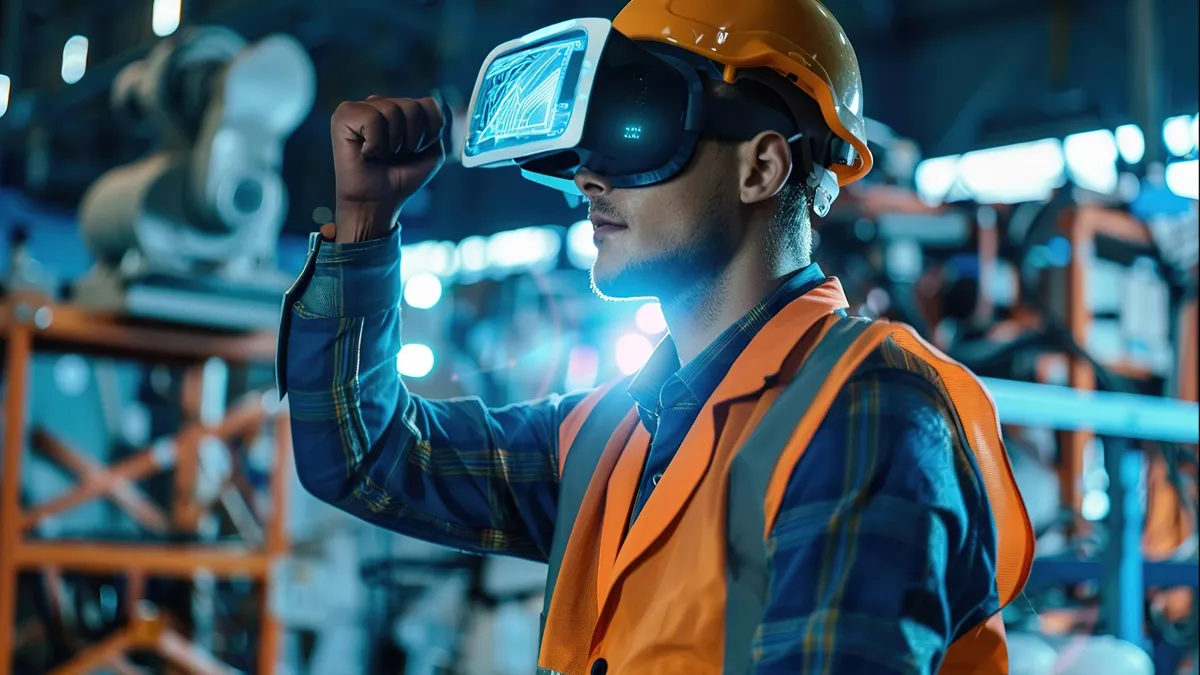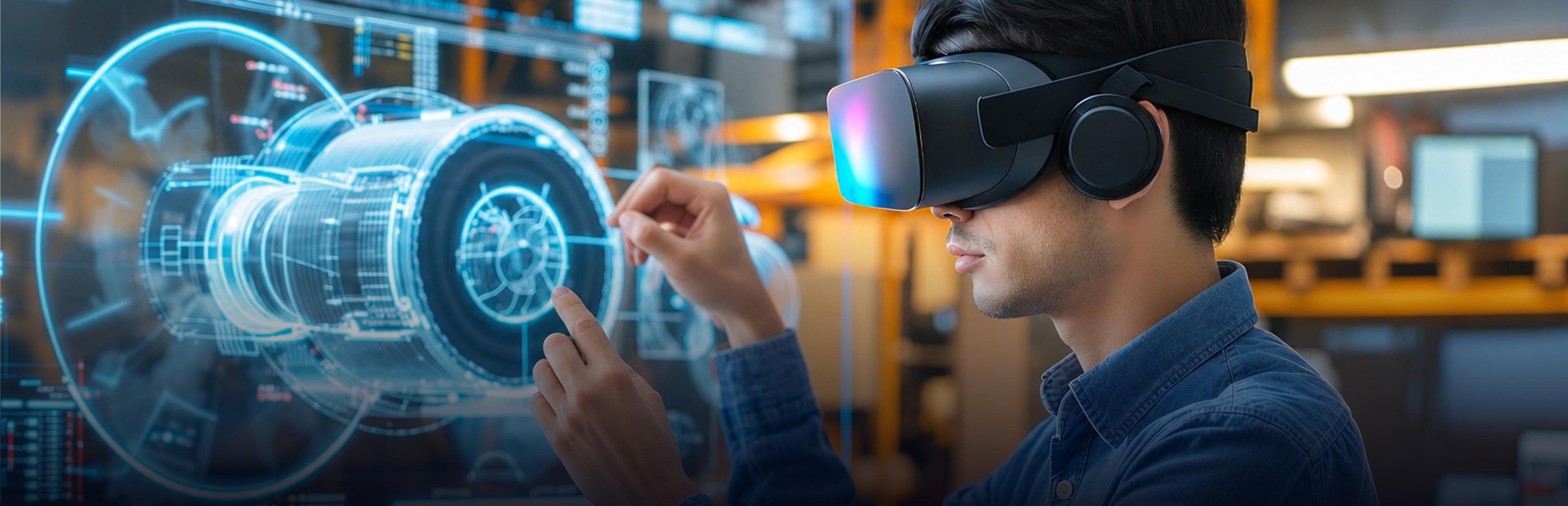
The demand for XR training solutions in industries is increasing since companies are searching for more efficient and safe training methods for their employees. According to the 2024 HTC VIVE survey, 70% of manufacturers who were using XR have applied it to employee training already. Yet, a successful introduction of technology requires more than VR/AR/MR implementation. Learning how to choose an Industrial XR Training Development Company may turn out to be not that easy. While some of them can provide you with impressive demo videos, they will lack the necessary experience in working with industrial equipment, potential workplace risks, and safety measures. Some of them may not know how to work with LMS, have issues with compatibility and scaling, and cannot provide you with the price and measurable results of training. Here we share information about ten factors that should be considered when choosing a provider, including a vendor selection checklist, critical questions, and warning signs.
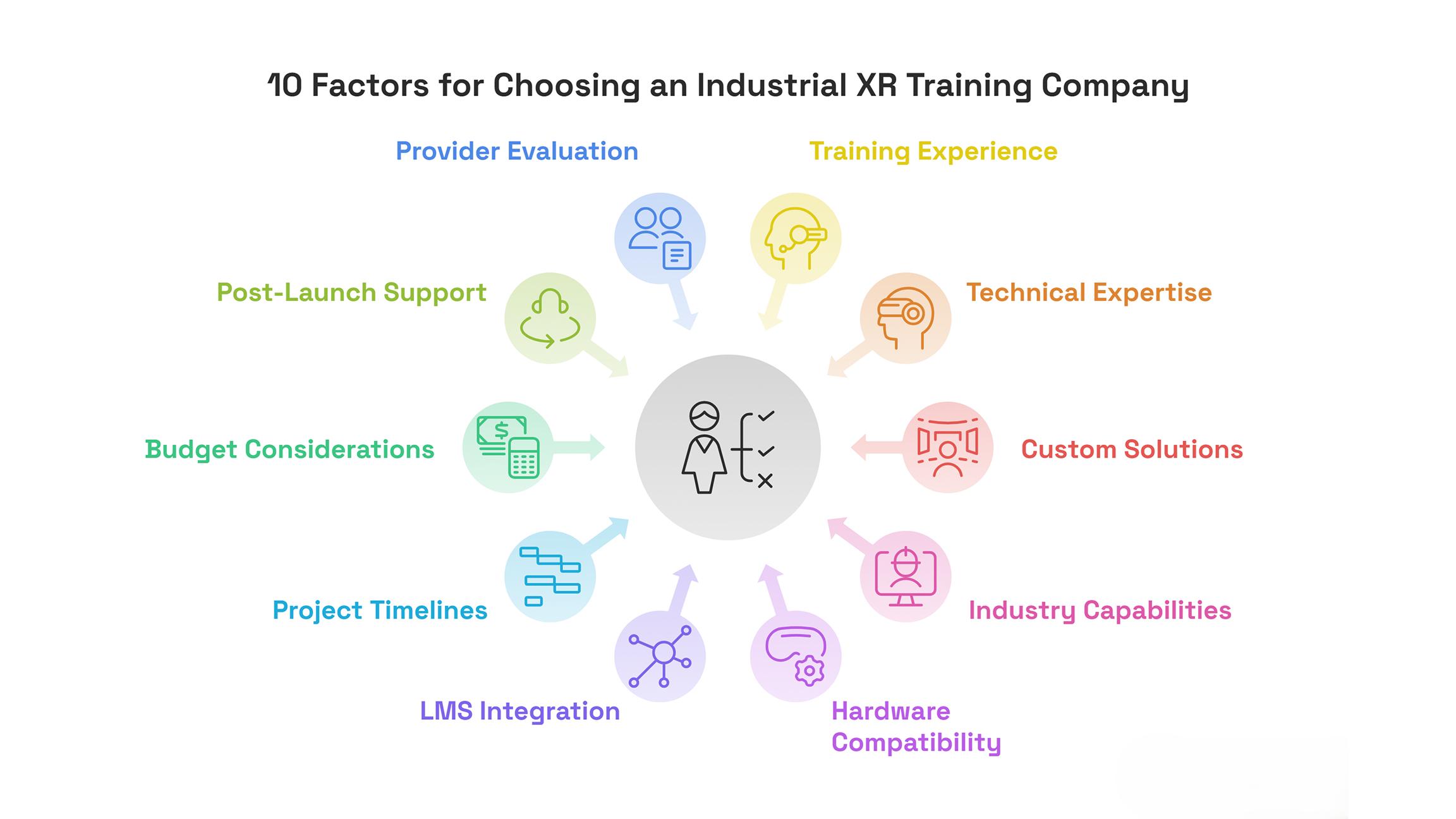
10 Factors to Consider When Choosing an Industrial XR Training Development Company
The risk is in the room. Your simulation needs to be robust to prevent you from taking the wrong actions, giving your safety team a false sense of security, or not being tested at all after a launch event. In fact, the hard part is working with people to do your procedures, operate your equipment, and stay safe.
The right partner will speed this up for you. The wrong partner will leave you with a nice demo, lots of headsets, but nothing you can do to change your content, as a procedure changes. Doing your extended reality training solution right from the start will save you a lot of money later.
1. Industrial XR Training Experience and Portfolio
First of all, review the portfolio of the vendor, but do not get fooled by the beautiful presentations. Find some industrial XR training solutions that fit your working environment, such as process training, safety training, or high-tech equipment training, rather than some promotional projects.
Ask for projects implemented in real-life environments. Two successful implementations in your industry may be more convincing than twenty demos in completely different industries. If the vendor does not have any implementation in your particular industry, try to find projects related to the same challenges that your industry has.
In addition, find out who will be involved in implementing your project. Ask the vendor to introduce team members who will develop and deliver the training to you. These people who present the project to you should clearly state how they will be involved in the implementation of your training.
2. Technical Expertise in VR, AR, and MR
A good XR training service will know all three formats and be upfront as to which is best for a given job. VR is suitable for dangerous or hard-to-access work. AR is suitable for working on real-world equipment. MR is suitable for working with both real and virtual equipment.
Technical quick review:
- Experience with the most common real-time engines, Unity, Unreal, etc.
- 3D modelling and optimisation skills, so that CAD files are lightweight assets for the headset.
- Interaction design for hands, controllers, and real tools.
- Testing performance on the actual devices you plan to use.
- Experience working in a real industrial environment where lighting and reflective surfaces are an issue.
A provider that tries to shove everyone through the same format isn't solving your problem; they're selling you a product.
3. Custom XR Training Solutions
Standard modules might address broad subjects like fire safety. But most of your industrial teams require something far more targeted: your equipment, your working areas, your lock-out procedures, your standards.
Inquire about how the company converts your substance into content. An ideal response includes a site visit or video capture, an assessment of your SOPs, interviews with subject matter experts, CAD or scan data, and a review cycle with your trainers. Ask who approves the accuracy of the content, because a simulation that doesn't match the real equipment can teach poor procedures.
Customisation also means a logical, well-thought-out content update strategy. Equipment and procedures evolve. Discover the cost of a quick paragraph tweak, a significant change, and the time it takes to make them.
4. Industry-Specific Training Capabilities
They have different requirements. Manufacturing relies on assembly, changeovers, and quality assurance. Oil and gas requires lock-out, pressure systems, and emergency shutdown. Mining requires equipment and underground hazards. Aviation requires thorough inspection and maintenance processes. Energy requires high-voltage safety.
Ask the supplier to run through the regulations and hazards within your industry in their own words. If they are not able to hold an interview about permit-to-work, lock-out and tag-out, or your relevant standards with some confidence, you will have to teach them your industry during your project.
5. Hardware and Software Compatibility
Headset product lines are a moving target, and the device you purchase today could be discontinued in the middle of your content's lifespan. Support vendors that offer a common, portable platform and that can give you the price of switching to another device.
Questions worth asking:
- What headsets, tablets, and smart glasses do you currently support?
- Is the content compatible with the devices we have?
- Does it function with gloves, protective eyewear & safety hat?
- Can lessons run offline for sites with weak connectivity?
- Is the software compatible with our IT standards for networking, device protocols & management, and SSO?
Select vendor and content plan first, hardware second. Selecting headsets before you determine what you will run on them is one of the more common mistakes.
6. LMS Integration and Scalability
If results aren't flowing into your LMS, then someone will be tracking XR training on a spreadsheet. Find out what standards the vendor supports, SCORM, XAPI, and which LMSs they have actually integrated with (not simply boasted about being able to).
See how a learner starts a lesson, how completion and scores are reported, and what the manager views. Standards-based reporting lets you take your data with you when you switch providers later.
Scalability is just as important. Will you be able to deploy the same module across ten locations, in multiple languages? Will you be able to assign by role, push updates to all devices simultaneously, and manage a whole fleet of headsets from a central console? A pilot that works for twenty will require some thought before scaling up to two thousand.
7. Development Process and Project Timelines
A clear process is always a good sign. A regular project progresses along the following steps:
- Discovery: goals, audience, tasks, equipment, and success criteria.
- Scoping: a plan, scope, and outline of the content to be written.
- Prototype: a miniature, more manageable version of one lesson.
- Build: 3D assets, interactions, assessment logic, and integration.
- Review and testing: content validation with your experts; device testing.
- Pilot: a test involving actual learners using the agreed criteria.
- Rollout and support: implementation, train-the-trainer, and ongoing improvements.
Timelines are based on the complexity of the scenarios and the amount of 3D content and integration involved. A bespoke pilot can take from several weeks to several months. Ensure you get a schedule with dates, milestones, and your involvement, because delays may be caused by slow approvals, finding source data, or 3D content being provided late.
8. Pricing and Budget Considerations
Cost depends on scope, so compare apples to apples. Get a line-item proposal including content development, 3D assets, systems integration, hardware, and ongoing support. This will tell you what you are paying for today and what you can wait on.
There are three common ways to buy:
| Model | How it works | Best for |
|---|---|---|
| Fixed-price project | A set scope for a set price | A first module or pilot with clear requirements |
| Retainer | A monthly arrangement covering updates and new modules | A roadmap of several modules |
| In-house build | Your own team builds and maintains content | Large organisations making XR a permanent function |
MadXR, an XR studio, believes many clients begin with a fixed-price pilot followed by a retainer once they have a content roadmap in place. That makes sense, but that is one vendor's perspective.
Also consider the cost of change. Inquire as to what the cost of a standard content update will be after a year, and who will own the source files and assets when the contract terminates.
9. Post-Launch Support and Maintenance
Training programmes fall short in ops more than in tech: headsets no one wants to use, bugs no one has seen, version confusion across sites. Make sure support agreements are in writing:
- Response times by severity.
- What happens after launch and for how long.
- Who manages devices and updates.
- Request and cost of content changes.
- What are the ongoing costs of support after the included period?
A vendor providing a full month of support post-launch should be able to show you what month two is.
10. Evaluating Providers Through Case Studies and Client Reviews
Look for case studies that include details: the problem, the delivery format, how many learners were involved, and what changed. Watch out for ones that just describe the technology or regurgitate marketing messages.
Questions to ask when reading a case study:
- Is the client operating in an industry similar to yours?
- Did we deliver to actual learners at scale?
- Is there an outcome that can be measured, e.g., less training time, fewer errors?
- Was the work still in use a year later?
Then pick up the phone for references. Talk with a customer whose project is at least a year old and find out about the order, communication, how they solved the challenges, and whether they would hire the firm again. Independent review sites are helpful, but direct engagement is better.
Vendor Comparison Checklist
Use this table to score two or three shortlisted providers against one another.
| Criterion | What good looks like | Warning sign |
|---|---|---|
| Industrial experience | Shipped projects in your sector, with named references | Only demos and trade-show pieces |
| VR, AR and MR skills | Advises the right format for each task | One format for every problem |
| Customisation | Builds from your SOPs, CAD and site visits | Generic modules with your logo |
| Hardware fit | Works on your devices and your safety gear | Locked to one device or player |
| LMS integration | Named LMS integrations and standards-based reporting | "Can integrate" with no examples |
| Scalability | Multi-site, multi-language, fleet management | Works only for small pilots |
| Process | Clear stages, dates, and review points | Vague plan, unnamed team |
| Pricing | Line-item proposal and updated costs | Single number, no breakdown |
| Support | Written terms and response times | Support ends at launch |
| Evidence | Case studies with measured results and calls with past clients | Claims without proof |
Questions to Ask Before You Hire
- Are we able to reach the client to discuss a project of a year or more?
- What happens to the source files, 3D assets, and learner data when we finish?
- How do we manage our content if our headset gets discontinued?
- How much will this module cost, and what will influence the cost?
- How do you actually measure whether they could do the task afterward, not simply whether they completed it?
- What will a standard content refresh cost over a year, and for how long?
- Where does learner data live, and who has access to it?
- What LMS platforms have you integrated with, and can we see the reporting?
- How long is your support response time, and what is the support cost after launch?
- Who exactly will work on our project?
Red Flags to Avoid When Choosing a Provider
- A portfolio of demonstration projects with no evidence of actual implementations.
- No pricing guidance, even in the form of ranges.
- Content that plays solely in the vendor's player, with no way to export.
- Learning results are replaced with satisfaction scores.
- Returns promised before anyone has seen what you do.
- Unwillingness to conduct a pilot with measures that have been agreed.
- Inconclusive responses regarding data, security, or access to recordings.
Criteria to Choose Industrial XR Training Development Company
- Write up what the assignment is, the target audiences, sites, platforms, and what a success would be.
- Shortlist three to five providers. Use portfolios and referrals.
- Conduct discovery calls. See how they react to your industry.
- Refer to the checklist above for comparison.
- Check references and case studies. Talk to real clients.
- Decide on a pilot. Agree on the scope, measures, and dates before getting underway.
- Decide once the pilot is complete. Scale up, change, or stop based on outcomes.
Working with an Extended Reality Development Partner
The most complete match is generally a partner who can deliver extended reality development services from design, 3D content, engineering, integration, and support so that one team owns the end-to-end responsibility from first lesson to roll out. For teams looking for a turnkey solution, an Industrial XR training solution provider can align VR, AR, and MR content with LMS integrations and performance tracking. No matter who you select, be sure they walk you through your checklist (not just their presentation).
Conclusion
Selecting the appropriate industrial XR training development company is not only about evaluating the portfolio or even demonstrating technologies. A good company must know how the business works, create the training according to your equipment and safety protocols, and make sure that the solution will be compatible with your hardware and LMS.
Before choosing the company, you need to evaluate its level of competence, customization, development process, cost, and long-term support. Study case studies, talk to their clients, and start with a pilot project to evaluate the efficiency of the training process. A competent partner will care not only about the quality of the VR/AR training but about its safety and usability as well.
Written By Charu Sharma