Picking between Android and iOS is an essential step for businesses considering launching a mobile game. While both of these operating systems ensure that developers can reach a broad audience of users, each of them has its own environment, testing procedures, and hardware compatibility. The choice you make will depend on the target market, budget, complexity of the game, and monetization strategies. It will also affect the amount of time you have to spend on testing and maintenance. In this article, we provide a detailed description of Android vs iOS game development and show how businesses can choose the best platform for a mobile game development project.
Android vs iOS Game Development at a Glance
It’s always a wise idea to get acquainted with the development environments when deciding which one to use. Understanding these differences can also help you choose the right game development services for your project. In the following table, we provide an overview of the differences between Android and iOS game development.
| Factor | Android | iOS |
|---|---|---|
| Device range | Wide range of manufacturers, chipsets, screen sizes, and OS versions | Smaller range of Apple devices and screen sizes |
| Testing effort | Higher because of device fragmentation | Lower, but older-device testing is still important |
| Main store | Google Play, plus other stores in some regions | App Store |
| Store console | Play Console | App Store Connect |
| Pre-release testing | Internal, closed and open testing tracks | TestFlight |
| Native languages | Kotlin and Java | Swift and Objective-C |
| Graphics APIs | Vulkan and OpenGL ES | Metal |
| Billing and services | Google Play Billing, Play Games services | StoreKit, Game Center |
| Review model | Automated and manual checks, with account-based requirements | Human review against published guidelines |
| Fee structure | Varies by region and install type | Varies by program and region |
Android offers flexibility and reach to many devices, but it requires handling different hardware. Apple’s closed environment is more predictable when testing, though its review process and technical requirements require scrutiny.
Understanding Platform Rules and Requirements
Store rules are the most rapidly changing parts of mobile game development. There have been changes in fees, account requirements, review requirements, privacy disclosures, and minimum required target versions over the years, and some of these requirements might change again.
For businesses considering mobile game development, it is important to distinguish stable differences between the platforms and requirements and verify them.
This guide examines three kinds of information:
- Stable differences, such as the variety of Android devices compared to iPhones
- Rules that are verified in official sources and mentioned by name and link
- Areas that should be verified, since the correct information will depend on your target markets, business model, and launch dates
Before making any decisions and spending your development budget, make sure someone from your team checks the latest information in the official documentation for both stores.
Device Fragmentation and Compatibility
One of the most significant distinctions in practice between Android and iOS is the issue of device fragmentation. This factor influences the process of testing, optimizing, and supporting various devices by developers.
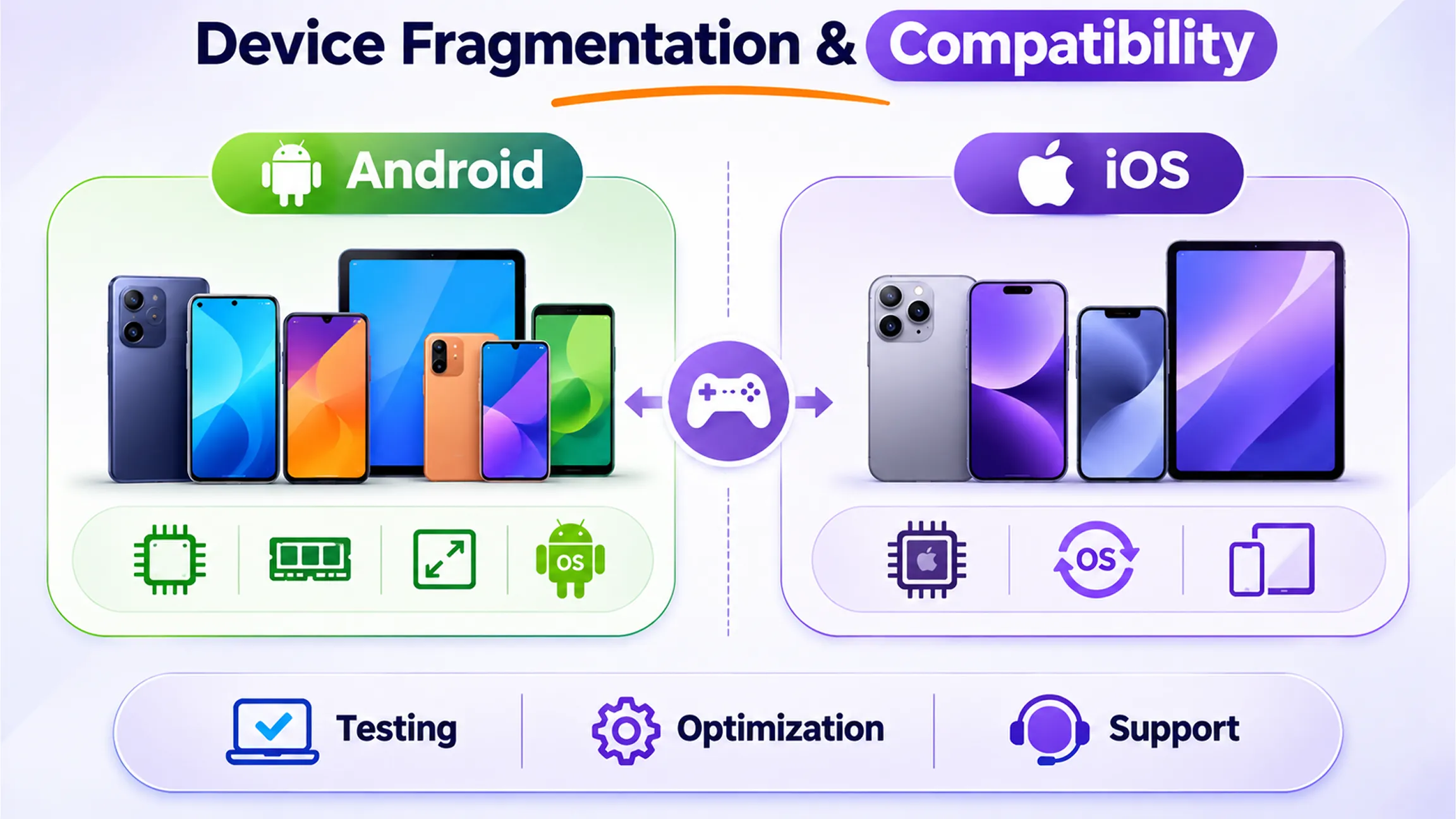
Android: Various manufacturers produce Android-powered smartphones and tablets with different hardware, different processors, graphics processing units, RAM capacity, screen sizes and frequencies, and proprietary software layers. Thus, a game may work perfectly fine on one brand of device, but they encounter problems on another one. Users support versions of operating systems for many years, so developers have to choose which ones to support with their games.
When companies are going to make investments in Android game development, they must take device fragmentation into account at the planning stage.
iOS: The platform developer controls both hardware and operating systems, which limits the number of compatible devices. Besides, many users are upgrading their operating systems regularly. This makes performance and behavior more predictable, although developers still have to test old iPhones and iPads that players continue to use.
Such an environment makes it easier to handle iOS game development in terms of compatibility issues between various devices. Nevertheless, there is still no escape from extensive testing.
How the environment influences the development process:
- For Android, a device matrix is required. Pick real devices from your target markets of all low, middle, and high tiers with popular brands, not just flagship products.
- For iOS, you need fewer devices, but you should also consider older ones. A less powerful and older phone with smaller memory capacity can uncover the flaws, which would otherwise remain hidden.
- Quality tiers will work on both platforms. Set up low, middle, and high tiers of resolution, effects, and frame rate with default values depending on the hardware capabilities.
- Various screens influence the user interface. Notches, rounded corners, foldable screens, and different aspect ratios have to be considered.
- Do not depend on emulators solely. Emulators will not be able to simulate thermal behavior and real GPU drivers and bugs associated with hardware manufacturers.
The fragmentation of devices has consequences for the schedule of game development as well. The wider the selection of devices, the longer the testing period, and the more necessary device-specific bug fixes become. Companies have to take all these factors into account when planning their initial projects.
Testing Requirements and Strategies
Testing is one of the crucial stages in the process of creating mobile games. Regardless of whether developers use the Android or iOS platform, they need to conduct quality testing prior to releasing their game to the general public.
Pre-release channels: Google Play provides internal, closed, and open testing tracks via Play Console. Apple provides TestFlight for delivering builds to testers.
Google Play requirement that is already verified: As per the current help page by Google, personal account developers who created their account after 13 November 2023 will be required to conduct a closed test with at least 12 testers who remain opted in continuously for 14 days prior to seeking production access.
This requirement is an important consideration for schedule planning by businesses who are developing their first Android game. It is recommended that developers find testers early and allocate time for testing in the launch plan.
Please refer to Google’s documentation for more details.
What to test on both platforms:
- Gameplay, progression, saving and loading, and cloud synchronization
- Touch controls across different screen sizes
- Performance, RAM usage, battery drainage, and heating over extended periods
- Interruption factors such as calls, notifications, low battery, and app-switching
- Purchasing, restoring, and subscriptions in the sandbox environment of each app store
- Installing, upgrading, and updating from older versions of the app
- Behavior during offline and poor network conditions
- Locals and accessibility options
Where to conduct the test: A combination of testing approaches is advised: in-house testing devices, cloud-based device testing service, and beta testing.
Android project development demands additional care concerning the range of devices and hardware compatibility. For developing for Apple devices, developers should pay more attention to outdated hardware, supported OS, and App Store approval criteria.
A well-planned quality assurance process allows businesses to decrease technical problems and provide a smooth gaming experience for users of both platforms.
App Distribution, Store Fees and Monetization
Distribution is the intersection of business decisions and technical considerations. It is essential that businesses understand the distribution mechanics, store fees, discovery, and monetization in order to select the right store(s) to distribute the app.
Fees and commissions: Store fees impact revenue, pricing, and monetization models. Fees are also evolving. Google's documentation about service fees provides information about different fees based on the region, whether the user is a new or returning installation, and the developer's participation in certain programs in certain regions as of 2026.
Apple's documentation of its Small Business Program specifies reduced commissions for eligible developers, whose annual income is below the applicable annual threshold in some regions, including the EU.
Since such policies may vary in time and by location, it is important for the business to study both documents to prepare the financial model. Do not use only one percentage when calculating revenue.
Alternatives to the major stores: Rules about alternative payment systems, alternative app stores, and external links differ by region and continue to evolve. If your app distribution depends on such alternative approaches, make sure you know the current rules for each of the targeted markets.
Discovery: The discovery process depends on search, charts, editorial, and personalized recommendations in both cases. A good listing with an appropriate title, icons, screenshots, preview video, and description is essential in both stores. The game ratings, reviews, and player retention also affect the process of game discovery.
Audience and money spent: Different countries prefer different platforms. In one country, users may prefer Android, while in another, those who spend more per user may prefer iOS. Businesses should use the data obtained from their target audience and from the soft launches.
These aspects are crucial for deciding which platform to focus on, especially if you plan to monetize your business.
Platform APIs and Services
While most mobile games are developed using cross-platform engines, certain platform services are necessary to provide particular functionality.
| Area | Android | iOS |
|---|---|---|
| In-app purchases and subscriptions | Google Play Billing | StoreKit |
| Push notifications | Firebase Cloud Messaging | Apple Push Notification service |
| Game services such as achievements and leaderboards | Play Games services | Game Center |
| Sign-in and cloud save | Google account and Play services | Apple ID and iCloud |
| Augmented reality | ARCore | ARKit |
| Graphics | Vulkan and OpenGL ES | Metal |
| Performance and device information | Android tooling and vendor APIs | Xcode Instruments and Apple frameworks |
| Integrity and anti-abuse | Play Integrity services | App Attest services |
The process is not about memorizing these names. The billing mechanism, notification service, and game services of every platform require their own integration, testing, and even business logic.
A cross-platform engine typically provides these plugins, but it is good practice to test purchase and login flows in the testing environments of each platform separately.
Graphics are another area worth consideration. A cross-platform engine normally takes care of using the appropriate graphics APIs, but the performance and visual behavior might differ across different GPU architectures. Profiling on physical devices is necessary for both platforms.
Release Requirements
Release requirements are the list that comes between your complete build and the final release. While the structure of release requirements is very similar, there are specific submission processes and requirements for each store.
Companies need to take these factors into consideration before setting up the release date.
- Developer accounts: An account and developer agreement are required in both cases. Verification might also be required depending on the type of developer account you open.
- Store listing: Icons, screenshots, description, categories, keywords, and preview videos should be prepared for all languages you support.
- Privacy and data disclosure: Both stores require details about the data collected by your game and its SDKs, as well as the privacy policy. Ad and analytics SDKs require extra scrutiny.
- Age ratings and content declarations: Questionnaires deal with content, ads, purchases, and data, with extra requirements for children’s audiences.
- Build requirements: Each store imposes technical requirements for build formats, supported OS versions, platform tools versions, and target API levels. Requirements are regularly revised.
- In-app purchase configuration: Products, pricing, and subscriptions should be configured and tested.
- Review: Submission is evaluated according to the policy of each store. Additional changes may be required for the first submission; allow extra time for that.
- Requirements for testing new Google accounts: The closed testing requirement for newer personal accounts may influence the release process on Android.
Create a release checklist for each platform, allocate an owner, and schedule deadlines far ahead of the launch date. Consider store compliance as a part of the production process.
Android Game Development: Advantages and Disadvantages
Android game development provides businesses with an opportunity to work with various devices and users. At the same time, a variety of hardware requires more testing and optimisation.
Advantages:
- Businesses can cover a broad range of devices and markets with their product.
- There is flexibility in distribution in certain markets.
- Good support for a diverse audience where Android devices prevail.
- Opportunities for testing and staged release through the Play Console.
- Ability to target different categories of devices and hardware configurations.
Disadvantages:
- Variety of devices, which means extra testing and fixing.
- Optimisation of performance on multiple hardware types.
- The necessity of accounts and testing that might be problematic for first-time publishers.
- Different markets yield different revenue per user; therefore, businesses should consider this variation based on their experience and data.
Additionally, it might require more testing, thus increasing maintenance costs.
iOS Game Development: Advantages and Disadvantages
iOS game development is characterized by a more controllable hardware environment, which allows for easier testing and optimization. The ecosystem of development tools and distribution on Apple platforms also offers a defined release cycle.
Advantages:
- A limited number of predictable devices that are easier to test and optimize.
- Quick acceptance of the latest operating system versions by a large portion of users.
- Good tools such as Xcode Instruments and TestFlight.
- In some countries, substantial player spending.
- Uniform hardware and software combination.
Disadvantages:
- Strict review criteria, as well as a possible refusal to publish due to review results.
- Necessity to update the product according to changes in SDKs and development tools.
- Limitations in terms of distribution in many regions.
- Requirement of Apple hardware for native building and signing.
- Additional work in connection with privacy requirements and App Store policies.
Businesses interested in iOS platform development need to consider their target market and monetization model carefully.
Mobile Game Platform Selection: How to Choose
The choice of platform should be based on your business case and not an overall preference for Android vs iOS. Your choice should be dictated by the location of your players, monetization, and development team abilities.
Answer these questions to select your platform:
- Where are your players? Refer to market data for your target markets. Platform penetration and spend vary greatly depending on geography.
- How will you make money? Ads, IAPs, subscription and premium sales can have a different performance on different platforms. Validate the model through a soft launch.
- What type of game and technical needs does your title have? A graphics-intensive 3D game will have different hardware targeting needs compared to an accessible puzzle game.
- What can you test? If you cannot test your app on an extensive Android device matrix, start where you can test.
- When do you need to launch? Account creation, testing, and the review process can impact your launch timing.
- What is the cost of stores for your revenue model? Find out the current fee structure in the target market.
- Do you need platform-specific functionality? Think about augmented reality, payments, and platform-specific game services.
There are three primary launch options:
| Strategy | Good when | Watch out for |
|---|---|---|
| iOS first | You want a predictable device set and strong monetization in your markets | Review time and smaller reach in some regions |
| Android first | You want broad reach and quick iteration, perhaps in soft launch markets | Fragmentation and testing effort |
| Simultaneous | You have a cross-platform engine, a strong QA plan, and the budget | Double the release work and support |
Most game studios tend to soft launch their product on one platform in some countries to analyze player behavior and then roll out further.
Instead of making an assumption about the platform performance, the company needs to make decisions based on player engagement, retention, and monetization.
Development Costs and Timeline Considerations
The total mobile game development cost depends on the project's complexity, number of integrations, testing process, and post-launch support. These factors also influence the game development timeline as each stage requires time for proper execution.
Even though the cross-platform engines allow reducing development efforts by half, the two platforms require extra resources anyway.
Costs and schedules to consider include:
- QA and coverage of devices: While Android may require more time for device testing, iOS requires additional preparation for review and compatibility.
- Platform integration: Billing, notifications, sign-in, and game services will each have to be implemented on both platforms.
- Store operations: Separate accounts, listings, disclosures, and releases will have to be managed.
- Update process: Every update in operating systems and SDKs may require a new build for both platforms.
- Support: With two stores, a separate review process, crash reporting, and player queries will be involved.
Businesses that wish to compare development costs will need to take these costs into account when estimating their initial budgets. The development process incurs costs beyond just creating the game itself.
Having a development roadmap will help businesses estimate resources needed and save from any cost surprises along the way.
Cross-Platform Game Engines: Benefits and Limitations
Unity and Unreal are cross-platform engines that let developers develop games for both Android and iOS, using a common code base. These engines cover a lot of the variance in graphics APIs, inputs, and platform settings.
In some cases, cross-platform development makes things easier since developers don’t have to write each game element twice, once for each operating system.
Cross-platform development doesn’t eliminate the need for separate tests for each platform. Developers will have to integrate the store service, optimise their work for different devices, and adhere to separate release requirements.
Engine selection should be determined by the complexity of the game, its graphics requirements, developers' experience, and the necessity for further maintenance.
Official Documentation and Resources to Check
Before choosing your development strategy, check out the official documentation that applies to the markets and releases relevant to your business.
- Help Center of Google Play Console: service fees, testing requirements, policy center, Data safety, and target API level requirements.
- Android Developers documentation: target API levels, Android App Bundle, Play Billing, and testing tools.
- Apple App Store Small Business Program Eligibility page.
- Game Engine release notes.
- Professional legal opinion about regulations related to consumers, payments, and privacy in each country.
Assign a person to check all these sources before releasing your game. The requirements of the stores and technical limitations may vary from the time of your first submission until another release.
Choosing the Right Mobile Game Development Partner
The choice of a suitable mobile game development partner will make planning, production, and release management much easier. Understanding how to choose a game development company can help businesses find a reliable partner who can assess platform requirements, select the right technology, and create realistic development roadmaps.
Game development services include game design, development, integration, testing on devices, submission to the store, and post-release maintenance. A partner that works with Android and iOS will be able to help you organize cross-platform releases considering the requirements of each platform.
Before choosing a partner, consider its previous projects, expertise, testing process, and experience submitting games to Google Play and the Apple App Store. Find out how the team solves problems of compatibility with devices, optimization, store policy updates, and regular updates.
A proper development partner can create a game that is suitable for your business needs.
Common Mistakes When Choosing a Mobile Game Platform
When developing a mobile game, business owners can avoid making some common mistakes if they analyze technical and financial requirements for the project in advance.
- Relying on assumptions: Making conclusions based on general statements about expenses or audiences rather than on statistics in your target markets.
- Overlooking Android device fragmentation: It causes extra time for testing and possible bugs.
- Neglecting account and store review preparation time: It may take weeks to verify your game, test it, and receive reviews from the stores.
- Fixing one fee rate: Fees are calculated depending on the program, region, and time of submission.
- Not accounting for platform-specific integrations: Purchasing and sign-in need to be tested in each store separately.
- Using outdated plugins: They can be incompatible and cause delays.
- Skipping the soft launch market test prevents comparing platforms based on data provided by players.
Conclusion
Android and iOS platforms both have their advantages for companies starting in the mobile gaming business. The Android platform gives more coverage of devices but needs extensive testing for its compatibility, whereas the iOS platform is limited to a narrower hardware base and store environment.
Ultimately, your target audience, revenue model, budget, and technical specifications will determine your choice. Whether you choose Android game development, iOS game development, or a cross-platform approach, make sure to adapt your game to the specific platform. A proper strategy for mobile game platform selection will help minimize risks in the development process. Collaboration with a professional game development services provider will make this process simpler.
Written By Vaibhav Karanwal