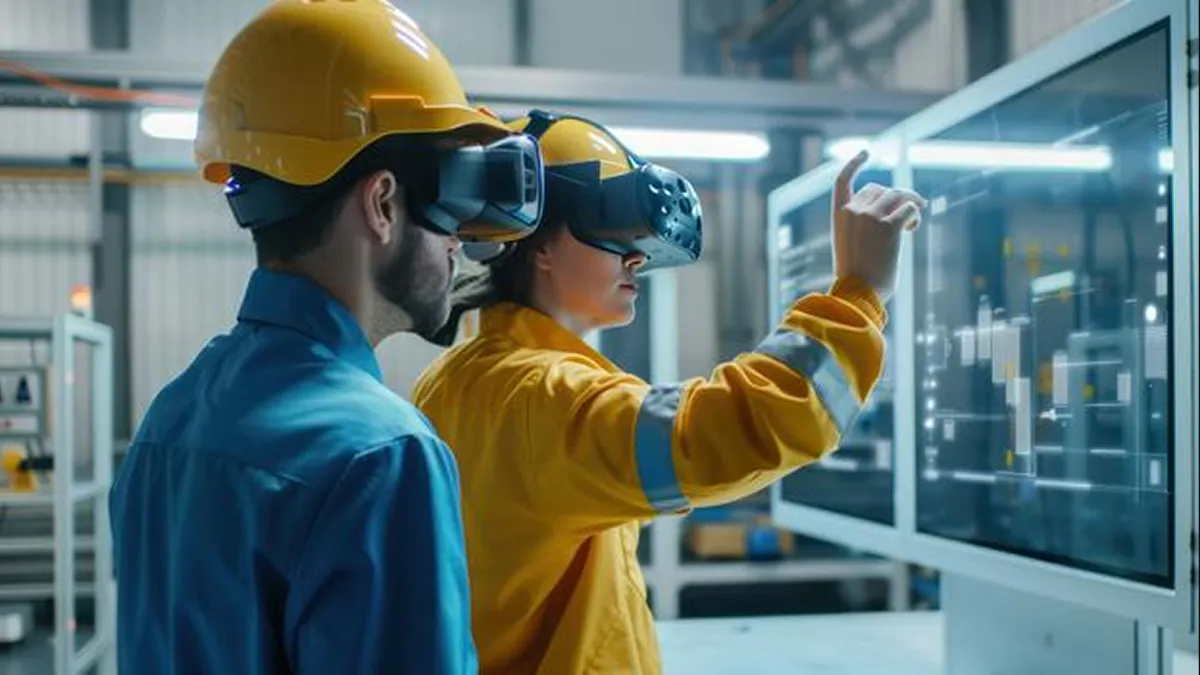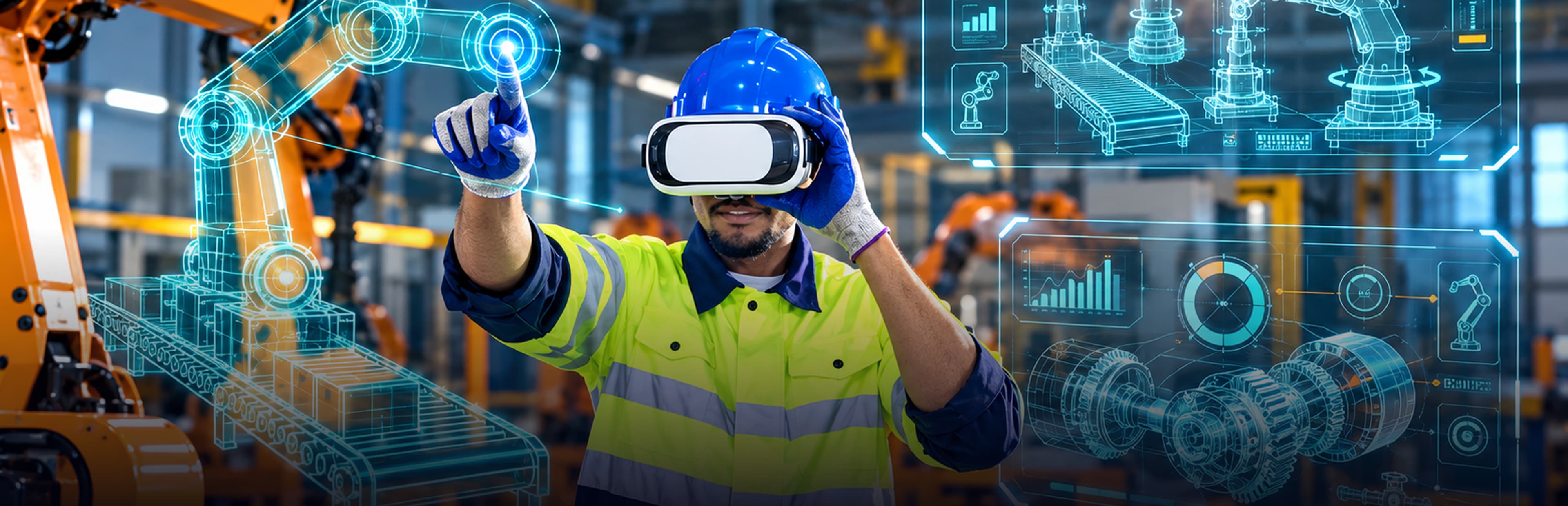
XR Training Development Company provides the opportunity for staff members to simulate dangerous scenarios through a safe virtual world. Rather than simply studying safety tips and viewing slide shows, staff members can put on their headsets and learn how to exit buildings in case of fires, cope with emergencies, and work in hazardous zones. In addition, the managers will have the opportunity to evaluate their skills and detect weak spots in their knowledge. The active shooter VR training simulator created by Abhiwan Technology for Abu Dhabi Police proves that virtual reality can be used to train people in dangerous situations. This guide discusses how XR safety training works and how it can be implemented.
What Does an XR Training Development Company Do?
XR Training Development Company develops simulations and training programs based on virtual reality (VR), augmented reality (AR), and mixed reality (MR). Such programs allow employees to practice various workplace skills in virtual environments, explore virtual realities, and learn specific procedures using realistic simulations. In general, XR training development may include understanding the training goals, designing 3D environments, developing interaction scenarios, testing the program, and deploying it on the right devices.
In fields like manufacturing, healthcare, construction, and aviation, XR training development services may include equipment use, safety procedures, and emergency response. Moreover, an experienced company would make sure that the simulations reflect real-life situations and give the user appropriate feedback. In accordance with the particular project, the training modules may work on a VR headset, PC, tablet, and even a mobile device, and may be integrated into an LMS.
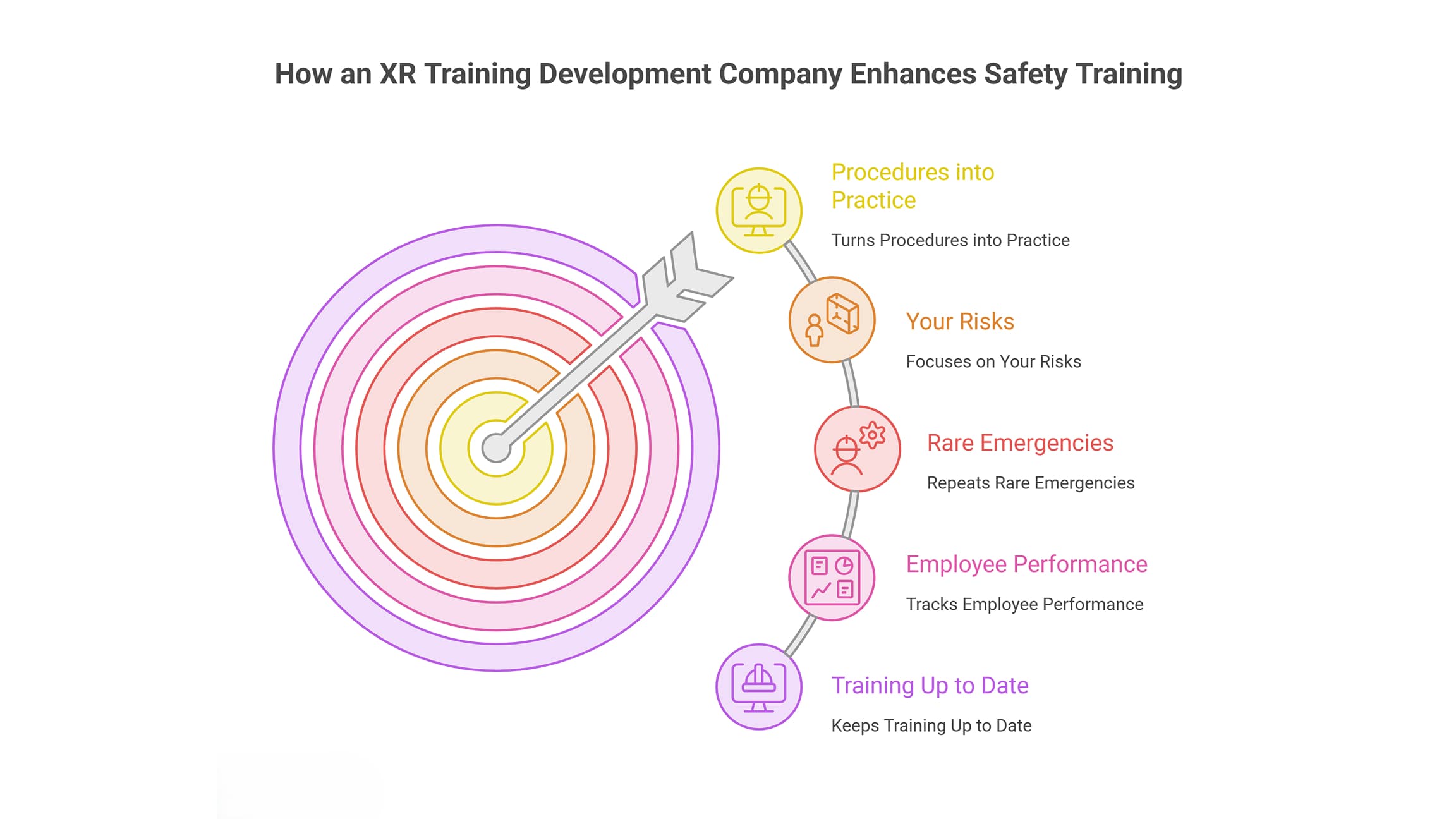
How Does an XR Training Development Company Enhance Safety Training?
The difference between an ordinary training and one enhanced with the help of an XR Training Development Company lies in certain specific advantages rather than in making the training more interesting.
Turns Procedures into Practice
When an employee has practically gone through an evacuation or a lockout procedure, they remember it much better than if they just read about it once. The repetition within a simulation helps to develop the reaction required during a real emergency.
Focuses on Your Risks
With the help of XR training development services, the specialists will analyze your facilities and incidents and develop the training scenarios according to your specific situations. Training that is designed especially for your organization hits harder than the generic course developed for some average organization.
Repeats Rare Emergencies
A specialist from the XR Training Development Company can recreate the fire, a chemical spill, or any other danger as many times as needed without causing any damage to a plant or its staff members. Situations that most workers won’t face during their career will become repeatable through XR training.
Tracks Employee Performance
The new technology in XR training solutions allows the tracking of how a worker responds to different challenges, what he or she did wrong, and how much time was taken. Instead of just signing the form, safety managers will receive information about workers' progress in the right way.
Keeps Training Up to Date
With the help of this solution, there is no need to reprint or refilm the video when a procedure, machine, or regulation is changed. Every employee will be trained according to the current situation.
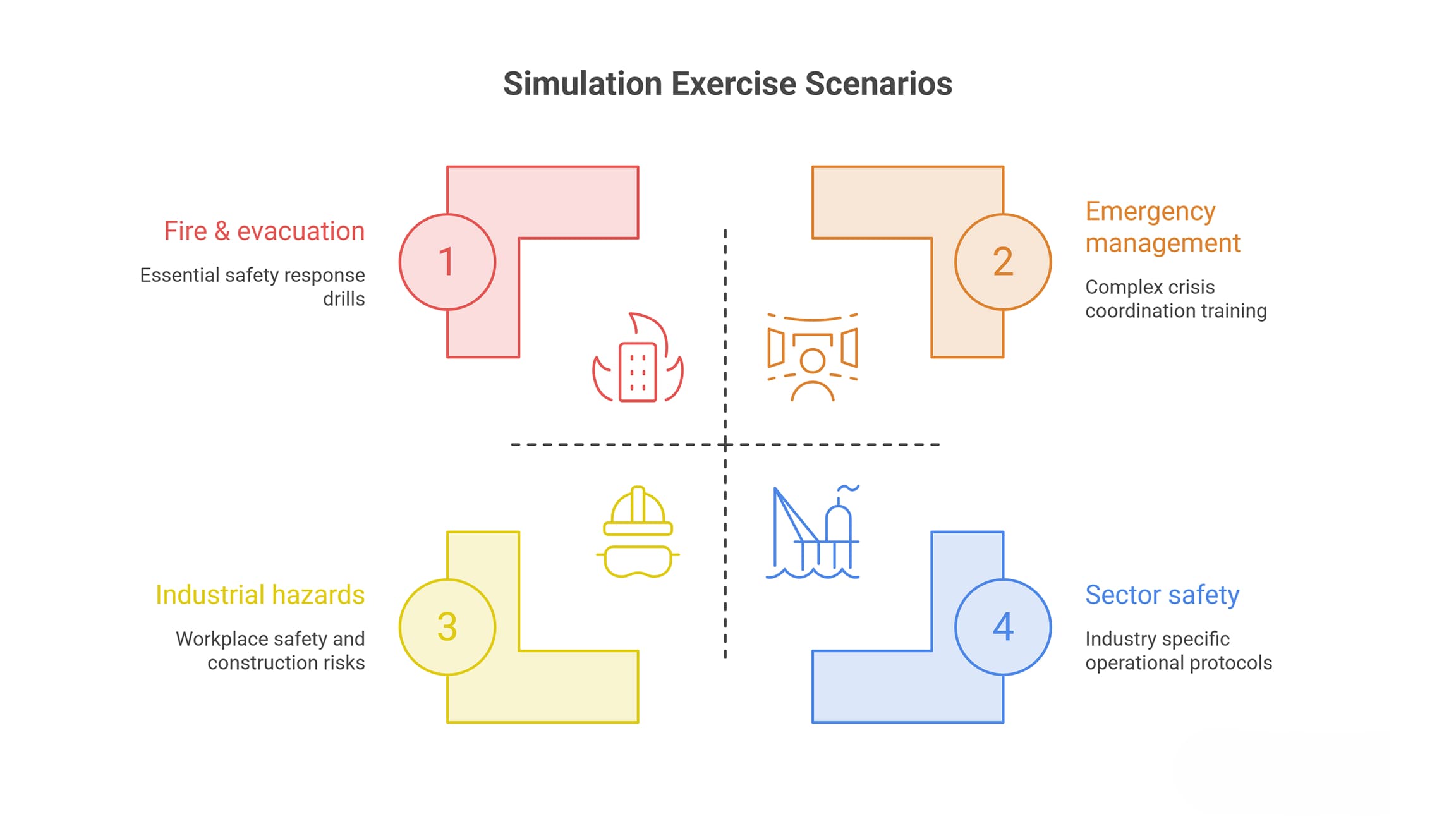
Scenarios Worth Practising in Simulation Exercises
The best examples will involve scenarios that are risky, expensive, or just too infrequent to actually train in the real world.
Fire & evacuation
Employees learn how to raise the alarm, choose an exit in case their chosen route is inaccessible, and use a fire extinguisher, all within the stresses of a realistic fire.
Industrial and construction hazards
Examples include working at heights, lockout/tagout procedures, entering a confined space, heavy equipment areas, and hazard recognition on an active work site.
Emergency management
Simulations train on coordinating an emergency situation like a chemical spill, medical emergency, and security threat, including all aspects of communication and decision-making under pressure.
Healthcare and Oil and Gas safety
Both industries require strict protocols where skipping a step is very expensive, which makes repetitive and tracked training more valuable.
A helpful litmus test for finding scenarios to simulate is to ask which scenarios your people don't practise now. If a drill would be too disruptive to run frequently or the actual incident would be too risky to conduct as a live drill, simulation could be the solution.
XR Training Development Company: Key Facts and Figures
- Simulation-based safety training is being implemented in such industries as manufacturing, oil and gas, construction, healthcare, logistics, aviation, and mining; that is why one XR Training Development Company works for several industries at once.
- In a survey of military XR training, 67% of respondents reported that the format helps them get prepared for stressful situations.
- One project can deliver training in VR headsets, mobile, and web; this means that a safety training program does not have to target only those locations that have VR headsets.
What are the 7 types of training?
There are seven different kinds of employee training, which are as follows: technical training, quality training, skills training, soft skills training, safety training, team training, and management training. Every type caters to a different requirement in the workplace. While technical training and skills training make sure that employees are able to accomplish job-related tasks, quality training and safety training make sure that standards and processes are maintained. Soft skills training involves communication, problem-solving, and conflict resolution, and team training promotes teamwork. Management training trains employees to take up roles in which decision-making is necessary. A corporate training games development company can develop games that can make sure that employees are able to go through different scenarios at the workplace and learn through their decisions. XR Training Development Company can also develop simulations of different technical and safety tasks.
How does XR work?
XR is the umbrella term for augmented reality, virtual reality, and mixed reality. A headset with the use of sensors and cameras detects any motion of the head or hands, and redrawing a 3D scene many times per second from the perspective of the trainee makes everything feel realistic. For safety training, the XR Training Development Company superimposes the scenario logic: any hazards activated at the right time, any consequences for a wrong decision, and any scoring based on the actions of the learner. The outcome is an immersive experience that the brain processes as a real one.
Conclusion
An XR Training Development Company makes safety training more effective by translating written protocols into practiced actions, reproducing emergencies when required, and providing real performance data for managers. Effective programs are based on the actual hazards you face, validate their scenarios against your own procedures, and remain up-to-date as regulations and technologies change. An XR development company such as Abhiwan Technology can design a program according to the specific hazards your facilities are exposed to, ranging from fire response to confined space entry. Before signing a contract, request a sample of a similar project done in the past, understand the evaluation metrics used, and how updates will be provided.
Written By Charu Sharma