360° Virtual Property Tours provide a new way of navigating real estate locations before coming to a decision about visiting them. The application of virtual tours is rapidly spreading beyond the real estate sector and finding use in other business fields, including education, healthcare, tourism, commercial activities, and the hotel business. This fact is supported by data collected by the National Association of REALTORS in its 2025 Generational Trends report, which stated that 41% of people using the Internet for house hunting found virtual tours valuable in their search for property. A 360 virtual property tours development company creates interactive experiences to help customers to learn property layouts without being physically present at the location. Similarly, real estate virtual tour services and the best real estate virtual tour software can make digital property exploration more detailed and accessible.
What Are 360° Virtual Property Tours and How Do They Work?
360° Virtual Property Tours are interactive digital depictions of real-world places created by using specialized tools like panoramic cameras, 360-degree photography, or spatial scanning technology. Unlike looking at a still image or video, users can view the site from any angle and navigate through various interconnected spaces. It starts with taking several panoramic pictures of the real estate or location in question, which are later processed and stitched together by specialized software. Then, a 360 virtual property tours development company can add various functionalities such as floor plans, labels, hot spots, dimensions, videos, or inquiry forms. As a result, this technology gives users a better spatial perception of the space compared to other means of advertising. They can find out how rooms are linked to each other, inspect certain regions of the premises in detail, or go back to the areas they are curious about.
For companies, this means real estate virtual tour services can be present on the Internet even when the property is physically closed to visitors.
Why Do Businesses Use Virtual Property Tours?
The main value of immersive tours is convenience. They help users gather more information before spending time or money on a physical visit.
Remote Exploration
Anyone can visit properties, hotels, campuses, and other sites from almost anywhere. This is particularly helpful for people who are in different cities or countries.
Better Spatial Understanding
Pictures show a few selected angles, but a virtual tour gives a better idea of what the place looks like and how it is configured and built.
Faster Shortlisting
Virtual visits enable users to exclude undesirable options already in the course of research. Therefore, there is an opportunity to visit those places that meet preliminary requirements.
Wider Accessibility
The digital tour can be shared through a website, listing page, email, or any other online platform. This allows businesses to reach people who may not be able to visit immediately.
More Informed Enquiries
Customers can evaluate an area before making inquiries to a company. Hence, their inquiries are likely to be more precise since they already know something about the environment.
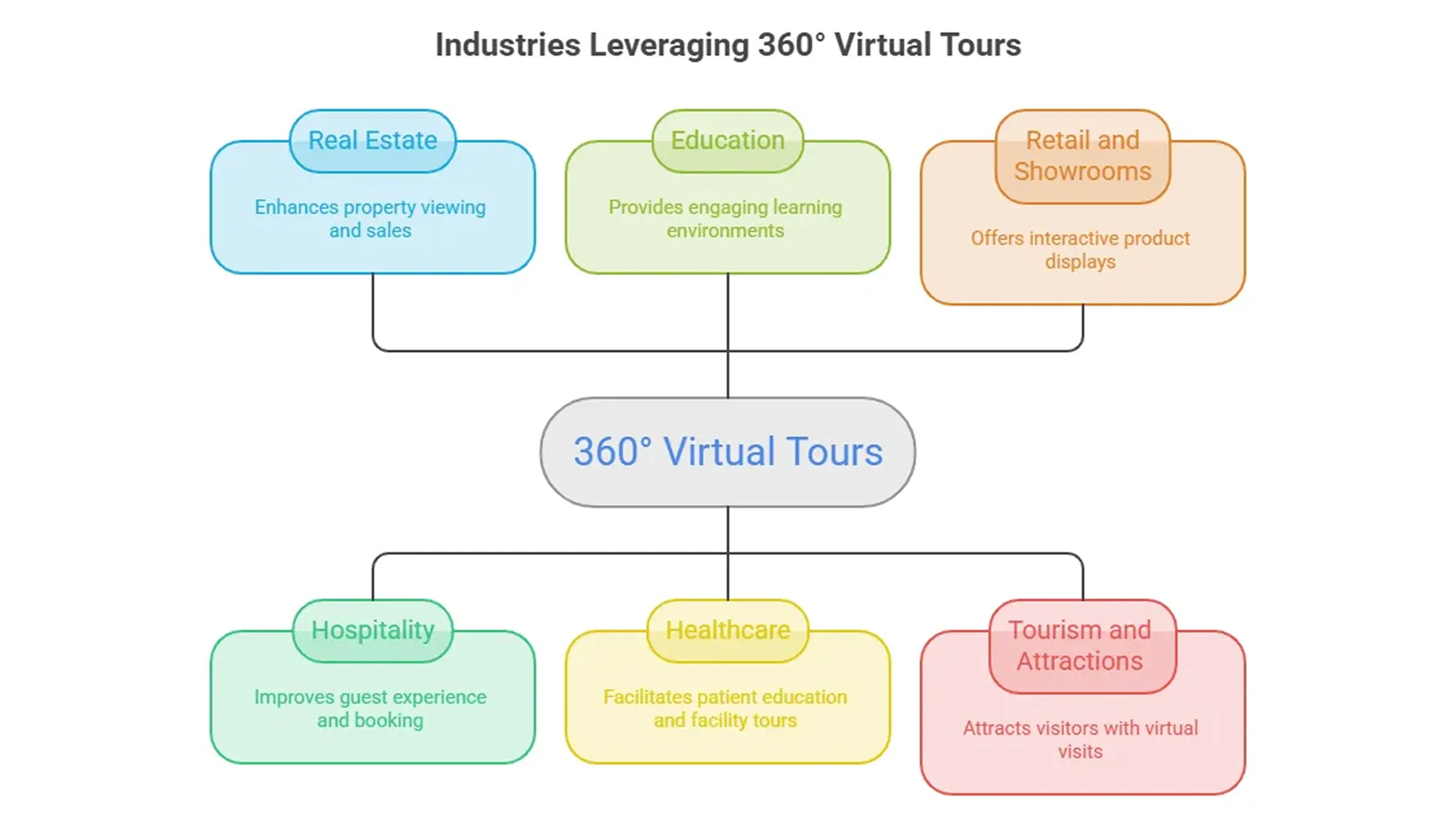
Top Industries That Benefit From 360° Virtual Property Tours
The technology is especially useful in industries where the physical environment influences a purchase, booking, visit, enrolment, or leasing decision.
1. Real Estate
The real estate sector shows the highest feasibility of adopting 360° Virtual Property Tours for viewing apartments, offices, shops, and real estate properties remotely. Using Real estate virtual tour services will increase the quality of online listings and improve the process of choosing a property before on-site visits.
2. Hospitality
Hotels, resorts, serviced apartments, and other event venues can benefit from using virtual tours for displaying their rooms, outdoor areas, restaurants, pools, and conference rooms. A professional 360 virtual property tours development company can create interactive products that will help guests familiarize themselves with the property before booking.
3. Education
Educational institutions can utilize virtual tours to show their facilities to future applicants and their parents. Through virtual tours, users can see classrooms, labs, libraries, dormitories, and sports complexes from a distance.
4. Healthcare
Hospitals, treatment centers, laboratories, and medical institutions may also want to take advantage of 360° Virtual Property Tours. The approach will help potential patients familiarize themselves with lobbies, reception areas, waiting halls, and every public zone of the hospital beforehand.
5. Retail and Showrooms
Retail shops, furniture stores, car dealers, and special showrooms can build their online equivalents. The required real estate virtual tour software can create immersive virtual experiences beforehand.
6. Tourism and Attractions
There are many opportunities to create immersive experiences in institutions like museums, galleries, and visitor centers to entice visitors. The principles of Real estate virtual tour services may also be utilized in creating navigable experiences, including informative points, maps, etc.
How Do Virtual Tours Improve Customer Experience?
A successful tour should answer practical questions instead of simply providing impressive visuals. The right combination of information and navigation can make digital exploration more useful.
Easier Comparison
Individuals can check out multiple sites and contrast architecture, equipment, and general surroundings before choosing which sites merit additional focus.
Reduced Travel
It is not necessary for people to visit every property or space in person in the early stages of evaluating the options. This is highly useful when the selected sites are located far from one another.
Better Decision-Making
Detailed spatial data provide users with more clarity about what to expect prior to contacting companies or traveling to the site.
Flexible Viewing
Users can navigate information at their own speed and visit different areas later on. This is helpful for groups of people who are looking through space.
Interactive Information
The best real estate virtual tour software can integrate panoramic image viewing with floor plans, measurements, hyperlinks, and additional details.
Consistent Presentation
When the actual tour is done professionally, all people who enter these images see the same environment. This allows companies to deliver one message through various channels of communication.
How to Choose the Right Virtual Tour Solution?
Different locations require different levels of detail. A small property may need a simple walkthrough, while a large commercial project may require advanced navigation and integrations.
Capture Quality
The use of high-quality panoramic images allows the viewer to clearly see what is happening inside a space. In addition, effective HDR solutions and high-quality stitching can significantly boost the results in tricky lighting conditions.
Interactive Features
A well-developed virtual tour involves elements such as maps, labels, floor plans, and other useful things. The best real estate virtual tour software enables combining them effectively, while at the same time keeping the interface easy to navigate.
Mobile Experience
Many people use mobile devices such as smartphones for researching properties. As a result, it is essential to have a mobile-friendly tour.
Loading Speed
Large files may slow down loading speeds, particularly on mobile devices. Thus, the best real estate virtual tour software must have optimized multimedia, allow for mobile viewing, and offer quick loading speeds so that users may view properties.
Analytics
Analytics can show what rooms, areas, or aspects of interactivity get attention, which helps businesses understand how people navigate through their spaces.
Integration
The tour may need to connect to websites, booking systems, CRM, property listings, maps, or inquiry forms. This is something that marketers have to bear in mind when planning.
Real-World Applications of Virtual Property Tours
The practical value of immersive technology depends on how well it solves a specific business or customer problem.
Pre-Sale Marketing
The completed, staged, or planned spaces can be brought to interested buyers through developers. Thus, an innovative 360° Virtual Property Tours allows users to familiarize themselves with layouts without scheduling an in-person meeting.
Remote Property Evaluation
By using the 360° Virtual Property Tour technology, investors or tenants can also view properties in other cities or countries and make decisions based on their impressions.
Virtual Open Houses
Agents can provide property tours to potential buyers at any time. Therefore, users can enjoy a tour of a property at their own convenience.
Construction Visualization
Planned spaces can also be showcased digitally to let prospective buyers find out about future layouts and facilities before properties are completed.
Facility Documentation
Companies and schools utilize electronic media to collect and dispatch information essential for operations, planning, communication, etc.
Hospitality Discovery
Hotels and venues can let potential guests inspect rooms and facilities before booking. Similar spatial principles used in real estate virtual tour services can be adapted to these environments.
How much does a 360 virtual tour cost?
The price of a 360 Degree Virtual Tour generally varies between $150 and $1,000+, depending on the size of the property, number of rooms, the requirement of photography, amount of editing, the need for hosting, and required interactive features. A simple tour of a small property can remain at the lower end, whereas the price of larger properties or custom tours that include floor plans, hot spots, dimensions, videos, and integration may get much more expensive. There might be continuing hosting costs or software fees as well; the total budget should account for production costs and recurring expenses.
Which 360 camera is best for real estate?
It is true that the best 360 camera for real estate depends on the size of the property in question, the lighting, the image quality required, and what type of viewing experience you require. Important factors to consider when looking into 360 cameras include the camera's resolution, HDR (high dynamic range) performance, stitching accuracy, low light performance, speed of the device, and compatibility with the virtual tour software. When working with property and doing property photography or virtual tours, image quality is particularly important, as properties often have windows and artificial lights, and dark areas in their interior. However, it should be kept in mind that it is not only the camera that is important in this process but also the best real estate virtual tour software, as it has a key impact on image processing and the overall quality of the virtual tour that is produced.
Conclusion
360° Virtual Property Tours are not limited to their original property-related uses anymore, as they are appropriate in a variety of fields such as hospitality, education, health care, retail, tourism, different kinds of commercial environments, and construction. Their main merit is that they allow users to become familiar with physical environments before visiting them. The latest industry statistics show that there is a great demand for more comprehensive virtual property experiences as there is a growing trend of online exploration, which is gradually getting into the everyday decision-making process. Therefore, businesses need to emphasize user practicality, the use of relevant content, mobile performance, and interactive features rather than focusing only on visual effects.
Written By Charu Sharma