
An educational game development company helps organizations turn learning content into interactive digital experiences. Instead of relying only on textbooks, videos, or traditional training sessions, educational games allow learners to practice concepts through challenges, scenarios, rewards, and interactive activities. Game-based learning is an effective method of teaching a language. As part of the process of language learning, learners acquire vocabulary, structure sentences, and improve their listening and speaking skills through games with real-time action. Schools, education technology companies, training institutions, and corporations can come up with their own games for language learning that will fit their audience's needs and training targets. Abhiwan Technology develops custom educational games for different learning requirements, including language learning, employee training, skill development, and interactive education. Request a Quote to discuss your educational game development project.
What Is Educational Game Development?
Educational game development is the process of creating games that combine learning objectives with interactive gameplay. The purpose is to make educational content more engaging while giving learners opportunities to practice and apply what they have learned. Learning games can include various types of activities such as quizzes, puzzles, simulations, stories, challenges, levels, rewards, and interactive scenarios. The selection of game mechanics and components will depend on the subject, as well as the targeted learning group. In the case of a language learning application, the offered activity could consist of vocabulary tasks, listening exercises, conversation scenarios, matching words, forming sentences, and practicing pronunciation. The game can also provide immediate feedback. For example, if a learner selects the wrong word, the system can explain the correct answer and allow the learner to try again.
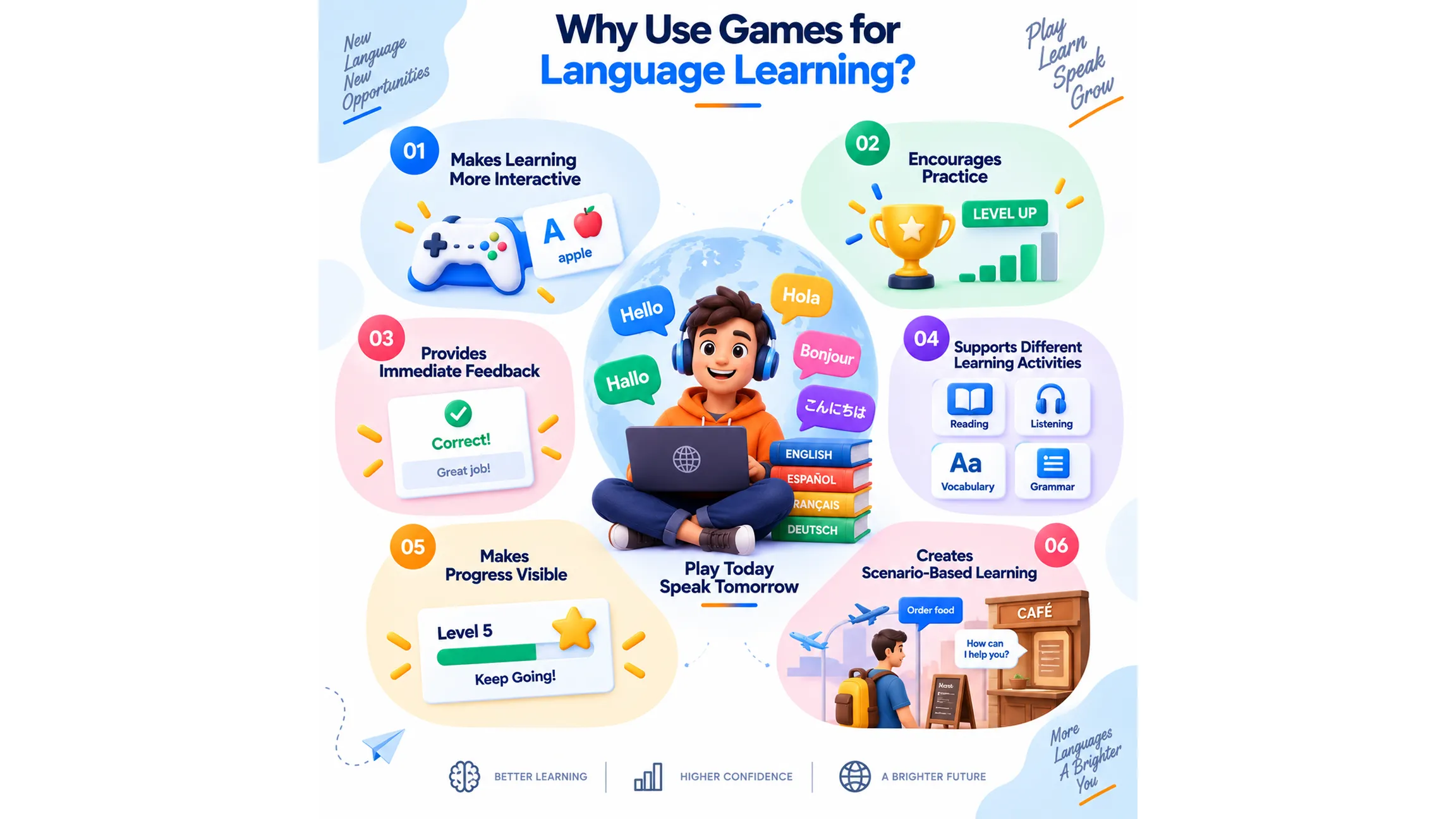
Why Use Games for Language Learning?
Learning a new language requires regular practice. Learners need to remember words, understand sentence structures, listen to conversations, and apply language in different situations.
1. Makes Learning More Interactive
Learners do not just learn words and phrases. They can perform activities with language skills like answering questions or solving puzzles.
2. Encourages Practice
Learners are motivated to practice further by introducing levels, points, prizes, and ways to track their progress.
3. Provides Immediate Feedback
Interactive games will allow learners to know whether their answer is right and guide them if they have made a mistake.
4. Supports Different Learning Activities
One language learning game can incorporate reading and listening skills, vocabulary, and grammar exercises.
5. Makes Progress Visible
Various levels, scores, rewards, and indicators help learners see how much of the language has been learnt by them.
6. Creates Scenario-Based Learning
Games involve learners in realistic situations like ordering dinner, introducing themselves, attending a meeting, travelling, or dealing with customers.
Key Features of Language Learning Games
An experienced educational game development company can build language learning games around the curriculum and learning goals.
Vocabulary Games
Students could make word-image matches, search for the meaning of words, solve word puzzles, or reveal vocabulary while playing.
Grammar Challenges
Grammar exercises may become interactive challenges to let learners choose, arrange, or correct sentences.
Listening Activities
The audio tasks may help learners develop their ability to understand spoken language. Users could listen to sentences or conversations and choose an appropriate answer.
Pronunciation Practice
Language games may have elements of audio recording and pronunciation where suitable.
Conversation Scenarios
Scenario-based gaming can mimic real conversations and help learners to make decisions about their responses.
Progress Tracking
Students could control their progress – see the completed lessons and scores.
Rewards and Achievements
Scores, badges, levels, and virtual rewards could create the motivation to do their best.
Multiplayer or Competitive Modes
In relevant learning contexts, multiplayer challenges and leader boards can add a social dimension to language learning.
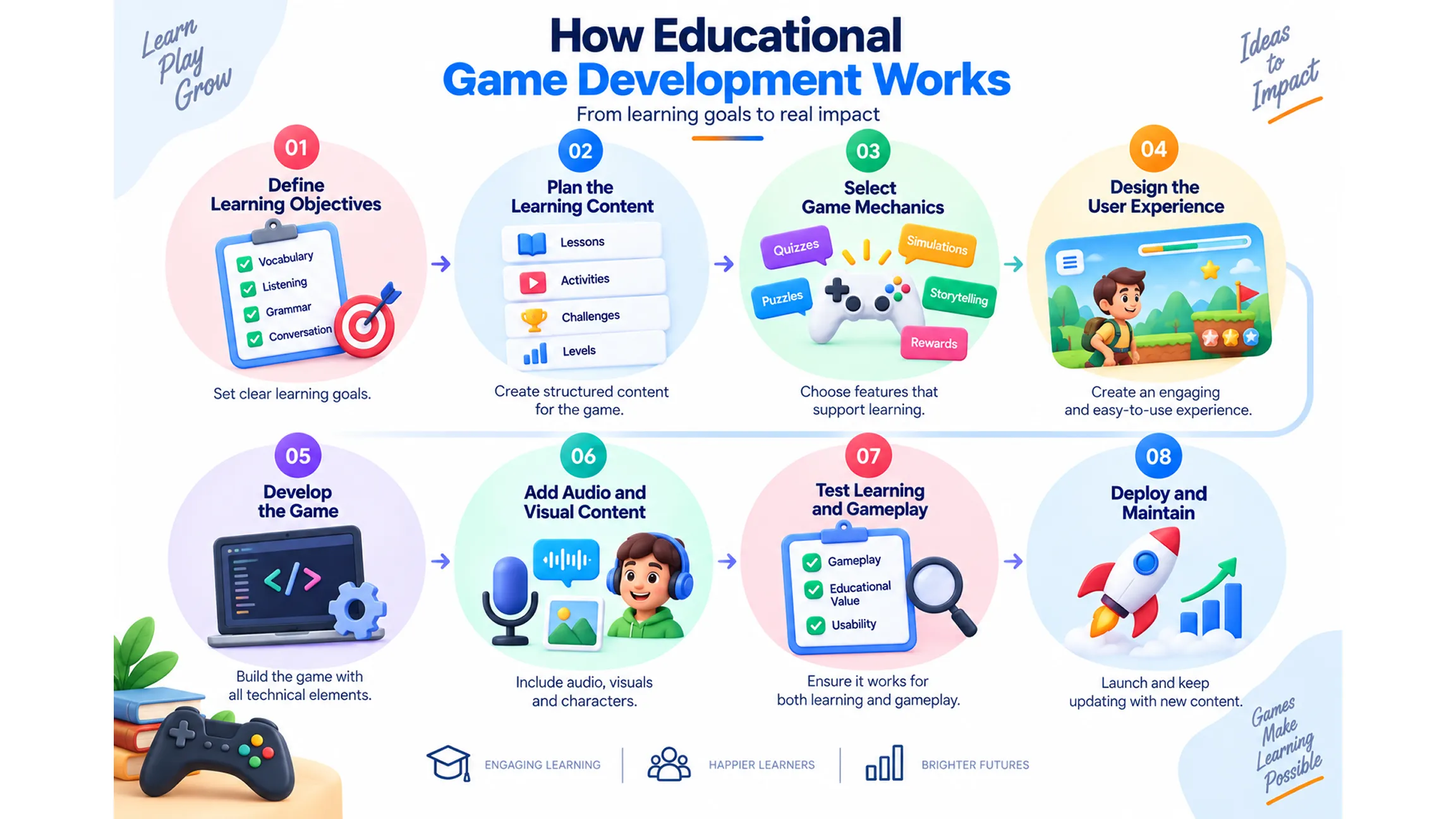
How Educational Game Development Works
Creating a learning game requires more than developing gameplay. The educational content and game mechanics need to work together.
Step 1: Define Learning Objectives
The first step is identifying what the learners should know or be able to do after using the game. In the context of a language learning project, it could involve learning a specific vocabulary, improving listening skills, practicing grammar, or learning to respond in standard conversations..
Step 2: Plan the Learning Content
Add the educational content in the form of lessons, activities, challenges, and levels.
Step 3: Select Game Mechanics
The development team chooses feature sets supporting learning goals consisting of quizzes, puzzles, simulations, storytelling, and awards.
Step 4: Design the User Experience
User interface and user experience should be designed to make the game easily usable and understood by learners.
Step 5: Develop the Game
Game developers create all tech elements of gameplay, interactions, content systems, etc.
Step 6: Add Audio and Visual Content
Language games may require some audio for pronunciation practice, illustrations, and characters.
Step 7: Test Learning and Gameplay
Testing must evaluate not only technical performance but educational usability of the game.
Step 8: Deploy and Maintain
As the game is initialized, it has to be supplemented by new lessons, vocabulary, and challenges depending on learners’ needs.
Educational Games for Schools and EdTech
Schools and edtech companies may utilize educational games as a means to enhance classroom learning or offer further practice sessions.
A language learning game consists of some short activities that would help learners strengthen classroom lessons. The younger the learners, the more effective the games based on a combination of visual storytelling with simple challenges. Older students may play games with an emphasis on grammar, vocabulary, interaction, or real-life situations.
Additionally, edtech companies can add educational games into comprehensive learning platforms. Depending on the type of application, educational games can be connected with users' profiles, progress tracking, assessments, and course systems. Thus, educational game development has proven its viability as an independent product, but it can also be used in a broader digital learning context.
Corporate Training Games for Communication Skills
Educational games are not limited to schools. Businesses can use corporate training games to make employee learning more interactive. Organizations that have teams speaking different languages might resort to language games to enhance communication at work. To demonstrate, a business might develop interactive scenarios to simulate customer calls, meetings, presentations, or emails.
Corporate training games can also cover subjects beyond language, including:
- Workplace communication
- Customer service
- Product knowledge
- Compliance
- Workplace safety
- Leadership
- Sales training
- Onboarding
- Soft skills
HR Training Games for Employee Development
By using HR training games, organizations can provide training of their employees through learning scenarios, rather than relying on traditional modes of training. For instance, in an HR game, participants are placed in various workplace situations and are required to choose the most appropriate response for certain situations. Upon doing so, players are given feedback and insights regarding their choice.
Potential use cases include:
- Employee onboarding
- Workplace policies
- Communication skills
- Diversity and inclusion training
- Leadership development
- Conflict management
- Workplace ethics
- Customer interaction
- Team-building activities
Benefits of Educational Game Development
Educational game development allows organizations to build the learning experience around their specific requirements.
Customized Learning Content
The educational institution has the opportunity to utilize its own programs and instructional materials, as well as a glossary of terms and product details in the game.
Flexible Game Mechanics
This game offers various options because its development is done according to the objectives of learning.
Brand Integration
Corporates and educational institutions have a chance to integrate their brand’s look, style, brand virtues, and communication in the game.
Scalable Content
The fresh learning material can be easily added to the existing one in case of necessity.
Platform Flexibility
Depending on the requirements of the project, the game may be available on the web, mobile, or desktop.
Analytics and Progress Tracking
Learning activities can be connected with progress tracking and analytics to help organizations understand participation and performance.
How Different Organizations Can Use Educational Games
| Organization | Possible Use |
|---|---|
| Schools | Language practice and classroom support |
| EdTech companies | Interactive learning products |
| Universities | Subject-based learning games |
| Corporate L&D teams | Employee training |
| HR departments | Onboarding and soft skills |
| Language institutes | Vocabulary and conversation practice |
| Training companies | Interactive professional courses |
| Enterprises | Product, compliance, and communication training |
Why Choose Abhiwan Technology?
Abhiwan Technology develops custom interactive and educational game experiences for organizations with different learning requirements. As a company that develops educational games, Abhiwan can develop experiences that are based on gaming for the learning of languages, skill development, employee training, product education, and other educational purposes. The development process can include game design, user interface and experience, interactive content, and either 2D or 3D graphics, gameplay mechanics, and tracking of progress. For businesses, educational institutions, and other organisations, Abhiwan Technology can design games that provide corporate training and human resources training that are tailored in relation to the particular needs of the working environment. The gaming solution can be made depending on the audience, learning tasks, platform requirements, content, and objectives of the company.
Conclusion
An educational game development company can help organizations transform traditional learning content into interactive digital experiences. Games can help learners to practice different aspects of language learning, such as vocabulary, grammar, listening skills, pronunciation, and communication in real-life settings through fun events and activities. The same method can also be applied to employee training via corporate and human resources games to enable businesses to organize training events for onboarding, communication, compliance, leadership, and other essential training purposes. Abhiwan Technology provides educational game development services for schools, edtech firms, educational game developers, and organizations using training games. Depending on the clients’ needs, Abhiwan Technology can create customized educational games for learning in various fields. Do you want to plan your own educational or language game? Contact Abhiwan Technology for a project quote.
Written By Vaibhav Karanwal